Recent POST






Find Your First Coding Language
Select the goal that best matches your current interest or career aspiration. We'll recommend the most suitable starting language.
Data & AI
Automate tasks, analyze data, or explore Machine Learning.
Web & Freelance
Build websites, interactive interfaces, or get freelance gigs quickly.
Enterprise & Android
Work in large corporations or build native Android apps.
Game Dev
Create video games with Unity or work with Microsoft tech.
Recommended Language:
| Feature | Details |
|---|
You stare at a blinking cursor. You want to build apps, websites, or maybe just automate that boring spreadsheet work. But then the question hits you: which coding is best for beginners?
It’s the first wall every new developer hits. The internet screams conflicting advice. Some say start with C++ because it teaches you how computers actually think. Others insist on JavaScript because you can see results instantly in your browser. And then there’s Python, the friendly giant everyone seems to love.
Here’s the truth: there is no single "best" language for everyone. It depends entirely on what you want to build and how your brain likes to solve problems. Choosing wrong doesn’t mean you fail; it just means you might hit more friction early on. Let’s cut through the noise and look at what actually works for people starting their journey in 2026.
Why Your First Language Choice Matters (And Why It Doesn’t)
Let’s address the fear first. Many beginners worry that picking the "wrong" language will waste months of learning. This is mostly myth. Programming concepts-loops, variables, functions, logic-are universal. Once you understand how a loop works in one language, switching to another is mostly about syntax changes, not relearning logic.
However, the choice does affect your momentum. If you pick a language with steep setup requirements or cryptic error messages, you might quit before you ever write a useful program. The goal for your first six months isn’t mastery; it’s building confidence. You need a language that gives you quick wins. You need feedback loops that are short. If you spend three hours setting up an environment and get zero visual output, motivation dies fast.
Think of it like learning instruments. Starting with piano lets you hear harmony immediately. Starting with violin requires weeks of practice just to make a pleasant sound. Both are valid, but one keeps you playing longer in the beginning. For most self-learners, we’re looking for the piano equivalent.
Python: The Gentle Giant
If you ask ten instructors what they teach first, seven will likely say Python is a high-level programming language known for its readability and simplicity. It reads almost like English. No curly braces cluttering your screen. No semicolons ending every line. Just clean, indented code.
| Feature | Details |
|---|---|
| Readability | High (English-like syntax) |
| Primary Use Cases | Data Science, AI, Web Backends, Automation |
| Learning Curve | Gentle |
| Job Market Demand | Very High |
Why do beginners love it? Because it handles the messy stuff for you. Memory management? Handled by Python. Complex data structures? Built-in lists and dictionaries work out of the box. You focus on solving the problem, not fighting the compiler.
But here’s the catch. Python’s simplicity can hide complexity. When things go wrong, errors can be vague. Also, if you want to build mobile apps or interactive websites, Python isn’t the native choice. You’ll need extra tools. But for automating tasks, analyzing data, or understanding core logic, it’s unbeatable. If you hate typing and love reading clear instructions, start here.
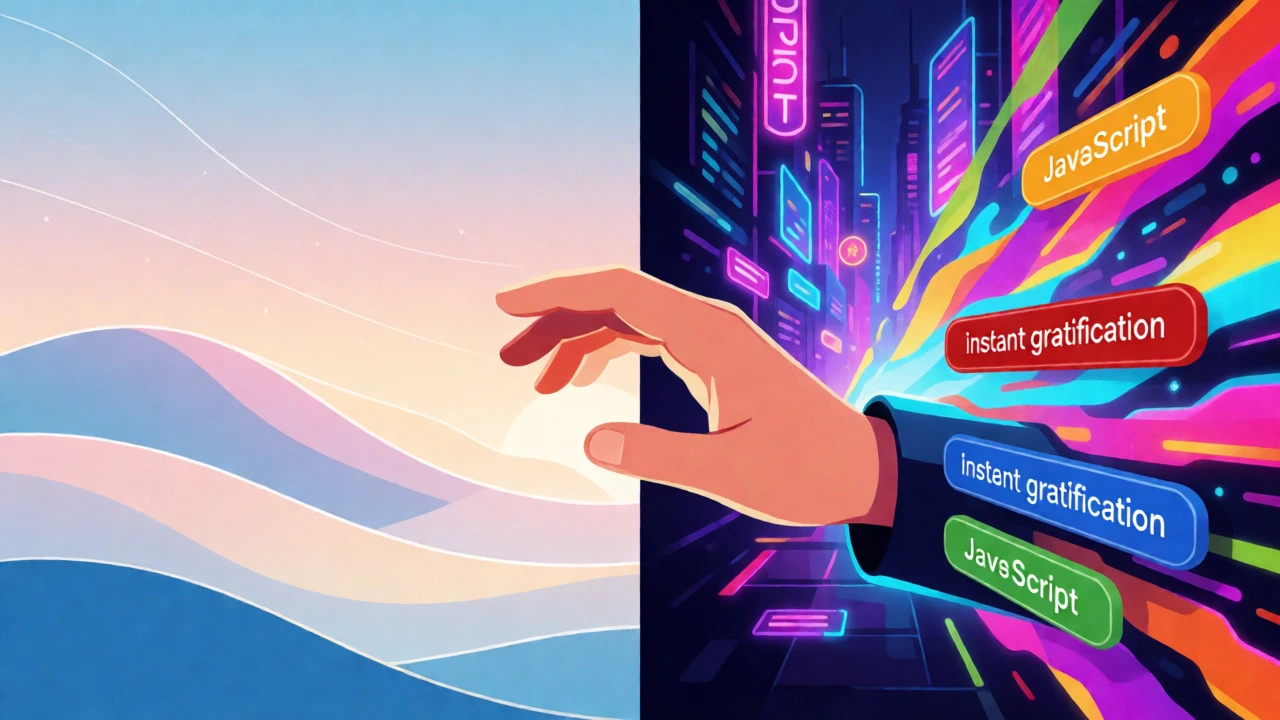
JavaScript: The Instant Gratification King
Do you want to see something happen when you click a button? Then JavaScript is the scripting language that runs in web browsers is your gateway. It lives everywhere. Every website you visit uses it. You don’t need to install complex software. Open your browser, press F12, and you have a console ready to run code.
| Feature | Details |
|---|---|
| Readability | Moderate (Syntax can be tricky) |
| Primary Use Cases | Web Frontend, Mobile Apps, Server-side (Node.js) |
| Learning Curve | Moderate (Quirks exist) |
| Visual Feedback | Immediate (Browser-based) |
The biggest advantage of JavaScript is visibility. You change a color, refresh the page, and boom-it’s different. That dopamine hit keeps you going. Plus, the ecosystem is massive. Need a chart library? Done. Want to animate text? There’s a tool for that.
However, JavaScript has quirks. It’s loosely typed, which means it tries to guess what you mean. Sometimes it guesses wrong, leading to bugs that confuse beginners. "Undefined is not a function" becomes your nemesis. But once you get past the initial confusion, the ability to build full-stack applications (front-end and back-end) with one language is a huge career accelerator.
Java: The Structured Foundation
Then there’s Java is a class-based, object-oriented programming language. It’s verbose. You’ll type more words than in Python. You’ll deal with types strictly. If you try to put a number into a text field, Java will yell at you until you fix it.
| Feature | Details |
|---|---|
| Readability | Low (Verbose syntax) |
| Primary Use Cases | Enterprise Software, Android Apps, Large Systems |
| Learning Curve | Steep |
| Job Stability | Extremely High |
Why choose Java as a beginner? Because it forces discipline. It teaches you object-oriented programming properly. You learn about classes, inheritance, and encapsulation deeply. Many university courses still use Java for this reason. It prepares you for large-scale engineering projects where structure matters more than speed of writing.
But let’s be honest: it’s dry for a hobbyist. Setting up the environment takes time. Writing "Hello World" requires more boilerplate than other languages. If you’re aiming for corporate jobs or Android development specifically, bite the bullet. If you want to build fun projects quickly, Java might feel like wearing a suit to a beach party.
C#: The Game Developer’s Dream
If your dream is making video games, ignore everything above and look at C# is a modern, object-oriented language developed by Microsoft. It powers Unity, the most popular game engine for indie developers. It’s similar to Java but often considered more elegant and feature-rich.
C# strikes a balance between structure and usability. It has strong typing like Java but includes features that make coding less tedious. The integration with Visual Studio, Microsoft’s IDE, provides excellent debugging tools. For beginners interested in graphics, simulations, or enterprise Windows apps, C# offers a smooth path.
The downside? It’s tied heavily to the Microsoft ecosystem. While .NET Core made it cross-platform, the community resources are slightly less abundant than Python or JavaScript for general-purpose scripting. But if you open Unity and see your character jump because you wrote five lines of C#, you’ll forgive the verbosity.
How to Choose Based on Your Goals
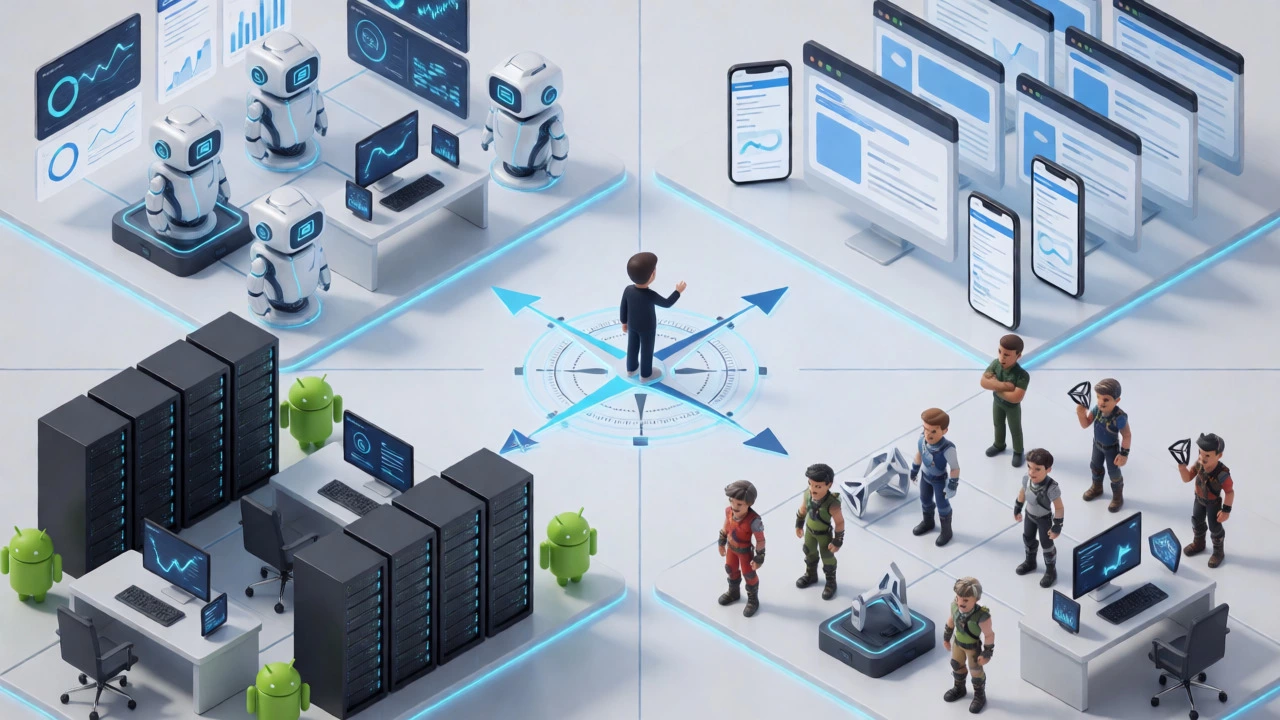
Stop asking "what is easiest?" Start asking "what do I want to build?" Here’s a simple decision tree:
- Want to analyze data, use AI, or automate office tasks? Pick Python. It’s the standard for data science and machine learning libraries like Pandas and TensorFlow.
- Want to build websites, interactive interfaces, or freelance quickly? Pick JavaScript. You can find gigs faster because every business needs a web presence.
- Want to work in big corporations or build Android apps? Pick Java. It’s stable, widely used, and respected in enterprise environments.
- Want to make games or work with Microsoft technologies? Pick C#. Unity makes game dev accessible, and Azure cloud services integrate seamlessly.
Don’t forget HTML and CSS. They aren’t programming languages in the strict sense-they’re markup and styling-but if you choose JavaScript, you must learn them. Think of HTML as the skeleton, CSS as the skin, and JavaScript as the muscles. You can’t have muscles without a body.
Pitfalls That Kill Beginner Momentum
Knowing the language is half the battle. Knowing how to study is the other half. Most beginners quit not because the code was hard, but because their process was broken.
First, avoid "tutorial hell." This is when you watch endless videos but never write code yourself. You feel productive, but you’re passive. Code breaks when you type it. Break it intentionally. Change a variable name. Delete a bracket. See what happens. That’s how you learn.
Second, don’t switch languages too soon. You’ll hit a plateau in any language around month two or three. It feels like you’re stuck. Beginners panic and think, "Maybe Python is better," so they switch. Now you’re a beginner in two languages instead of an intermediate in one. Push through the plateau. Build a small project-a calculator, a to-do list, a weather app. Completing something ugly but functional beats starting something perfect but unfinished.
Third, ignore the hype cycles. New frameworks pop up every week. React, Vue, Angular, Next.js... it’s overwhelming. Stick to the fundamentals. Frameworks change; programming logic doesn’t. Master the core language first, then add frameworks as needed.
Where to Learn in 2026
You don’t need a $50,000 degree to start. Online platforms have matured significantly. FreeCodeCamp remains a gold standard for free, structured JavaScript and Python paths. Coursera and edX offer university-backed courses if you prefer academic rigor. For hands-on practice, sites like Codewars or LeetCode provide gamified challenges.
Consider local meetups or online communities. Debugging alone is lonely. Posting a question on Stack Overflow or joining a Discord server connects you with humans who’ve faced the same errors. In Wellington, tech meetups are growing, offering networking chances that pure online learning misses. Human interaction accelerates learning more than any algorithm.
Remember, consistency beats intensity. Coding for 30 minutes daily yields better results than eight hours on Sunday. Your brain consolidates learning during rest. Small, frequent doses keep the neural pathways active.
Is Python really easier than JavaScript for beginners?
Generally, yes. Python's syntax is cleaner and closer to natural language, reducing cognitive load. However, JavaScript offers immediate visual feedback via browsers, which some learners find more motivating despite its syntactic quirks.
Can I learn two languages at once?
It is possible but not recommended for absolute beginners. Learning two syntaxes simultaneously causes confusion. Focus on one language until you can build basic projects independently, then transition to the second. Concepts transfer easily, making the second language much faster to learn.
Do I need math skills to start coding?
For most web and application development, no. Basic arithmetic and logical reasoning are sufficient. Advanced fields like game physics, cryptography, or machine learning require stronger math backgrounds, but you can reach those stages after mastering programming basics.
Which language pays the most for juniors?
Salary varies by region and industry, but Java and C# often lead in enterprise sectors due to stability demands. Python salaries rise sharply with specialization in Data Science or AI. JavaScript demand is high across all levels, but entry-level rates can vary widely based on portfolio quality.
How long does it take to become job-ready?
With consistent study (15-20 hours per week), most beginners can create a portfolio and apply for junior roles within 6 to 9 months. Mastery takes years, but employability comes sooner if you focus on building tangible projects rather than memorizing theory.