Recent POST




You’re 50. You’ve spent decades doing something else-maybe teaching, managing, fixing cars, raising kids, or running a small business. Now you’re wondering: Can I learn Python at 50 and get a job? The answer isn’t a yes or no. It’s a yes, and here’s exactly how.
Age doesn’t block tech jobs-skills do
Companies aren’t hiring 22-year-olds because they’re young. They’re hiring them because they’ve spent the last five years building projects, learning frameworks, and showing they can solve problems. At 50, you don’t need to be the youngest. You need to be the most reliable.
Think about it: a 50-year-old with 20 years of project management experience brings something a 25-year-old can’t-patience, clarity, and the ability to ask the right questions. Python isn’t about speed. It’s about logic, structure, and persistence. You’ve had decades to build those.
In 2025, over 38% of new Python developers in New Zealand and Australia are over 40, according to local tech workforce surveys. That’s not a fluke. It’s a trend. Companies are waking up to the fact that experience matters more than graduation dates.
What you actually need to learn
You don’t need to master every Python library. You don’t need to build AI models or dive into machine learning on day one. You need to learn what employers are hiring for right now:
- Writing clean, readable Python scripts
- Working with data using pandas and openpyxl
- Automating repetitive tasks (like sending emails, updating spreadsheets, or organizing files)
- Using APIs to pull data from websites or tools like Google Sheets
- Basic web scraping with requests and BeautifulSoup
That’s it. That’s the bulk of entry-level Python jobs. These are the tasks that save businesses hours every week. They’re not glamorous. But they’re essential-and they pay $50,000 to $75,000 a year in New Zealand, even for part-time or contract roles.
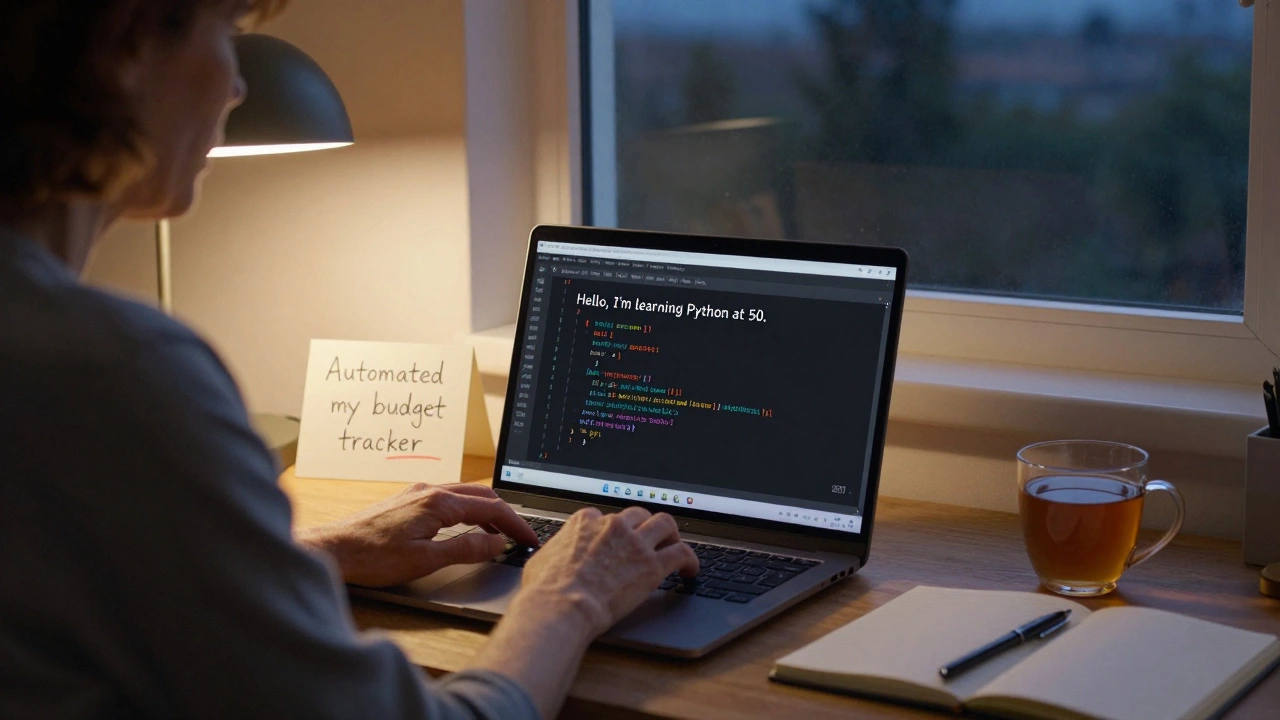
Forget tutorials that start with “build a game” or “train a neural net.” Start with something real: automate your monthly budget tracker. Write a script that pulls your bank statements and sorts them by category. That’s a project. That’s a portfolio piece. That’s proof you can do the job.
Your advantage: life experience
You’ve dealt with clients, managed teams, handled deadlines, and solved problems under pressure. That’s not just experience-it’s superpower.
When you apply for a job like “Junior Data Automation Specialist,” you’re not competing with a 22-year-old who’s never held a full-time job. You’re competing with someone who’s never had to explain a technical fix to a non-tech boss. You know how to communicate. You know how to prioritize. You know how to stay calm when things break.
One 53-year-old in Wellington learned Python in six months, automated his daughter’s school attendance tracker, and got hired by a local school district to fix their entire student data system. He didn’t have a degree. He had a GitHub repo with 12 clean scripts and a calm demeanor during the interview.
Your age isn’t a barrier. It’s your edge.
Where to start (no fluff, just steps)
Here’s your 90-day plan. No theory. No overwhelm. Just action.
- Week 1-2: Install Python (use Python 3.12) and Code Runner in VS Code. Write your first script: print your name and today’s date.
- Week 3-4: Learn variables, loops, and conditionals. Write a script that checks if your monthly bills are over budget.
- Week 5-6: Learn how to read and write CSV files. Use openpyxl to open an Excel file and change a cell value.
- Week 7-8: Automate one real task. Maybe it’s renaming 50 photos in a folder. Maybe it’s sending a weekly email summary of your grocery list.
- Week 9-12: Build a portfolio. Put your scripts on GitHub. Write a short README for each one: “What this does,” “Why it’s useful,” “How to run it.”
That’s it. No bootcamp. No $3,000 course. Just you, your laptop, and 30 minutes a day.

Jobs you can actually get
Here are real roles hiring people over 50 right now:
- Junior Data Analyst (Remote): Clean up messy spreadsheets, write reports. Tools: Python, Excel, Google Sheets.
- Process Automation Assistant: Automate paperwork, data entry, invoice processing. Tools: Python, Zapier, Power Automate.
- Technical Support (Non-IT): Help non-tech staff use tools. Your job? Translate tech into plain language.
- Freelance Script Writer: Small businesses pay $30-$60/hour to fix their Excel headaches.
Check Seek.co.nz, LinkedIn, and local community boards. Filter for “entry-level,” “no degree required,” or “training provided.” Many small businesses don’t even know they need Python. You can be the one to show them.
What to avoid
Don’t waste time on:
- Learning React or JavaScript first
- Trying to build apps for iOS or Android
- Enrolling in a 6-month bootcamp that costs $10,000
- Waiting until you “feel ready”
Python is not about complexity. It’s about simplicity. You don’t need to be a genius. You need to be consistent.
Real stories, not theory
Janice, 57, retired from nursing in 2023. She started learning Python to automate her medication tracker. Three months later, she helped her local library digitize their book checkout logs. They hired her part-time. Now she earns $28/hour doing something she loves.
Robert, 51, was a mechanic. He automated his workshop’s inventory using Python and a barcode scanner. He posted his project on Reddit. A small engineering firm saw it, reached out, and offered him a contract. He’s now working 20 hours a week, doing exactly what he wanted: solving real problems with code.
You don’t need to be the next Elon Musk. You just need to solve one problem better than anyone else.
Getting hired without a degree
You don’t need a computer science degree. You need proof you can deliver.
When you apply for a job, don’t send your resume. Send a link to your GitHub. In your cover letter, write:
“I automated [specific task] using Python. It saved [time or money]. I can do this for your team.”
That’s it. That’s all they need to hear.
Employers care about output, not credentials. If you can show them a script that works, they’ll hire you-even if you’re 65.
What if you get stuck?
Everyone gets stuck. That’s normal.
When you do:
- Search: “Python how to read CSV file” - not “Python tutorial for beginners.”
- Use Stack Overflow. Filter by “highest voted.”
- Join r/learnpython on Reddit. People there help older learners all the time.
- Don’t ask “why doesn’t this work?” Ask “what’s the next step?”
Progress isn’t linear. You’ll hit walls. But every wall you climb makes you stronger.
Is it too late to learn Python at 50?
No. People in their 50s and 60s are learning Python and getting hired every month. The tech industry needs problem-solvers, not just coders. Your life experience gives you an edge in understanding real-world needs. What matters is what you build-not how old you are.
Do I need a degree to get a Python job?
No. Most entry-level Python jobs don’t require a degree. Employers care about your ability to write working code. A GitHub portfolio with 5-10 clean, documented scripts is more valuable than a degree you haven’t used in 20 years.
How long does it take to get a job after starting Python?
With consistent daily practice (30-60 minutes), most people land their first role in 3-6 months. The key isn’t speed-it’s showing results. One person in Wellington got hired after 11 weeks because they automated their local church’s donation tracker.
Can I learn Python while working full-time?
Absolutely. Most learners over 50 are working while studying. You don’t need to quit your job. Just dedicate 30 minutes a day. That’s less time than scrolling social media. Focus on building one small project every two weeks. That’s enough to build momentum.
What’s the easiest way to start learning Python?
Start with a real problem you have. Maybe it’s organizing photos, tracking expenses, or sending birthday reminders. Use free resources like freeCodeCamp’s Python course or Corey Schafer’s YouTube tutorials. Install VS Code. Write code every day-even if it’s just one line. Progress is built in small steps, not giant leaps.
Next steps: Your 7-day challenge
Here’s what to do this week:
- Download Python 3.12 from python.org
- Install VS Code (it’s free)
- Open VS Code, create a new file called “first_script.py”
- Type:
print("Hello, I’m learning Python at 50.") - Run it. Celebrate.
- Each day, write one small script that solves a tiny part of your daily life.
- At the end of the week, post one script on GitHub. Don’t wait for perfect. Post it now.
You don’t need permission. You don’t need to be young. You just need to start.