Recent POST






JEE Physical Chemistry Strategy Simulator
Enter your current proficiency levels in Chemistry modules to see how much you stand to lose by deprioritizing Physical Chemistry.
Your Current Proficiency
Projected Score Impact
Maximum Potential Gain: +0 Marks
*Based on ~33% weightage of Physical Chemistry in total Chemistry section.*
Strategic Verdict
Enter your confidence levels and click "Analyze Strategy" to see your results.
Every year, thousands of aspirants stare at their Physical Chemistry textbooks with a mix of dread and confusion. It sits awkwardly between the conceptual clarity of Organic Chemistry and the memorization-heavy nature of Inorganic Chemistry. The question isn't just "is it hard?" but "can I actually survive without it?" The short answer is no, you cannot completely skip it. But can you minimize your effort while maximizing your score? Absolutely.
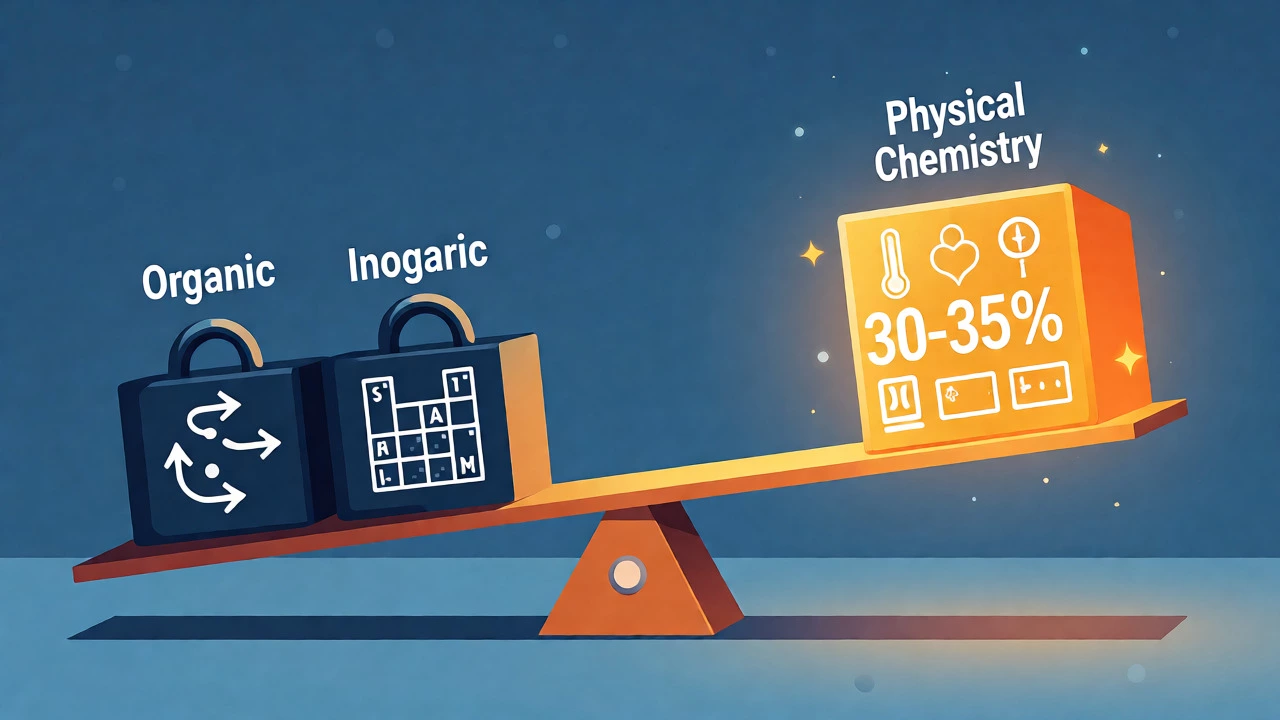
If you are thinking about dropping this module entirely, you need to look at the numbers before making that decision. In recent years, Physical Chemistry has consistently contributed around 30-35% of the total marks in the Chemistry section of the Joint Entrance Examination (JEE). That is roughly 12 to 14 questions out of 45. If you aim for a top rank, ignoring nearly one-third of a subject is a dangerous gamble. However, if your goal is a decent rank and you are struggling with calculus-based problems, there is a smarter way to approach this than total abandonment.
The Weightage Reality Check
Let's break down what happens if you ignore Physical Chemistry. The exam structure rewards balance. While Organic Chemistry relies on reaction mechanisms and logic, and Inorganic Chemistry demands rote learning of trends and exceptions, Physical Chemistry tests your ability to apply mathematical formulas to chemical concepts. It is often considered the most scoring part because the answers are objective-either the calculation is right or wrong. There is no ambiguity.
| Module | Average Questions | Marks Contribution | Difficulty Perception | Scoring Potential |
|---|---|---|---|---|
| Physical Chemistry | 12-14 | ~33% | Moderate-High (Math heavy) | High (Objective answers) |
| Organic Chemistry | 12-14 | ~33% | Moderate (Logic based) | High (Predictable patterns) |
| Inorganic Chemistry | 10-12 | ~25% | Low-Moderate (Memory based) | Moderate (Fact retrieval) |
Notice that skipping Physical Chemistry doesn't just lose you easy marks; it disrupts your entire preparation rhythm. Many topics in Physical Chemistry, like thermodynamics and equilibrium, overlap significantly with Physics concepts such as energy transfer and kinetics. By skipping them, you might also find yourself weaker in certain Physics areas, creating a double penalty.
Which Topics Are Non-Negotiable?
You don't have to master every single chapter with equal intensity. Some chapters are high-yield, meaning they appear frequently and are relatively straightforward if you know the formulas. Others are deep rabbit holes that consume time without guaranteeing returns. If you want to "skip" effectively, you should prioritize rather than eliminate.
- Mole Concept: This is the foundation. Without this, you cannot solve stoichiometry problems, which are basic and frequent. Skipping this is suicide for your Chemistry score.
- Thermodynamics: Directly overlaps with Physics. If you understand enthalpy and entropy from a physics perspective, half the battle is won. These questions are usually direct formula applications.
- Equilibrium: Chemical equilibrium is tricky, but ionic equilibrium is often tested via pH calculations. These are standard types. Learn the common mistakes students make here, and you can secure these marks easily.
- Electrochemistry: Nernst equation and conductivity are regular features. They are procedural. Once you practice the steps, they become mechanical tasks.
- Solutions: Colligative properties are formula-driven. Very few conceptual traps here. High return on investment for low study time.
Conversely, topics like advanced quantum mechanics or complex kinetic derivations might be less frequent or more time-consuming. If you are pressed for time, you can skim the theory and focus only on the standard problem types that appear in past papers.
The Math Barrier: Why Students Quit
Why do so many students want to skip this section? It’s rarely the chemistry itself-it’s the math. Physical Chemistry requires comfort with logarithms, exponentials, and sometimes differential equations. For a student who struggles with mathematics, seeing a rate law expression can feel like reading alien hieroglyphics. But here is the secret: JEE-level Physical Chemistry rarely uses advanced calculus. Most problems can be solved using algebra and basic arithmetic.
Consider the Arrhenius equation. It looks intimidating with its exponential term. But in exams, you are usually asked to compare two temperatures or calculate activation energy given two data points. You take the log of both sides, subtract the equations, and solve for Ea. It’s not calculus; it’s algebra disguised as chemistry. If you reframe your mindset from "doing math" to "plugging into formulas," the barrier lowers significantly.
Strategic Skipping: The 80/20 Rule
Instead of asking "Can I skip it?", ask "What is the minimum viable product I need to build in Physical Chemistry?" Apply the Pareto Principle: 80% of the questions come from 20% of the core concepts. Focus on mastering those core concepts and let go of the obscure exceptions.
Here is a practical workflow for a "minimalist" approach:
- Master the Formula Sheet: Create a one-page sheet with all major formulas. Memorize them. In the exam hall, recall is faster than derivation.
- Solve Previous Year Questions (PYQs): Do not start with new reference books. Go straight to the last 10 years of JEE Main and Advanced questions. Identify the recurring patterns. You will notice that certain types of questions repeat with different numbers.
- Ignore Derivations: Unless you are aiming for an AIR under 1000, you don’t need to derive the Van der Waals equation from scratch. Know how to use it.
- Focus on Numerical Accuracy: Many students lose marks not because they don’t know the concept, but because they make calculation errors. Practice doing calculations without a calculator, as JEE does not allow one.
When Is It Actually Okay to Deprioritize?
There are scenarios where reducing your focus on Physical Chemistry makes sense. If you are exceptionally strong in Organic and Inorganic Chemistry, you might afford to spend less time here. Similarly, if you are targeting specific branches in newer IITs where the cutoff is lower, securing a good score in the other two modules might be sufficient to get through.
However, be cautious. Inorganic Chemistry has seen a shift towards more conceptual questions recently, moving away from pure rote learning. Organic Chemistry remains volatile; a single tricky mechanism question can throw off your confidence. Physical Chemistry provides stability. It is the anchor of the Chemistry section. Losing that anchor means your boat drifts whenever the wind changes.
Action Plan for the Next 3 Months
If you have decided to tackle Physical Chemistry strategically, here is how you can allocate your time. Assume you have 3 months left until the exam.
| Month | Focus Area | Daily Time Allocation | Target Outcome |
|---|---|---|---|
| Month 1 | Mole Concept, Atomic Structure, Thermodynamics | 45 Minutes | Solve 50 PYQs per week. Master basic stoichiometry. |
| Month 2 | Equilibrium, Electrochemistry, Solutions | 45 Minutes | Understand pH calculations and cell potential basics. |
| Month 3 | Kinetics, Gaseous State, Revision | 30 Minutes + Mock Tests | Full-length sectional tests. Fix calculation errors. |
This plan assumes you are already studying Organic and Inorganic daily. Notice the time allocation is modest. You are not trying to become a professor; you are trying to become a scorer.
Common Pitfalls to Avoid
One major mistake students make is ignoring units. Physical Chemistry is unforgiving when it comes to units. Mixing up Celsius with Kelvin, or liters with milliliters, will give you the wrong answer even if your formula is correct. Always write down the units during each step of the calculation.
Another trap is over-reliance on shortcuts. Yes, there are tricks for balancing redox reactions or finding hybridization. But relying solely on tricks without understanding the underlying principle leaves you vulnerable when the question twists the standard format. Understand the 'why' behind the shortcut.
Finally, do not neglect the NCERT textbook. For Physical Chemistry, NCERT exercises are surprisingly relevant, especially for JEE Main. The language used in NCERT definitions often mirrors the phrasing in exam questions. Reading the text carefully helps you recognize what the examiner is actually asking.
Final Verdict
So, can you skip Physical Chemistry for JEE? Technically, yes, you can walk into the exam room without opening a single page of Physical Chemistry. But practically, you are leaving free marks on the table. It is the most predictable part of the syllabus. Unlike Organic, where a new reaction might surprise you, or Inorganic, where facts might slip your mind, Physical Chemistry rewards consistent practice of standard methods.
Treat it not as a monster to be feared, but as a toolkit to be mastered. Pick the high-yield tools, learn how to use them efficiently, and leave the rest. Your rank depends on the total score, not on how much pain you endured while studying a specific chapter. Work smart, not just hard.
Is Physical Chemistry harder than Organic Chemistry for JEE?
It depends on your strength. If you are good at math, Physical Chemistry is often easier because the answers are definite. If you struggle with calculations, it feels harder. Organic Chemistry requires logical reasoning and pattern recognition, which some students find more intuitive than numerical problem-solving.
How many hours per day should I dedicate to Physical Chemistry?
For a balanced preparation, 45 minutes to 1 hour daily is sufficient once you have covered the basics. During revision phases, increase this to 2 hours by solving mixed problem sets. Consistency matters more than marathon sessions.
Which chapters in Physical Chemistry are most important for JEE Main?
The highest weightage chapters are typically Mole Concept, Thermodynamics, Equilibrium (Chemical and Ionic), Electrochemistry, and Solutions. Mastering these five can cover approximately 60-70% of the Physical Chemistry questions.
Can I clear JEE Advanced if I am weak in Physical Chemistry?
Yes, but it is challenging. JEE Advanced questions are multi-conceptual. You might need to combine Physical Chemistry knowledge with Physics or Organic concepts. Being weak here limits your ceiling, but if you excel in the other two subjects, you can still secure a good rank.
Do I need to read NCERT for Physical Chemistry?
Yes, especially for JEE Main. NCERT covers the theoretical basis and standard definitions clearly. While reference books provide more numerical practice, NCERT ensures you don't miss out on conceptual questions that test your fundamental understanding.