Recent POST






Developer Workload & Burnout Calculator
Enter your details below to analyze your current or expected workload against industry standards.
Workload Analysis
Detailed Breakdown
You’ve probably heard the stereotype: programmers are nocturnal creatures who live on caffeine and energy drinks, coding until 3 AM in dark rooms. But is that actually how it works? If you’re thinking about taking coding classes or switching careers into tech, knowing the real workload is crucial. The short answer is that most professional coders work between 40 and 50 hours a week. However, the reality is messy. Some days you’ll code for eight hours straight; other days you’ll spend four hours in meetings discussing what to build next.
Understanding these hours isn’t just about curiosity. It’s about managing your expectations. When you start learning to code, you might think you need to practice six hours a day to succeed. Or you might worry that once you get hired, you’ll lose all your free time. Neither extreme is true. Let’s look at the actual data, the differences between roles, and how to avoid burning out before you even finish your first project.
The Standard 40-Hour Myth vs. Reality
In theory, a full-time job is 40 hours. In the tech world, this is often the baseline, but rarely the ceiling. According to recent surveys from platforms like Stack Overflow and Glassdoor, the average software engineer logs about 45 hours per week. That extra five hours usually comes from two sources: "invisible work" and context switching.
Invisible work includes things like debugging code that breaks unexpectedly, helping a colleague fix an error, or reading documentation to understand a new tool. You aren’t always typing code when you’re working. A significant portion of a coder’s week is spent thinking, planning, and communicating. If you sit down with the goal of writing 100 lines of code every hour, you’ll likely fail. Good code takes time to design properly.
| Role | Average Hours/Week | Overtime Frequency |
|---|---|---|
| Junior Developer | 40-45 | Low (Learning curve) |
| Senior Engineer | 45-50 | Medium (Meetings/Architecture) |
| Startup Founder/CTO | td>60-80Very High | |
| Freelance Coder | Variable (30-60) | High during deadlines |
Why Junior Developers Often Work Less (But Stress More)
If you are just starting out, perhaps after finishing some online courses, you might expect to be thrown into the deep end immediately. Surprisingly, junior developers often have more predictable hours than seniors. Why? Because they aren’t usually responsible for system architecture or client negotiations yet. Their primary job is to execute tasks assigned by senior team members.
However, "working less" doesn’t mean "having it easy." Juniors often struggle with imposter syndrome. They might stay late not because they are required to, but because they are afraid their code isn’t good enough. This self-imposed overtime is a common trap. Remember: speed comes with experience. If you spend three days solving a bug that a senior solves in three hours, that’s normal. Don’t punish yourself with extra hours. Focus on quality over quantity.
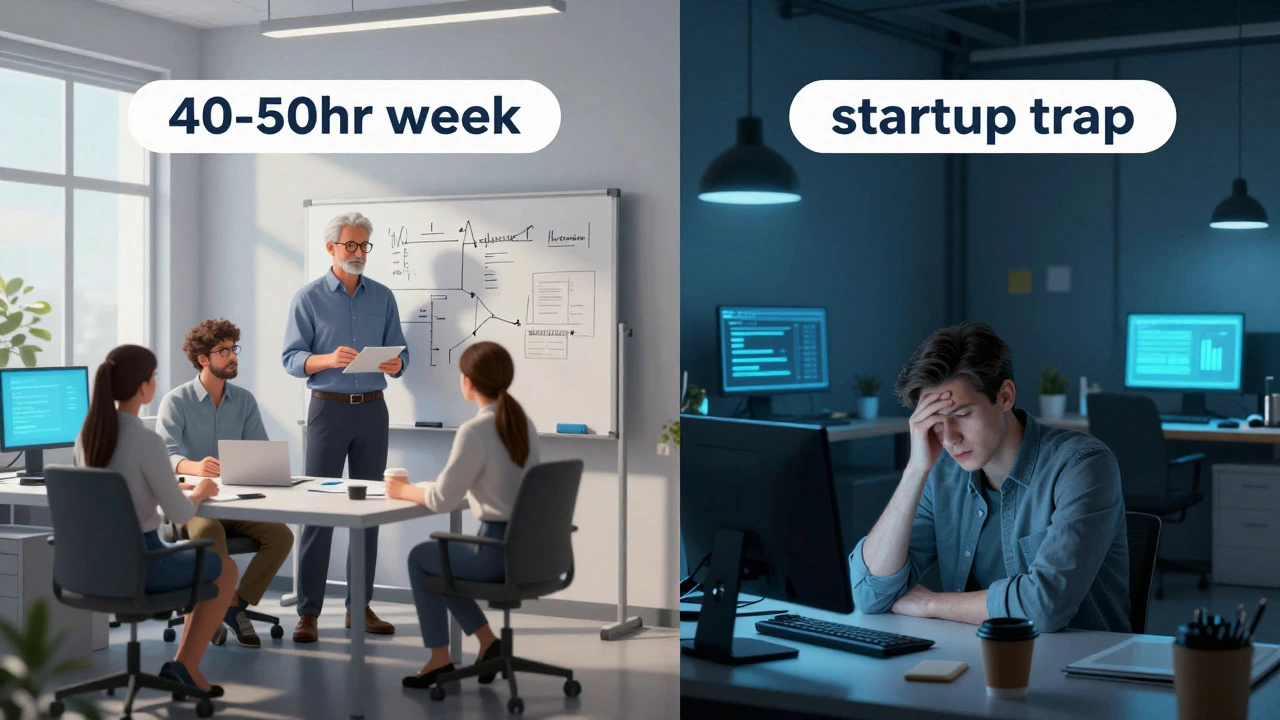
The Startup Trap: When 80 Hours Becomes Normal
Not all coding jobs are created equal. If you join a large corporation like Google or Microsoft, you will likely have strict boundaries. Managers there know that exhausted employees make expensive mistakes. But if you join a small startup, especially one that is pre-revenue or preparing for a product launch, the culture can be very different.
In early-stage startups, everyone wears multiple hats. You might code in the morning, handle customer support in the afternoon, and debug server issues at night. It’s not uncommon for founders and early engineers to work 60 to 80 hours a week. Is it worth it? Sometimes. You might learn more in one year at a chaotic startup than in three years at a stable enterprise. But it comes at a cost to your health and personal life. Before accepting a job, ask direct questions: "What does a typical sprint look like?" and "How do you handle deployment emergencies?" Their answers will tell you everything you need to know.
Freelancing: Freedom vs. Feast or Famine
Many people choose coding as a path to freedom. As a freelancer, you set your own hours. You can work 10 hours on Monday and zero hours on Tuesday. Sounds great, right? The catch is that clients don’t care about your schedule. They care about deadlines.
Freelancers often face "feast or famine" cycles. During busy periods, you might work 60 hours a week to deliver projects on time. During slow periods, you might spend 20 hours looking for new clients and only 10 hours coding. To succeed as a freelancer, you need discipline. You must treat your business like a job, even when no one is watching. Setting clear boundaries with clients is essential. If you say yes to every last-minute request, you will burn out within six months.
Remote Work and the Blur of Boundaries
Since 2020, remote work has become standard in the tech industry. This brings both benefits and risks. On one hand, you save hours on commuting. That’s pure profit for your free time. On the other hand, the office door is gone. Without a physical separation between "work" and "home," it’s easy to check emails at dinner or fix a bug while watching TV.
To protect your sanity, create rituals. Start your day by opening your laptop at a specific time. End your day by closing it and putting it away. Use tools like Slack status updates to signal when you are offline. Your brain needs downtime to process complex problems. Coding is mental heavy lifting. If you never rest, your creativity will dry up.

How to Manage Your Time as a New Coder
If you are currently studying, how many hours should you dedicate to learning? For beginners, consistency beats intensity. Studying for one hour every day is far better than cramming for seven hours on Sunday. Here is a practical approach:
- The 2-Hour Rule: Aim for two focused hours of coding practice daily. Use the Pomodoro technique (25 minutes work, 5 minutes break) to maintain focus.
- Build Projects, Not Just Tutorials: Watching videos feels productive, but building something from scratch teaches you real skills. Spend 70% of your time building and 30% learning theory.
- Sleep is Part of Learning: Your brain consolidates memory during sleep. If you cut sleep to code more, you retain less. Prioritize 7-8 hours of rest.
Signs You Are Working Too Much
Burnout in tech is real and dangerous. It doesn’t happen overnight. It creeps in. Watch for these warning signs:
- Cognitive Decline: You find simple bugs harder to solve than usual. You forget syntax you used to know.
- Irritability: Code reviews feel like personal attacks. Small delays frustrate you disproportionately.
- Physical Symptoms: Eye strain, back pain, and headaches that don’t go away with rest.
- Dread: You feel anxiety on Sunday nights thinking about Monday’s tasks.
If you notice these signs, step back. Take a day off. Talk to your manager. In healthy companies, managers want you to succeed, not suffer. They would rather have a consistent performer than a burned-out hero.
Conclusion: Quality Over Quantity
So, how many hours do coders work? Most work a standard full-time schedule with occasional spikes during critical releases. The key is not to count the hours, but to measure the output. Ten hours of distracted, tired coding produces worse results than four hours of focused, fresh work. Whether you are a student taking your first class or a seasoned engineer, remember that coding is a marathon, not a sprint. Protect your energy, set boundaries, and enjoy the process of creating.
Do programmers really work 80 hours a week?
No, this is a myth for most roles. While startup founders or engineers during critical crunch times might hit 80 hours, the average software developer works 40-50 hours per week. Large corporations typically enforce stricter work-life balance policies.
How many hours a day should I practice coding as a beginner?
Aim for 1-2 hours of focused practice daily. Consistency is more important than duration. Studying for one hour every day yields better long-term results than cramming for ten hours once a week.
Is overtime common in the tech industry?
Occasional overtime is common, especially around product launches or when fixing critical bugs. However, chronic weekly overtime is a sign of poor management or understaffing. Healthy teams plan sprints to avoid constant emergency work.
Do remote coders work more hours than office workers?
Studies show mixed results. Some remote workers report longer hours due to blurred boundaries between home and work. Others save time by avoiding commutes. It depends largely on individual discipline and company culture.
Can you make a living freelancing as a coder?
Yes, many developers freelance successfully. However, income can be inconsistent. You need strong project management skills and a steady pipeline of clients to ensure financial stability without working excessive hours.