Recent POST






English Fluency Confidence Quiz
How well do you understand the secrets to speaking English confidently? Take this quick quiz to test your knowledge against common misconceptions.
Loading question...
Quiz Completed!
You scored 0 out of 5
Review the answers above to reinforce your learning strategy.
Most people think they need a massive vocabulary or perfect grammar to speak English well. They’re wrong. I’ve seen countless learners stumble because they were too busy translating sentences in their heads to actually talk. The secret isn’t knowing every word; it’s being comfortable making mistakes while you figure things out. If you want to move from silent panic to casual chat, you have to change how you practice.
The Myth of Perfect Grammar
Let’s be honest: native speakers break grammar rules all the time. We use slang, drop subjects, and mix tenses when we’re tired or excited. Yet, many beginners freeze up because they are terrified of using the wrong verb tense. This fear is the biggest enemy of fluency. When you try to construct a "perfect" sentence before opening your mouth, you lose the natural rhythm of conversation.
Think about it this way. If you order coffee and say, "I want coffee," versus "I would like to have a cup of coffee," both get you caffeine. One is grammatically formal; the other is direct. Both work. Your goal as a beginner shouldn’t be academic precision but effective communication. Start by accepting that errors are part of the process. Every mistake is data telling you what to fix next time. Stop editing yourself mid-sentence. Just get the words out.
Building a Foundation with Input
You can’t output what you haven’t input. To speak fluent English, you need to hear it constantly. But not just any audio. You need comprehensible input-material where you understand about 80% of what is said. If you listen to a complex news broadcast and understand nothing, you aren’t learning; you’re just hearing noise.
Start with content designed for intermediate learners. Podcasts like 6 Minute English by the BBC or YouTube channels like English with Lucy are great because they speak clearly and explain context. Watch movies or TV shows with English subtitles first, then without them later. This trains your brain to connect sounds with meaning directly, skipping the translation step.
Here is a simple rule: consume content slightly above your current level. If it feels too easy, you’re bored. If it’s too hard, you quit. Find that sweet spot where you struggle a little but still follow the story.
Techniques for Active Practice
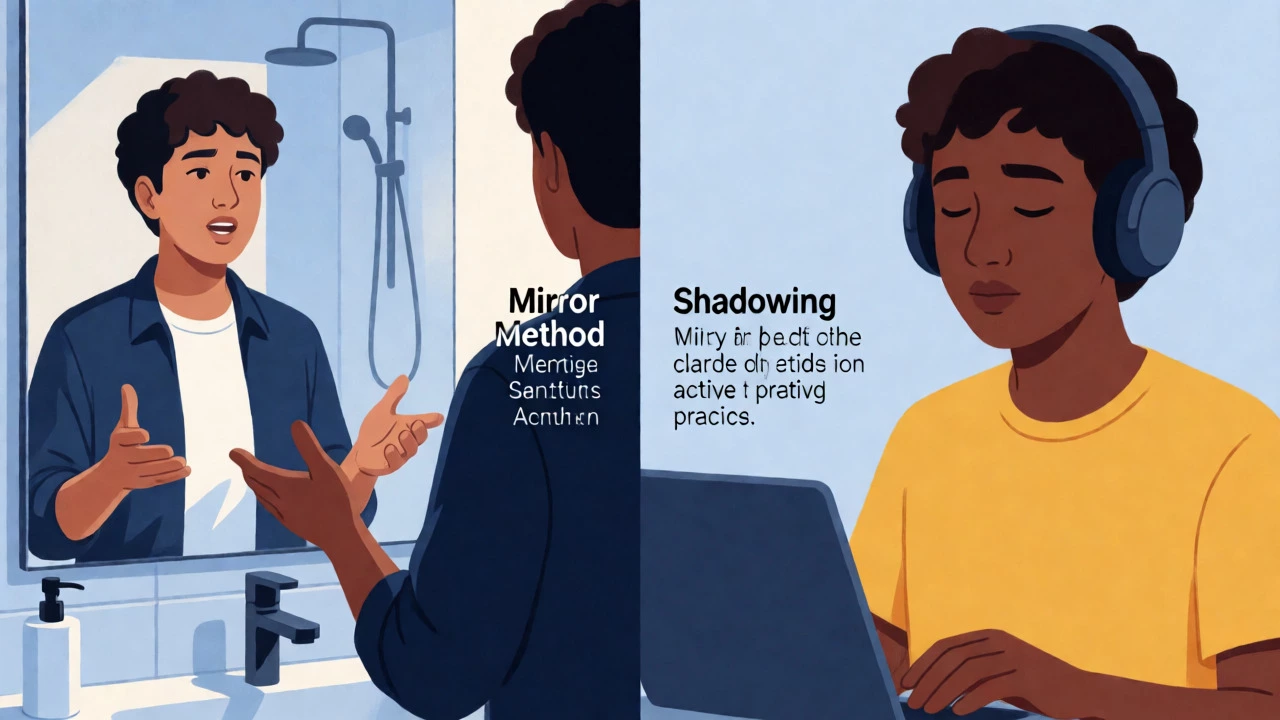
Passive listening builds recognition, but active speaking builds muscle memory. You need to physically produce sounds. Most beginners never do this alone. They wait for a class or a friend. Don’t wait. Here are three techniques that work wonders if you do them daily.
- Shadowing: Listen to a short clip of a native speaker and repeat exactly what they say, almost simultaneously. Mimic their speed, tone, and pauses. This improves your accent and intonation naturally.
- The Mirror Method: Stand in front of a mirror and talk about your day for two minutes. Watch your mouth movements. It feels silly, but seeing yourself speak helps build confidence and identifies awkward facial expressions.
- Record Yourself: Use your phone to record a voice memo answering a simple question like "What did I eat today?" Listen back. You’ll hear errors you missed while speaking. Compare it to a native speaker’s answer on the same topic.
Consistency beats intensity. Ten minutes a day is far better than two hours once a week. Your brain needs frequent repetition to wire these new pathways.
Overcoming the Fear of Judgment
Why do we stop talking? Usually, it’s shame. We worry people will laugh at our accent or judge our intelligence. Here’s a truth bomb: most native speakers are polite and interested in what you have to say, not how you say it. People care about connection, not correction.
To boost confidence, start with low-stakes environments. Talk to customer service agents over the phone. Order food in English even if the server speaks your language. Join online communities like Discord servers dedicated to language exchange. These platforms allow you to type and speak with others who are also learning, so the pressure is off.
If someone doesn’t understand you, don’t apologize profusely. Rephrase. Use simpler words. Gesture. Communication is a negotiation, not a test. The more you survive misunderstandings, the less scary they become.
Practical Tools and Resources
You don’t need expensive tutors to start. Technology has made learning accessible and cheap. However, choosing the right tools matters. Avoid apps that only teach flashcards. Look for ones that focus on speaking and listening.
| Tool Type | Best For | Cost Estimate (USD) | Key Benefit |
|---|---|---|---|
| Language Exchange Apps (e.g., Tandem) | Real conversation practice | Free - $10/mo | Connects with native speakers globally |
| AI Conversation Partners (e.g., ELSA Speak) | Pronunciation feedback | $5 - $15/mo | Instant correction without judgment |
| Online Tutors (e.g., iTalki) | Structured guidance | $10 - $30/hr | Personalized lesson plans |
| Media Immersion (Netflix/YouTube) | Vocabulary & Listening | Subscription fee | Cultural context and slang |
For beginners, I recommend combining one app for structure with one source of free media for immersion. For example, use an AI pronunciation tool for 10 minutes a day and watch one episode of a sitcom weekly. This balances technical accuracy with real-world usage.

Creating a Daily Routine
Motivation fades. Habits stay. To speak English fluently, you must integrate it into your life until it feels normal. You don’t need to study "English." You need to live in English.
Try this routine:
- Morning: Listen to a podcast while brushing teeth or commuting. No notes, just listen.
- Lunch: Read one news article or blog post. Highlight three new words. Try to use one in a text message.
- Evening: Spend 15 minutes shadowing a video or recording a diary entry in English.
Change your phone settings to English. Change your social media feeds to follow English-speaking creators. Surround yourself with the language so your brain has no choice but to adapt.
FAQ
How long does it take to speak English fluently?
It varies by individual, but generally, achieving conversational fluency takes 6-12 months of consistent daily practice. Reaching advanced professional fluency often takes 2-3 years. Consistency is more important than the total number of hours studied.
Do I need a tutor to become fluent?
No, you don't strictly need a tutor. Many people achieve fluency through self-study, language exchange partners, and immersion. However, a tutor can accelerate progress by providing structured feedback and correcting persistent errors that self-learners might miss.
Is it okay to make grammar mistakes when speaking?
Absolutely. Making mistakes is essential for learning. Native speakers rarely correct beginners unless asked. Focus on being understood rather than being perfect. Over time, you will self-correct as your ear becomes more attuned to proper structures.
What is the best way to improve my accent?
The most effective method is shadowing, where you mimic native speakers' intonation, rhythm, and stress patterns. Recording yourself and comparing it to the original audio also helps identify specific sounds you need to adjust. Remember, having an accent is fine; clarity is the goal.
Should I translate everything in my head?
Try to avoid it. Translating slows down speech and causes hesitation. Instead, associate English words directly with images, actions, or concepts. Start with simple nouns and verbs, then gradually move to abstract ideas. Thinking in English comes with exposure and practice.
Next Steps
You now have the roadmap. The hardest part is starting. Pick one technique from this guide-maybe shadowing or changing your phone language-and do it today. Don’t worry about tomorrow. Just speak now. Your future self will thank you for breaking the silence.