Recent POST





Global Education Board Matcher
Answer 4 simple questions to find out which education board aligns best with your family's needs.
Recommended Boards
When parents and students ask which board is most popular in the world, they are usually looking for a single name. The answer isn't as simple as pointing to one organization. If you measure by pure numbers, the Central Board of Secondary Education (CBSE) dominates the landscape. But if you look at prestige or global mobility, other names like the International Baccalaureate (IB) or Cambridge Assessment take the spotlight.
This confusion happens because "popular" can mean different things. It can mean the highest number of enrolled students. It can mean the most recognized certification across borders. Or it can mean the board that offers the best preparation for competitive exams. To make a smart choice, you need to understand what drives these numbers and how each system works in practice.
The Numbers Game: Why CBSE Leads in Enrollment
If we define popularity by headcount, the Central Board of Secondary Education (CBSE) is the undisputed leader. Based in New Delhi, India, this board oversees more than 30,000 schools worldwide. That includes over 18,000 schools within India and thousands more across the Middle East, Africa, Europe, and Asia-Pacific regions.
Why are the numbers so high? There are three main reasons. First, affordability. Many private schools choose CBSE because the affiliation fees and exam costs are lower compared to international boards. Second, alignment with national goals. In India, millions of students aim for engineering and medical seats through competitive exams like JEE and NEET. The CBSE syllabus aligns closely with these entrance tests, making it the default choice for ambitious families.
Third, the diaspora effect. Indian families living abroad often send their children to CBSE-affiliated schools to keep them connected to their cultural roots and educational standards. This has turned CBSE into a global phenomenon, not just an Indian one. When you see a CBSE student in Dubai, London, or Singapore, they are part of this massive network.
The Prestige Factor: IB and Cambridge
While CBSE wins on volume, the International Baccalaureate (IB) is a rigorous academic program designed for students aged 16-19 who want to develop critical thinking skills often wins on prestige. The IB Diploma Programme is recognized by top universities in the US, UK, Canada, and Australia. It is known for its holistic approach, requiring students to study six subject groups plus a core component involving community service, theory of knowledge, and an extended essay.
Similarly, Cambridge Assessment International Education is the largest provider of international qualifications, offering IGCSE and A-Level courses holds a strong position, especially in Commonwealth countries. Cambridge A-Levels are highly respected for their depth. Students typically choose three or four subjects and study them in great detail. This specialization appeals to students who know exactly what career path they want to follow, such as medicine or law.
These boards are popular among expatriates and affluent local families who plan to send their children to university abroad. They are less about rote learning and more about inquiry-based education. However, they come with higher tuition fees and require schools to invest heavily in teacher training and infrastructure.
Regional Giants: State Boards and Local Systems
We cannot talk about global popularity without mentioning state boards. In India alone, state boards like Maharashtra State Board, Uttar Pradesh Madhyamik Shiksha Parishad, and Tamil Nadu State Board educate millions of students. When you add up all state boards in India, China, Brazil, and Nigeria, the numbers rival even CBSE.
However, these boards are fragmented. Each state has its own syllabus, language medium, and examination pattern. This makes it hard to compare them directly with centralized boards like CBSE or IB. Their popularity is local rather than global. A student from a state board in Kerala might find it difficult to transfer to a school in California without taking additional placement tests, whereas an IB student can move between countries with minimal disruption.

Comparing the Top Contenders
To help you decide which board fits your needs, let's look at a direct comparison of the major players. This table highlights key differences in structure, focus, and recognition.
| Board | Primary Focus | Global Recognition | Cost Level | Best For |
|---|---|---|---|---|
| CBSE | Competitive Exam Prep | High (Especially in Asia/Middle East) | Moderate | Students aiming for Indian engineering/medical colleges |
| ICSE | Language & Literature | Medium (Strong in India) | Moderate to High | Students focusing on arts, humanities, and strong English skills |
| IB Diploma | Holistic Critical Thinking | Very High (Global Universities) | High | Students planning to study abroad in US/UK/Europe |
| Cambridge IGCSE/A-Level | Subject Specialization | High (Commonwealth Countries) | High | Students with clear career paths early on |
Understanding the ICSE Alternative
In the context of Indian education, another name often comes up: the Indian Certificate of Secondary Education (ICSE). Administered by the Council for the Indian School Certificate Examinations (CISCE), ICSE is known for its detailed syllabus and emphasis on English literature and languages. While CBSE has more schools globally, ICSE commands loyalty in certain regions, particularly in South India and parts of North India.
Parents often choose ICSE because they believe it builds stronger communication skills. The exams are descriptive and require long answers, which helps students articulate their thoughts better. However, ICSE is less flexible than CBSE when it comes to changing schools mid-year, as the syllabus coverage is very specific. If your family plans to stay in India but values a well-rounded liberal arts foundation, ICSE remains a top contender despite having fewer total enrollments than CBSE.
How to Choose the Right Board for Your Child
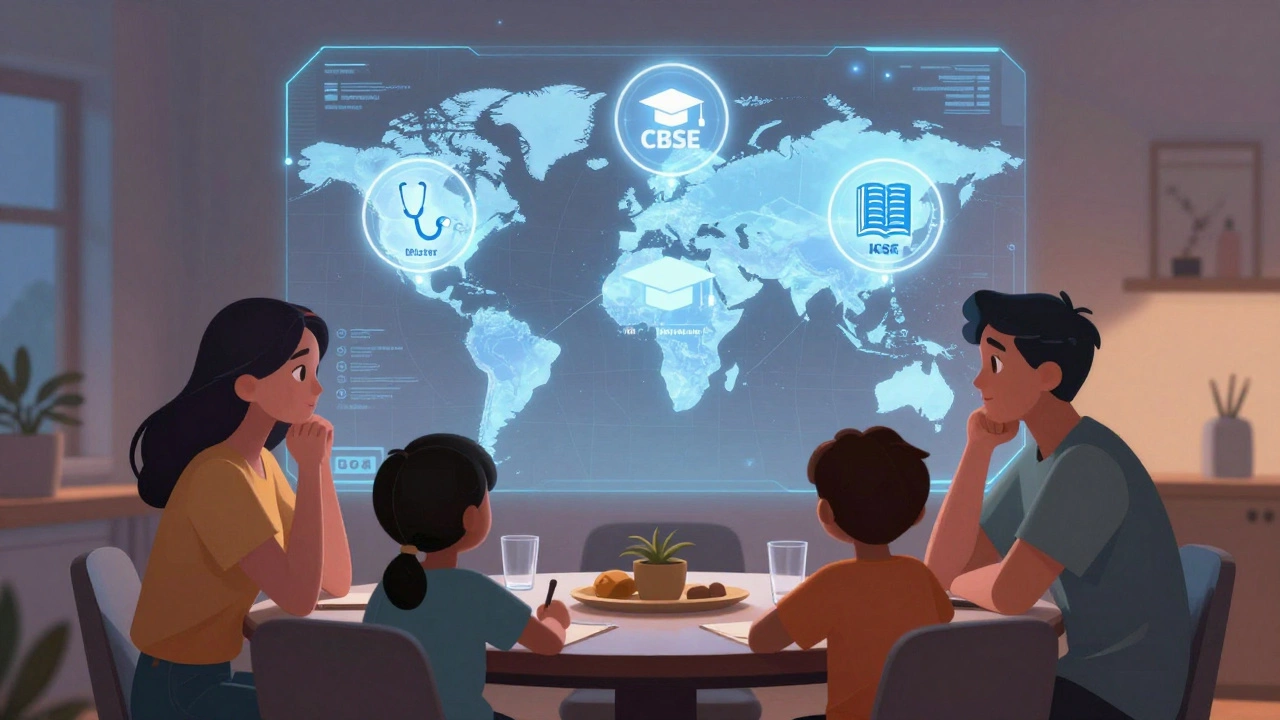
Selecting a board is not just about picking the most popular one. It is about matching the educational style to your child's personality and your family's future plans. Here is a practical guide to help you navigate this decision.
- Define your university destination: If you plan to send your child to university in the United States, the IB Diploma or AP courses offered by some CBSE schools are advantageous. If the goal is admission to IITs or AIIMS in India, stick with CBSE or a strong state board.
- Assess learning style: Does your child thrive in structured environments with clear rules? CBSE provides this structure. Does your child prefer open-ended projects and debates? IB might be a better fit.
- Consider mobility: If your job requires frequent relocation, IB or Cambridge offers the smoothest transition. You can drop your child into a school in another country, and the curriculum will likely match.
- Evaluate financial capacity: International boards like IB and Cambridge are expensive. Tuition fees can be double or triple those of CBSE schools. Ensure this investment aligns with your long-term budget.
The Future of Global Education Boards
The landscape of school boards is evolving. We are seeing a trend toward hybrid models. Some CBSE schools now offer IB Career-related Programmes (CP) alongside their regular curriculum. Others integrate Cambridge resources into their teaching methods. This blurring of lines suggests that the rigid boundaries between boards are softening.
Technology also plays a role. With online learning platforms, access to quality content is no longer restricted by geography. A student in a remote village can access the same digital textbooks as a student in a metropolitan city. However, the certification and assessment frameworks remain distinct. The board you choose still dictates how your child is evaluated and where their diploma holds weight.
As we move further into 2026, the demand for skills-based education is rising. Boards that adapt quickly to include coding, financial literacy, and mental health awareness will gain popularity. CBSE has already introduced changes in its syllabus to reduce rote memorization and increase application-based questions. Whether it can maintain its lead against agile competitors like IB remains to be seen.
Is CBSE really the most popular board in the world?
Yes, in terms of the number of affiliated schools and enrolled students, CBSE is the most popular. It has over 30,000 schools globally, significantly more than any other single board. Its dominance is driven by its presence in India and among the Indian diaspora worldwide.
Which board is better for studying abroad: CBSE or IB?
The IB Diploma is generally considered better for studying abroad, particularly in the US, UK, and Canada. It is widely recognized by top universities for its rigorous academic standards and holistic approach. CBSE is also accepted, but students may need to take additional standardized tests like SATs or ACTs to strengthen their applications.
Can I switch from CBSE to ICSE in middle school?
Switching boards is possible but challenging. CBSE and ICSE have different syllabi, especially in subjects like Mathematics and Science. ICSE tends to be more detailed and language-heavy. If you switch, your child may face a gap in knowledge and need extra tutoring to catch up with the new curriculum's depth.
Are state boards worse than central boards?
Not necessarily. State boards are tailored to local languages and cultures, which can be beneficial for regional identity. However, they often lack the uniformity and global recognition of central boards like CBSE or international boards like IB. Quality varies greatly depending on the specific state and school infrastructure.
What is the cost difference between CBSE and International Boards?
CBSE schools are generally more affordable. Annual fees can range from $500 to $2,000 depending on the location and facility. International boards like IB or Cambridge often charge between $5,000 and $20,000 per year due to higher operational costs, specialized teacher training, and smaller class sizes.
Does the board choice affect college admissions in India?
For top engineering and medical colleges in India, CBSE is highly preferred because its syllabus aligns with entrance exams like JEE and NEET. IB and Cambridge students are eligible but must prepare separately for these competitive exams, as their curricula do not cover the same depth in physics, chemistry, and mathematics required for these tests.