Recent POST






Competitive Exam Strategy Calculator
Use this tool to determine your optimal study focus based on your target exam, natural aptitude, and available preparation time.
Your Strategic Focus
Most students walk into a bookstore or log onto an education portal with one burning question: "Which subject is best for competitive exams?" It feels like there should be a magic bullet-a single discipline that guarantees a high score and opens every door. But here’s the truth that seasoned educators often whisper in hallways: there is no universal "best" subject. The right choice depends entirely on the specific exam you are targeting, your natural strengths, and the career path you want to build.
Imagine trying to run a marathon while training only for sprinting. You might have speed, but you’ll lack endurance. Similarly, picking a subject just because it’s popular or trendy can leave you struggling when the actual test demands depth, logic, or specific technical knowledge. Before we dive into how to pick the right focus, let's look at why this decision matters so much. In high-stakes testing environments, time is your most scarce resource. Focusing on a subject that aligns with your cognitive style allows you to answer questions faster and more accurately. For instance, if you enjoy structured problem-solving, mathematics will feel like a puzzle. If you thrive on context and nuance, literature or history might be your playground. Understanding this alignment is the first step toward success. And while we’re talking about making smart choices based on personal fit, it’s worth noting that this principle applies everywhere-even in niche industries where finding the right match is crucial, such as browsing through this directory to find a companion who fits specific criteria perfectly.
The Myth of the "Easy" Subject
A common trap for aspirants is chasing the "easiest" subject. Many believe that General Knowledge (GK) or Current Affairs is the low-hanging fruit because it requires less memorization of formulas. While it’s true that GK doesn’t demand complex calculations, it has a massive scope. You can’t cram ten years of world events, scientific discoveries, and political shifts into a week. On the other hand, subjects like Mathematics or Physics have defined boundaries. Once you master the core concepts, you can solve thousands of variations of problems. This predictability makes them easier to prepare for systematically.
Consider the Indian Civil Services Exam (UPSC). Candidates often spend months mastering Polity and History because these subjects form the backbone of the preliminary and main exams. They aren’t necessarily "easy," but they are high-yield. Every hour spent understanding the Constitution yields multiple marks across different papers. Contrast this with a subject like Art and Culture, which, while interesting, offers fewer direct scoring opportunities unless you have a specialized interest. The key takeaway? Don’t pick what looks easy; pick what gives you the highest return on investment for your study hours.
Aligning Subjects with Career Goals
Your choice of subject should mirror the job you want. If you aim for a career in engineering, focusing heavily on Physics and Chemistry during your entrance exam prep isn’t just academic-it’s professional training. These subjects teach you how to think analytically, a skill you’ll use daily in design labs and field projects. Conversely, if you’re eyeing a role in journalism or public relations, strengthening your English comprehension and logical reasoning will serve you better than drilling calculus problems.
Let’s look at medical entrance exams like NEET or MCAT. Biology is non-negotiable here. It’s not just about passing the test; it’s about building the foundation for patient care. A doctor who struggles with biological concepts in their teens will struggle with clinical diagnoses in their twenties. Therefore, the "best" subject is the one that bridges the gap between your current exam and your future profession. Ask yourself: What skills does my dream job require? Then, reverse-engineer your study plan to prioritize those areas.
Assessing Your Natural Aptitude
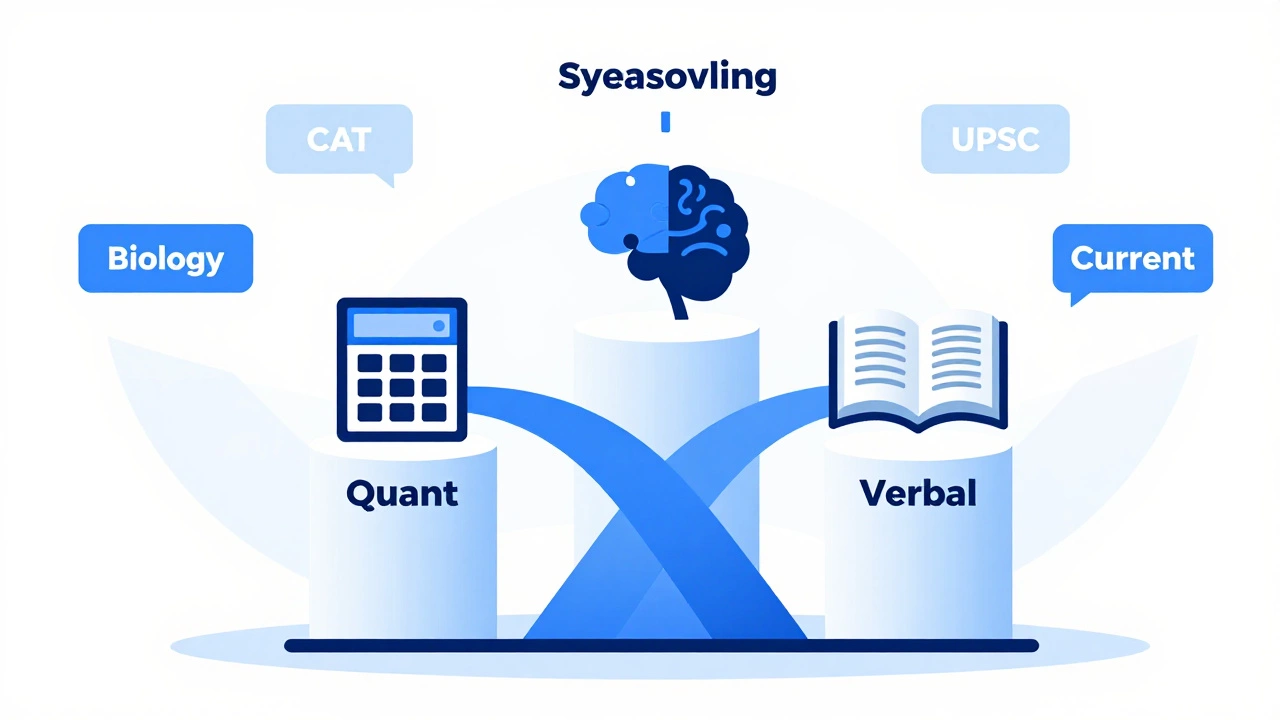
Self-awareness is a powerful tool in competitive exam preparation. Some people have a natural flair for numbers. They see patterns in data instantly. For them, Quantitative Aptitude is a goldmine. Others are verbal powerhouses, capable of dissecting complex arguments and spotting logical fallacies in seconds. For these individuals, Verbal Reasoning and Reading Comprehension are where they shine.
To assess your aptitude, take a few diagnostic tests before committing to a study schedule. Look at your scores not just as grades, but as indicators of cognitive strength. Did you breeze through the math section but stumble on reading passages? Or did you ace the essay writing but freeze up during geometry problems? Use this data to weight your preparation. If you’re strong in math, allocate 60% of your time to advanced problem sets and 40% to brushing up on weaker areas. If you’re weak in math, don’t ignore it-but don’t let it consume all your energy either. Focus on mastering the basics and moving on to stronger suits where you can secure maximum marks.
The Role of Syllabus Overlap
One of the smartest strategies in competitive exam prep is leveraging syllabus overlap. Many exams share common sections. For example, almost every major competitive test in India-whether it’s CAT, GMAT, GRE, or Bank PO-includes Quantitative Aptitude, Logical Reasoning, and Verbal Ability. By mastering these three pillars, you position yourself for multiple opportunities simultaneously.
This approach reduces redundancy. Instead of studying separate curricula for each exam, you create a unified core. You then add specific subjects as needed. Applying for an MBA? Add Data Interpretation. Applying for a government job? Add General Awareness. This modular method saves time and prevents burnout. It also builds versatility. A candidate who is proficient in both reasoning and quant is adaptable, able to pivot between different types of challenges quickly. This flexibility is invaluable in dynamic testing environments where question patterns can shift unexpectedly.

Resource Availability and Quality
Even the most talented student will struggle without good resources. The "best" subject is also the one with the most accessible, high-quality study materials. Check what’s available for your chosen focus. Are there reputable textbooks, online courses, and practice platforms? Is there a community of peers or mentors who can help clarify doubts?
For instance, if you choose Computer Science for a tech-focused exam, you’ll find endless coding challenges, open-source projects, and tutorial videos. This abundance accelerates learning. However, if you pick a niche subject like Ancient Philosophy for a humanities exam, you might find fewer interactive tools and more reliance on dense texts. Evaluate the ecosystem around your subject. A robust support system can make a difficult subject manageable, while poor resources can make an easy subject frustrating. Always verify the credibility of your sources. Outdated books or unreliable apps can lead you down the wrong path, wasting precious time.
Time Management and Study Habits
Your daily routine plays a huge role in determining which subject works best for you. Do you prefer deep, uninterrupted blocks of time? If so, subjects requiring intense concentration, like Advanced Mathematics or Scientific Research, suit you well. Do you learn better in short bursts? Then languages, vocabulary building, or current affairs updates might be more effective.
Create a realistic timetable. Break down your subjects into manageable chunks. Use techniques like the Pomodoro method to maintain focus. Remember, consistency beats intensity. Studying two hours every day is far more effective than cramming ten hours once a week. Track your progress weekly. Adjust your plan if certain subjects are taking too long to grasp. Flexibility is key. Life happens, and your study plan must adapt without losing momentum.
Is Math really the best subject for all competitive exams?
No. While Math is crucial for engineering, finance, and many management exams, it is irrelevant for law, arts, or pure science entrances. Choose based on your target exam’s requirements.
How do I know if I’m choosing the wrong subject?
Signs include constant frustration, declining mock test scores, and lack of interest. If you dread opening your textbook, it might be time to reassess your strategy or seek tutoring.
Can I switch subjects mid-preparation?
Yes, but early on. Switching late wastes time already invested. If you realize a mismatch after a few weeks, pivot quickly. Better to start fresh than to persist in failure.
What if I’m average in all subjects?
Focus on accuracy over breadth. Master the fundamentals of each required area. In many exams, clearing the cutoff with consistent moderate scores beats excelling in one and failing others.
Does previous academic performance matter?
It provides a baseline, but don’t let past grades limit you. Many students improve dramatically with focused effort. Use past results to identify weaknesses, not to define your potential.