Recent POST



Degree Value & Employability Checker
Check how a hiring manager in 2026 would likely perceive your qualification based on the factors discussed in the article.
Employability Perception
The Accreditation Rule
Regional accreditation makes an online degree legally and professionally equivalent to on-campus degrees.
The Portfolio Pivot
Focus on what you can do rather than how you learned it to neutralize any online bias.
Industry Nuance
Digital roles embrace online learning; high-touch clinical roles still require physical labs.
You’ve spent thousands of dollars and countless late nights staring at a screen, only to wonder if your diploma is actually worth the paper-or the PDF-it's printed on. There is a lingering fear that hiring managers see an online degree as a "shortcut" or a second-rate version of the traditional college experience. But here is the reality: the gap between "traditional" and "online" has almost entirely vanished. Most employers today care far more about whether you can actually do the job than where you sat while learning how to do it.
Quick Takeaways: The Bottom Line on Online Degrees
- Accreditation is everything: If the school is recognized, the degree is usually viewed as equal to an on-campus one.
- Skills over certificates: Employers prioritize a portfolio of work and proven skills over the delivery method of the degree.
- Soft skills matter: Online learners often have an edge in digital literacy and time management.
- Industry varies: Tech and business are very open to online degrees; medicine and high-end lab sciences still lean toward traditional labs.
The Shift in Hiring Mindsets
A few years ago, a degree from an online portal might have raised an eyebrow. Today, that's rarely the case. Online Degrees is an academic qualification earned through distance learning platforms, typically utilizing asynchronous or synchronous digital classrooms. Since 2020, the corporate world has undergone a massive shift. With the rise of remote work, the "digital-first" mindset has moved from the periphery to the center of business operations.
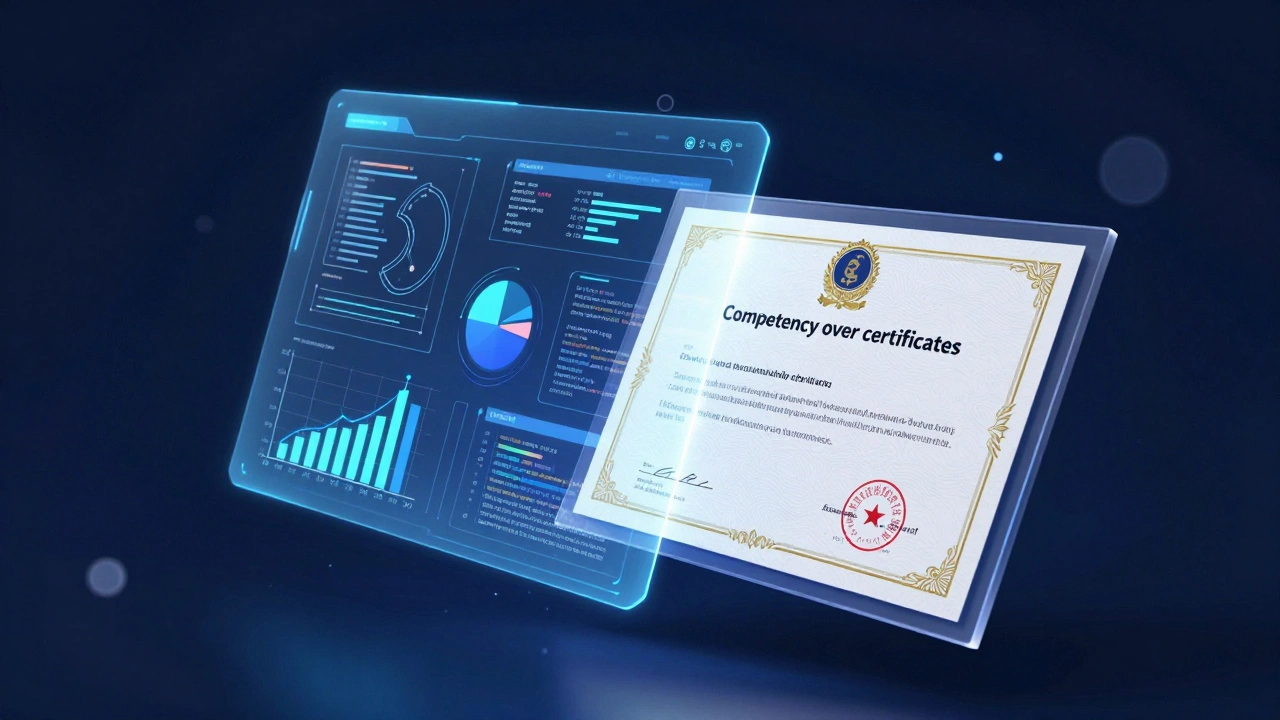
Hiring managers are no longer just looking for a piece of paper. They are looking for evidence of competency. If you can demonstrate that you've mastered Data Analysis or Project Management through a combination of a degree and real-world projects, the method of instruction becomes a footnote. In fact, many managers view the discipline required to finish a degree online-without a professor physically reminding you to turn in assignments-as a sign of high self-motivation.
Accreditation: The Make-or-Break Factor
When people talk about "degree mills,'" they aren't talking about legitimate online universities. They are talking about unaccredited sites that sell certificates for a fee. This is where the stigma actually lives. If your degree comes from an institution with regional accreditation, it is legally and professionally equivalent to an on-campus degree.
For example, if you get a degree from a state university that happens to offer an online track, that is the same degree as the one given to the student sitting in the lecture hall. Employers rarely check if you attended classes in person or via Zoom; they check if the institution is recognized by the Department of Education or a recognized accrediting body. If the school is a known entity, you're in the clear.
| Degree Type | Employer Perception | Key Value | Risk Level |
|---|---|---|---|
| Traditional On-Campus | High/Standard | Networking & Campus Life | Low |
| Accredited Online | High/Equal | Flexibility & Tech Savvy | Low |
| Bootcamps/Certificates | Moderate (Skill-based) | Rapid Skill Acquisition | Medium |
| Unaccredited "Diplomas" | Very Low | None | High |
Where Online Degrees Give You an Edge
Surprisingly, there are areas where an online degree actually looks better on a resume. Think about the traits required to succeed in a virtual environment. You have to manage your own schedule, troubleshoot your own tech issues, and communicate effectively through writing and video calls. These are exactly the skills needed for the modern, distributed workforce.
If you are applying for a role at a company that uses Slack, Microsoft Teams, and Zoom for 90% of its operations, showing that you've successfully navigated a multi-year degree in a digital environment is a proof of concept. You aren't just saying you can work remotely; you've already done it for years.
Industry-Specific Nuances
Does every industry feel the same? Not quite. The level of acceptance depends heavily on the nature of the work. In fields like Computer Science, Digital Marketing, and Business Administration, online degrees are completely normalized. The output-code, a marketing strategy, or a financial report-is digital, so the education can be too.
However, if you're pursuing a degree in Nursing, Mechanical Engineering, or Chemistry, a purely online degree is an impossible sell. Why? Because these roles require tactile, physical mastery of tools and biological systems. You can't learn to perform a surgical procedure or calibrate a physical turbine through a screen. In these cases, a "hybrid" model-where you do the theory online and the labs in person-is the only acceptable path. If you're in a high-touch field, ensure your program has a physical component.
How to Present Your Online Degree to Employers
The biggest mistake graduates make is over-explaining their degree. If your diploma says "Bachelor of Science in Psychology" from a reputable university, you don't need to put "(Online)" in parentheses next to it. Most diplomas from reputable schools don't even distinguish between the two modes of delivery. If the degree is the same, the label is the same.
Instead of focusing on the delivery, focus on the application. If you're worried the employer might be old-school, pivot the conversation toward your projects. Use a portfolio or a GitHub profile to show what you can actually build. When you move the focus from "How I learned it" to "What I can do with it," the method of instruction becomes irrelevant. Use specific metrics: "Increased lead generation by 20% using techniques learned in my Digital Marketing degree" sounds a lot more impressive than "I took a 4-year online course in marketing."

Common Pitfalls to Avoid
While the stigma is fading, there are still ways to shoot yourself in the foot. The most common is choosing a program based solely on convenience without checking the alumni network. One of the main reasons employers like traditional degrees is the "pedigree"-the network of former students who can vouch for the quality of the program. When you go online, you have to be more intentional about networking. Don't just log in, do the work, and log out. Join the LinkedIn groups, attend the optional virtual mixers, and reach out to professors for mentorship.
Another mistake is ignoring the employer's specific requirements. Some government roles or high-security clearances still have rigid requirements about accredited institutional residency. If you are aiming for a very specific, highly regulated government role, double-check the civil service requirements for your region to ensure online credits are accepted.
Will a recruiter know if my degree was online?
In most cases, no. Many universities issue the exact same diploma regardless of whether the student was on campus or online. Unless you explicitly state it on your resume or the university name is exclusively an online entity (like WGU or Southern New Hampshire University), a recruiter usually won't know unless they ask specifically about your campus experience.
Are online degrees cheaper and less valuable?
They are often more affordable because they eliminate room and board costs, but that doesn't make them less valuable. The value of a degree comes from the accreditation, the curriculum, and the skills you acquire. A degree from an accredited online program is just as valuable as one from a brick-and-mortar school.
Do I need to mention that my degree was online on my resume?
Generally, no. You should list the institution and the degree earned. For example: "University of Florida, B.S. in Business Administration." Adding "Online" is unnecessary and can sometimes trigger unconscious bias in older recruiters who don't understand modern distance learning.
Which industries are most skeptical of online degrees?
Industries that require heavy hands-on laboratory work, clinical practice, or physical machinery are the most skeptical. This includes medicine, nursing, dentistry, and certain types of mechanical or chemical engineering. For these, a hybrid or traditional degree is almost always required.
How can I prove the quality of my online degree to a hiring manager?
The best way is to provide a portfolio of work. Show real-world projects, certifications you've earned along the way, and a list of specific technical skills. When you prove you have the competency, the method of how you learned it becomes a non-issue.
Next Steps for Online Students
If you are currently enrolled in an online program, stop worrying about the "online" label and start building your professional ecosystem. Start a side project today that applies what you're learning in class. If you're studying accounting, help a local non-profit with their books. If you're studying coding, build a tool that solves a real problem. This creates a tangible bridge between your virtual classroom and the physical workplace.
For those still deciding, ask yourself: does this role require a physical lab? If the answer is no, then an accredited online degree is a smart, efficient way to level up your career without putting your life on hold. Just remember to verify the accreditation through the official government or regional board before you sign the loan papers.