Recent POST






There’s no single number for how many digital platforms exist for e-learning - and that’s the point. The landscape isn’t a neat list you can count on one hand. It’s a sprawling, ever-changing ecosystem where new players pop up every month, old ones merge or fade, and tools adapt to what learners actually need. If you’re trying to pick one for your course, your team, or your kid’s remote learning, you don’t need to know every single one. You need to know what kinds exist - and which ones actually work.
What counts as an e-learning platform?
Not every website that has videos or quizzes is an e-learning platform. A true platform gives you more than content. It gives you structure: enrollment systems, progress tracking, assessments, instructor tools, certificates, and often, community features. Think of it like a digital classroom with a backend. That’s different from YouTube tutorials or a PDF download.
So when people ask, “How many are there?” - they’re really asking, “How many serious ones are out there?” The answer? Hundreds. But only about 20-30 of them are widely used by institutions, businesses, or individual learners at scale.
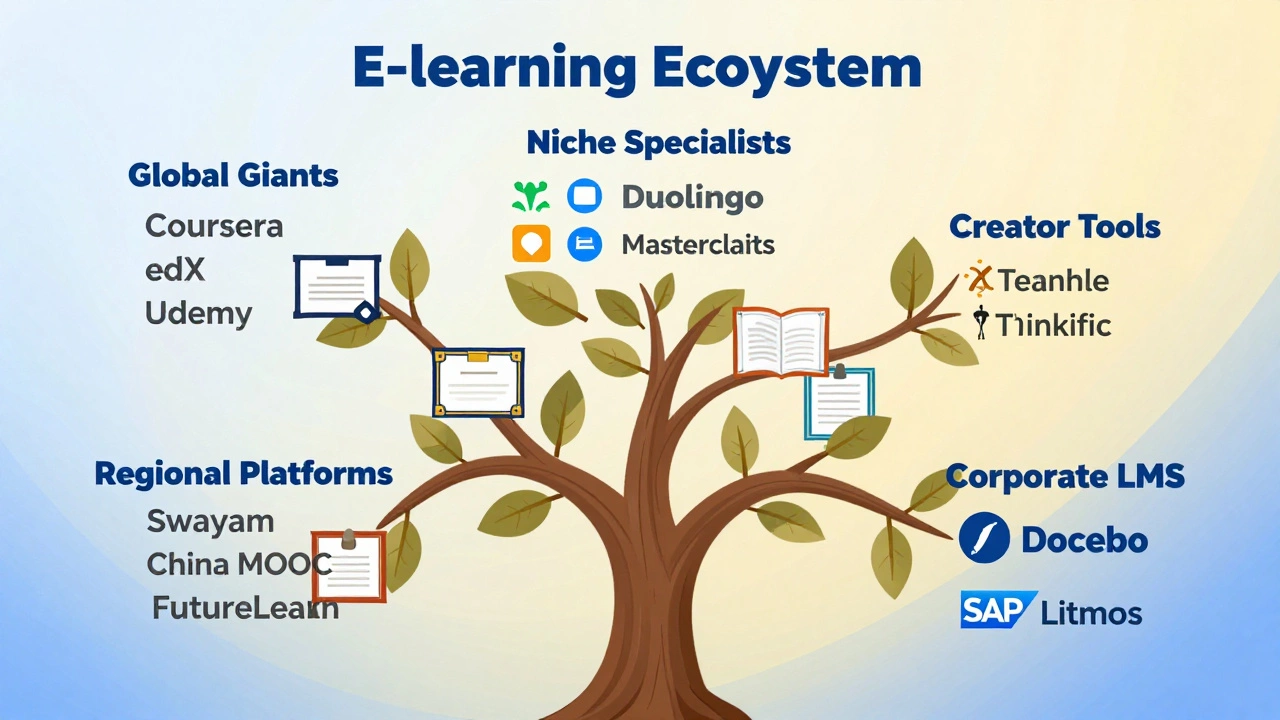
The big players: who’s dominating the space?
You’ve probably heard of a few of these. They’re the giants for a reason:
- Coursera - Partners with 300+ universities and companies. Offers degrees, certificates, and professional training. Used by over 130 million learners.
- edX - Founded by Harvard and MIT. Strong in academic and corporate learning. Known for micro-masters and university credit pathways.
- Udemy - The marketplace model. Over 210,000 courses created by instructors. Great for niche skills like Excel hacks or Photoshop, less so for structured degrees.
- LinkedIn Learning - Built for professionals. Integrates with your profile. Focuses on soft skills, software, and career growth.
- Pluralsight - Heavy on tech. Developers, IT pros, and data teams use this for upskilling. Deep libraries in cloud, security, and coding.
These five alone serve over 400 million users combined. They’re not the only ones, but they’re the ones most institutions trust.
The niche specialists: platforms for specific needs
Beyond the giants, there’s a whole layer of platforms built for very specific audiences:
- Khan Academy - Free, nonprofit, K-12 focused. Used by 120 million students globally. No certificates, but rock-solid curriculum.
- Duolingo - Language learning, gamified. 500 million users. Not a traditional platform, but it counts as digital education.
- Codecademy - Interactive coding. Teaches by doing. Popular with beginners and bootcamp prep.
- MasterClass - Celebrity instructors. Think Gordon Ramsay teaching cooking or Natalie Portman on acting. More inspiration than certification.
- Teachable and Thinkific - Tools for creators to build their own courses. Not learners’ platforms - they’re platforms for teachers.
These aren’t competing with Coursera. They’re filling gaps. Duolingo doesn’t teach Mandarin grammar like a university would. It teaches you to say “I want dumplings” - and that’s enough for millions.
The hidden players: regional and institutional platforms
Most global lists miss these - and that’s a mistake if you’re outside North America or Europe.
- SWAYAM - India’s national platform. Over 18 million users. Offers free courses aligned with Indian university curricula.
- MOOCs in China - Platforms like China University MOOC serve over 100 million learners, mostly in Mandarin.
- FutureLearn - UK-based, popular in Commonwealth countries. Works with universities like the University of London and Monash.
- OpenLearning - Based in Australia, used heavily in Southeast Asia. Focuses on community-driven learning.
If you’re in Brazil, Indonesia, or Kenya, you’re probably using local platforms that never show up on American tech blogs. The global e-learning map is far more diverse than most assume.
How many total platforms exist?
Let’s break it down:
- Major global platforms (15-20): Coursera, edX, Udemy, LinkedIn Learning, Pluralsight, Khan Academy, Duolingo, Codecademy, MasterClass, FutureLearn, OpenLearning, Swayam, China University MOOC, Alison, Skillshare, NovoEd, Canvas (for institutions), Moodle (self-hosted), Blackboard, and Google Classroom (basic).
- Creator tools (10-15): Teachable, Thinkific, Podia, Kajabi, LearnDash, LifterLMS, LearnWorlds, Academy of Mine, Kajabi, Ruzuku.
- Regional platforms (20+): From Japan’s Japan MOOC to Africa’s ALX and Latin America’s Platzi.
- Corporate LMS (10+): SAP Litmos, Docebo, TalentLMS, iSpring Learn - used by companies to train employees.
Add them up? You’re looking at 70-100 platforms that are active, have real users, and are being updated. And that’s just the ones with over 10,000 users. There are hundreds more small, local, or niche tools - like a platform built just for teaching traditional dance in Bali, or a government-run system for rural teachers in Nepal.

Why does this matter?
Knowing the number isn’t useful. What matters is what kind of platform you need.
- Need a degree? Go for Coursera or edX.
- Want to learn Python fast? Codecademy or Udemy.
- Teaching your team? Try Teachable or a corporate LMS.
- Helping kids in rural India? Swayam.
- Learning Spanish while commuting? Duolingo.
The right platform isn’t the biggest one. It’s the one that matches your goal, your budget, and your learning style.
What’s changing in 2026?
Three big shifts are reshaping the landscape:
- AI tutors - Platforms like Coursera and Udemy now offer AI-powered assistants that answer questions, summarize lessons, and adjust pacing in real time.
- Micro-credentials - Instead of 12-week courses, learners now take 3-hour modules that stack into certifications. Think: “AWS Cloud Fundamentals - 2 Hours” with a digital badge.
- Offline access - In regions with spotty internet, platforms like Swayam and ALX now let users download entire courses to phones and sync later.
These aren’t gimmicks. They’re responses to real problems: time poverty, connectivity gaps, and the need for immediate, practical skills.
Final takeaway
There are over 100 digital e-learning platforms in active use today. But you don’t need to know them all. You need to know what kind of learner you are - and what kind of outcome you want. The best platform isn’t the most popular. It’s the one that gets you from where you are to where you want to go - without wasting your time.
Are all e-learning platforms free?
No. Some, like Khan Academy and Swayam, are completely free. Others, like Coursera and Udemy, offer free trials or audit options, but charge for certificates, graded assignments, or degrees. Corporate platforms like LinkedIn Learning usually require a subscription. Always check what’s included before signing up.
Can I trust platforms I’ve never heard of?
Yes - if they’re backed by credible institutions or have clear user reviews. For example, ALX in Africa partners with tech companies like Google and Microsoft. Platforms like Teachable let anyone create courses, so quality varies. Look for accreditation, partner logos, or student testimonials before committing.
Do employers recognize online certificates?
It depends. Certificates from Coursera, edX, or LinkedIn Learning are widely recognized, especially if they come from universities or big companies. Certificates from unknown platforms or self-made courses on Teachable may not carry weight unless you can show real projects or skills. Always pair certificates with a portfolio or work samples.
What’s the difference between a learning platform and an LMS?
A learning platform (like Udemy) is designed for learners to find and take courses. An LMS (Learning Management System), like Moodle or Canvas, is designed for organizations to manage, deliver, and track training - usually for employees or students. Think of it like Amazon vs. a corporate warehouse: one sells to you, the other manages delivery for a group.
Are there e-learning platforms for kids?
Absolutely. Khan Academy Kids, ABCmouse, and Duolingo ABC are built specifically for children under 12. They use games, stories, and rewards to teach reading, math, and logic. Most are designed for parental supervision and avoid ads or data collection.