Recent POST






English Fluency Collocation Challenge
Fluency isn't just about vocabulary; it's about using the right words together naturally. This tool helps you identify common collocations (word partnerships) that native speakers use instinctively. Choose the most natural phrase for each situation.
Loading question...
You know the words. You’ve studied the grammar rules until they’re second nature. Yet, when it’s time to speak, your mind goes blank or you stumble over simple sentences. It’s a frustrating gap between what you know and what you can say. This isn’t about intelligence; it’s about muscle memory and mindset. Speaking English fluently and confidently is a skill you build through specific, actionable habits, not just by memorizing more vocabulary lists.
Fluency is often misunderstood as perfection. In reality, fluency is the ability to communicate ideas smoothly without excessive pauses or mental translation. Confidence comes from competence in handling those moments of uncertainty. When you stop aiming for perfect grammar and start aiming for clear connection, everything changes. Here is how you bridge that gap.
Stop Translating, Start Thinking
The biggest barrier to fluent speech is translating from your native language in real-time. If you hear a question, translate it to your mother tongue, formulate an answer, translate it back to English, and then speak-you are already too slow. The conversation has moved on.
To fix this, you need to train your brain to associate concepts directly with English words. Start small. Look around your room right now. Don’t think "chair" in your native language. See the object and immediately label it "chair." Do this for ten objects. Then, try forming simple sentences. "The chair is blue." "I am sitting on the chair."
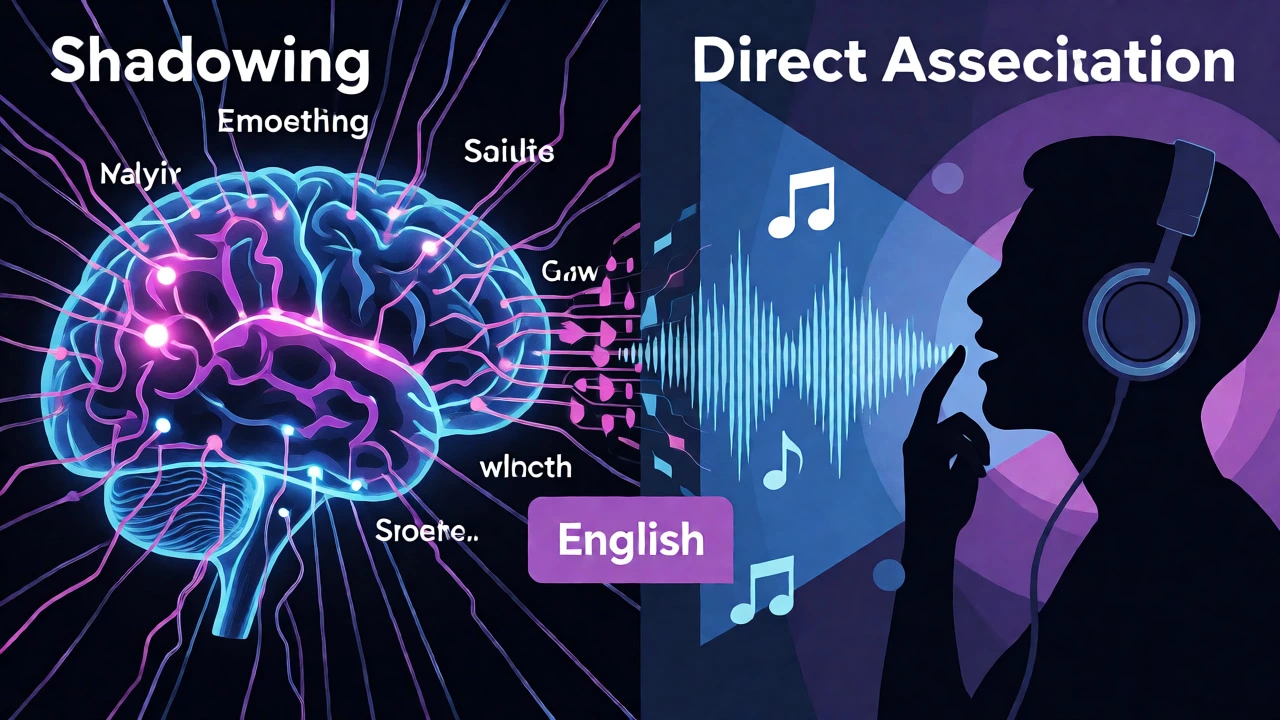
This technique, often called Direct Association, bypasses the translation layer. It feels silly at first, but it rewires your neural pathways. Over time, complex thoughts will begin to form in English because your brain stops treating English as a code to be deciphered and starts treating it as a medium for thought.
Master the Art of Shadowing
If you want to sound natural, you need to copy natural speakers. Textbooks teach you grammar; podcasts and movies teach you rhythm. Enter Shadowing, a technique used by polyglots worldwide. It involves listening to a native speaker and repeating what they say almost simultaneously, like an echo.
Why does this work? Because English is a stress-timed language. We don’t give every syllable equal weight. We stress important words (verbs, nouns) and glide over others (articles, prepositions). Shadowing forces you to mimic this rhythm. You aren’t just learning words; you’re learning the music of the language.
Here’s a simple routine:
- Pick a short audio clip (30-60 seconds) from a TED Talk, podcast, or YouTube video with a transcript.
- Listen once for meaning.
- Listen again while reading the transcript.
- Play the audio and speak along with the speaker, matching their speed, tone, and pauses.
- Record yourself doing this and compare it to the original.
Do this for ten minutes a day. Within weeks, your intonation will shift from robotic to conversational.
Embrace the Pause
Non-native speakers often fear silence. They fill gaps with "um," "uh," or rapid-fire filler words like "actually" or "basically." Native speakers pause too, but they do it strategically. A pause gives you time to think and signals to the listener that you are in control.
Confidence isn’t about talking fast. It’s about being comfortable with silence. When you feel stuck, stop. Take a breath. Say, "Let me think about that for a second," or simply pause. This buys you cognitive space to construct your next sentence properly. It makes you sound thoughtful rather than panicked.
Learn Chunks, Not Just Words
Memorizing isolated words is inefficient. Language works in blocks. These are called Collocations or lexical chunks. For example, we don’t say "do a mistake"; we say "make a mistake." We don’t say "big rain"; we say "heavy rain."
When you learn phrases as single units, your brain retrieves them faster. Instead of constructing "I + have + got + a + question," you retrieve the chunk "I’ve got a question." This speeds up processing and reduces errors.
| Literal Translation Attempt | Natural English Chunk | Why It Works Better |
|---|---|---|
| Make a photo | Take a photo | Fixed verb-noun pairing |
| Have a shower | Take a shower | Regional standard usage |
| Big success | Great success | Stronger collocation |
| Ask a question | Ask a question | Standard phrase |
| Do homework | Do homework | Correct, but "finish homework" is also common |
Start keeping a notebook specifically for these chunks. When you hear a phrase you like, write down the whole thing. Review these notes before speaking opportunities.
Create Low-Stakes Practice Environments
You won’t get confident by only practicing with teachers who correct every error. You need safe spaces where mistakes don’t matter. Join online communities, language exchange apps, or local meetups where the goal is communication, not accuracy.
Talk to yourself. It sounds strange, but narrating your day out loud helps. "I’m making coffee. I need sugar. Where is the spoon?" This builds the habit of producing speech without the pressure of an audience. Once you’re comfortable talking to yourself, move to talking to pets, plants, or recording voice memos.
For many learners, especially those preparing for exams like IELTS or TOEFL, structured practice is key. Consider joining an English Course that focuses on conversation rather than just grammar drills. Look for programs that offer live feedback and peer interaction.

Overcome the Fear of Judgment
Perfectionism is the enemy of progress. Many learners stay silent because they are afraid of sounding stupid. But here’s the truth: most people are too busy worrying about themselves to judge your accent or grammar. Even if they do notice a mistake, they rarely remember it five minutes later.
Shift your focus from "How do I sound?" to "Did they understand me?" If the message was received, you succeeded. Accent is part of your identity; it doesn’t need to disappear. Clarity matters more than sounding like a native speaker from London or New York.
Consistency Beats Intensity
You don’t need to study English for three hours a day. You need to engage with it for fifteen minutes daily. Consistency keeps the neural pathways active. Skipping days causes rust to set in quickly.
Build micro-habits into your routine. Listen to an English podcast during your commute. Read one article in English during lunch. Write a three-sentence journal entry before bed. These small actions compound over time, leading to significant gains in fluency and confidence.
Frequently Asked Questions
How long does it take to become fluent?
There is no fixed timeline, as it depends on your starting level, exposure, and practice intensity. However, consistent daily practice of 30 minutes can lead to noticeable improvements in confidence within 3-6 months. Fluency is a journey, not a destination.
Does my accent matter for fluency?
No. An accent indicates your background and does not hinder fluency. As long as you are intelligible and understandable, your accent is fine. Focus on clarity and rhythm rather than trying to erase your native phonetics completely.
What if I make grammar mistakes while speaking?
Native speakers make grammar mistakes too. Small errors rarely impede understanding. Prioritize flow and connection. Correct major errors that change meaning, but let minor slips go to maintain confidence and momentum.
Is watching movies enough to improve speaking?
Watching improves listening and vocabulary, but it is passive. To improve speaking, you must actively produce language. Combine movie watching with shadowing techniques and active conversation practice to see results in your own speech.
How do I find conversation partners?
Use language exchange apps like Tandem or HelloTalk, join local meetup groups, or enroll in online English courses that include live sessions. Libraries and community centers often host free conversation clubs as well.