Recent POST




Education Pathway Calculator
This calculator helps you understand which educational system (CBSE or American) might be better suited for your goals and preferences. Select your priorities to get personalized recommendations based on the article content.
What are your primary goals?
What are your personal preferences?
Parents in India often ask: is the American syllabus easier than CBSE? The answer isn’t simple. It depends on what you mean by ‘easier.’ If you’re thinking about less homework, fewer exams, or more freedom to choose subjects, then yes - the American system often feels lighter. But if you’re measuring depth in math and science, or how well it prepares students for competitive exams like JEE or NEET, then CBSE might be the tougher, and more focused, path.
What CBSE Actually Teaches
CBSE stands for Central Board of Secondary Education. It’s the most common school board in India, used by over 20,000 schools. Its syllabus is standardized, tightly structured, and built around national exams. From Class 6 onward, students follow a clear progression: Physics, Chemistry, and Biology are separate subjects by Class 8. Math gets harder fast - by Class 10, students solve quadratic equations, trigonometry, and coordinate geometry. By Class 12, they’re doing calculus, electrostatics, and organic reaction mechanisms.
There’s little room for choice. If you’re in the science stream, you take all five core subjects: Physics, Chemistry, Biology/Mathematics, English, and a fifth subject (like Computer Science or Physical Education). No electives. No switching tracks mid-year. The exam pattern is rigid: 80% written exam, 20% internal assessment. And yes - the board exams in Class 10 and 12 are high-stakes. They affect college admissions, scholarship eligibility, and even job interviews in some cases.
CBSE doesn’t just teach content. It teaches discipline. Students learn to memorize formulas, write answers in strict formats, and manage time under pressure. This works well for India’s competitive exam culture - JEE, NEET, AIIMS, and government entrance tests all expect this kind of preparation.
How the American System Works
The U.S. doesn’t have a national curriculum. Each state sets its own standards, and even schools within a district can vary. But most public schools follow the Common Core State Standards - a set of guidelines for math and English, not science or history. That means you’ll find wide differences in what’s taught.
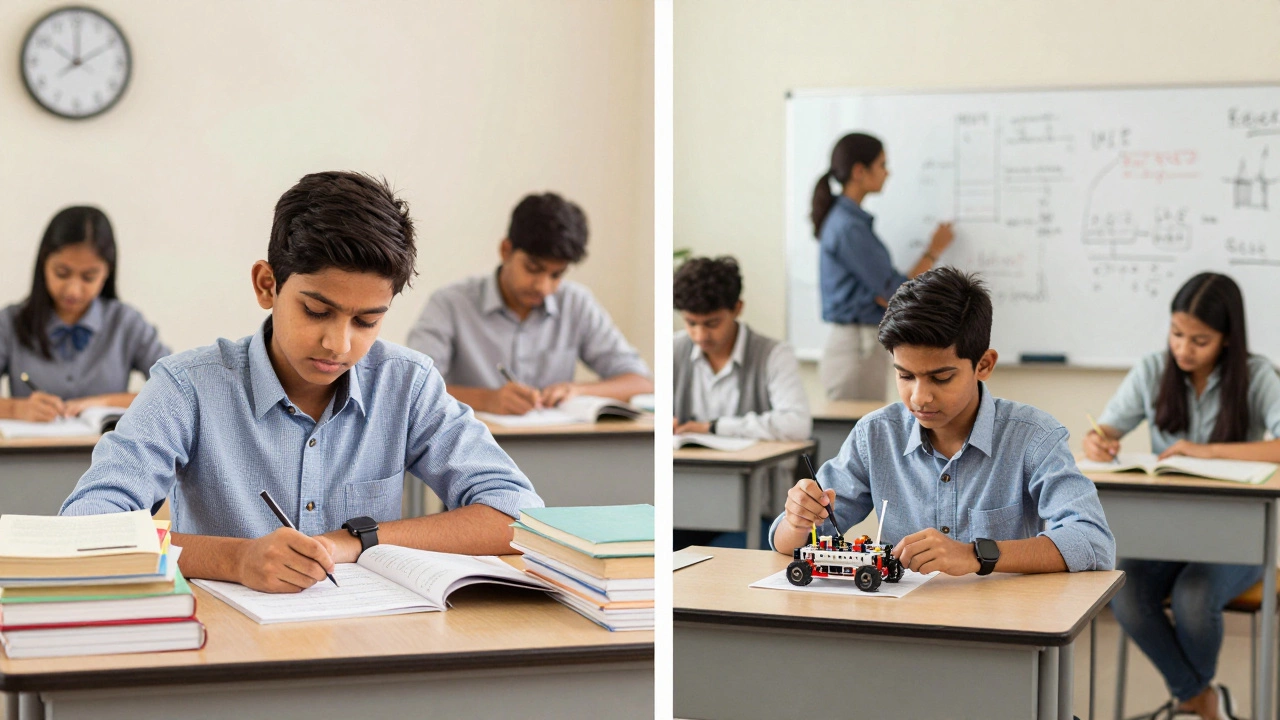
In American high schools, students typically take four years of English, three years of math (often Algebra I, Geometry, Algebra II), two to three years of science (Biology, Chemistry, sometimes Physics), and social studies. But here’s the big difference: students pick electives. Want to take photography, robotics, or film studies? You can. Want to drop Physics and take Psychology instead? Often, yes.
Assessment is spread out. There are no single, make-or-break final exams. Instead, grades come from homework, class participation, projects, quizzes, and midterm/final tests - each worth a small percentage. A student who slacks off in January can still pull up their grade by working hard in April. That’s not possible in CBSE.
Also, U.S. schools focus on critical thinking over rote learning. A history question might ask: “How did the Industrial Revolution change family life?” instead of “When was the Industrial Revolution?”
Math and Science: Who’s Deeper?
This is where the comparison gets sharp.
CBSE’s Class 12 Math syllabus includes: Limits and Derivatives, Integrals, Differential Equations, Vector Algebra, and Probability. That’s college-level calculus. In contrast, most U.S. high schools stop at Pre-Calculus or AP Calculus AB - which covers only the first half of college calculus. Even AP Calculus BC, the advanced version, doesn’t go as deep into applications as CBSE does.
Same with Physics. CBSE students learn topics like electromagnetic induction, alternating current circuits, and semiconductor devices in Class 12. U.S. students might cover these in AP Physics C - but only if they choose it. Most don’t. In fact, a 2023 National Science Foundation report found that only 12% of U.S. high school seniors take AP Physics. In India, nearly 70% of CBSE Class 12 students take Physics as a core subject.
CBSE students spend more hours on math and science. They’re expected to solve 50+ problems a week. U.S. students might solve 10-15. The workload isn’t just about quantity - it’s about complexity.

Language and Communication: Who’s Better Prepared?
CBSE teaches English as a subject, not as a medium of thinking. Students learn grammar rules, literature, and how to write essays in a formal structure. But they rarely debate, present, or write creatively in English outside class.
In the U.S., English class is about expression. Students write personal narratives, give oral presentations, analyze films, and argue positions in class discussions. They’re graded on clarity, originality, and voice - not just correct punctuation. That’s why many Indian students who move to U.S. colleges struggle with essays and group projects. They know grammar, but not how to think in English.
On the flip side, CBSE students often have stronger writing discipline. They can write a 500-word essay in 40 minutes with clear structure. U.S. students might take days to draft a 300-word reflection.
Stress, Pressure, and Mental Health
CBSE’s exam system is intense. One test in Class 10 can determine whether you get into a top school. One test in Class 12 can decide your engineering or medical college. That pressure leads to anxiety, sleep loss, and burnout - a reality backed by multiple Indian mental health studies since 2020.
The U.S. system isn’t stress-free. College admissions are competitive. SAT/ACT scores, extracurriculars, and recommendation letters matter. But there’s no single exam that defines your future. A bad grade in one class doesn’t ruin your chances. You can retake the SAT. You can switch majors. You can start at a community college.
Many U.S. schools now have mandatory counseling hours and mindfulness programs. CBSE schools are slowly adding mental health resources, but they’re not standard yet.

Which One Prepares You Better for College?
If you’re aiming for Indian universities - especially IITs, AIIMS, or NITs - CBSE is the clear path. The syllabus matches the entrance exams. The exam pattern trains you for the format. You’ll be ahead of students from other boards.
If you’re planning to study abroad - especially in the U.S., Canada, or the UK - the American system gives you an edge. U.S. colleges look for well-rounded students: someone who plays violin, volunteers at a shelter, and wrote a research paper on climate change. CBSE students often have stellar grades but fewer extracurriculars.
But here’s the catch: many Indian students on the American curriculum still take JEE. They’re stuck between two systems. They study for AP Physics while also grinding through HC Verma. They write college essays while memorizing the periodic table. That’s exhausting.
Real Stories, Real Trade-offs
Meet Priya. She studied CBSE in Delhi, scored 95% in Class 12, and got into IIT Delhi. She now works as a software engineer. She says: “I hated the pressure, but I learned to push through. That discipline helped me in my job.”
Then there’s Arjun. His family moved to Texas when he was 14. He switched from CBSE to the American system. He took AP Calculus, joined debate club, and built a robot for science fair. He got into Stanford. He says: “I didn’t know I could think like this until I stopped memorizing and started asking questions.”
Neither path is better. One is harder on the body. The other is harder on the mind.
What Should You Choose?
Ask yourself these questions:
- Do you want to study in India? Then CBSE gives you the clearest, fastest route to top colleges.
- Are you planning to study abroad? The American system builds skills colleges look for - but you’ll need to supplement it with math and science prep if you want to compete for STEM programs.
- Do you thrive under structure? CBSE suits you. Do you need freedom to explore? The American system gives you space.
- Can you handle 10+ hours of study a day? CBSE demands it. Can you manage your own time? The U.S. system expects it.
There’s no universal ‘easier’ path. Only the path that fits your goals.
Is CBSE harder than the American curriculum?
Yes, in terms of academic rigor - especially in math and science. CBSE covers more advanced topics earlier, with heavier workloads and high-stakes exams. The American system is less intense in content depth but more demanding in critical thinking and self-management.
Can a CBSE student switch to the American system?
Yes, but it’s challenging. CBSE students often need to catch up on English writing, project-based learning, and class participation. They may also need to retake standardized tests like the SAT or TOEFL. Schools in the U.S. usually accept CBSE transcripts, but students should prepare for a shift in teaching style.
Which system is better for IIT JEE preparation?
CBSE is far better. The JEE syllabus is based directly on CBSE Class 11 and 12 textbooks. Concepts like integration, thermodynamics, and organic chemistry are taught at the same depth. Students from other boards often need extra coaching to match CBSE’s level.
Do U.S. colleges prefer CBSE or American curriculum students?
U.S. colleges don’t prefer one over the other. They look for strong grades, challenging courses, and well-rounded profiles. A CBSE student with high scores in JEE-level math and science, plus leadership or research, can be just as competitive as a U.S. student. The key is showing depth and initiative, not just the board name.
Is the American curriculum cheaper than CBSE?
Not necessarily. Public schools in the U.S. are free for residents, but international students pay tuition - often $15,000-$30,000 per year. CBSE schools in India range from ₹20,000 to ₹1,50,000 annually. So for Indian families, CBSE is usually more affordable - unless they’re living abroad.