Recent POST





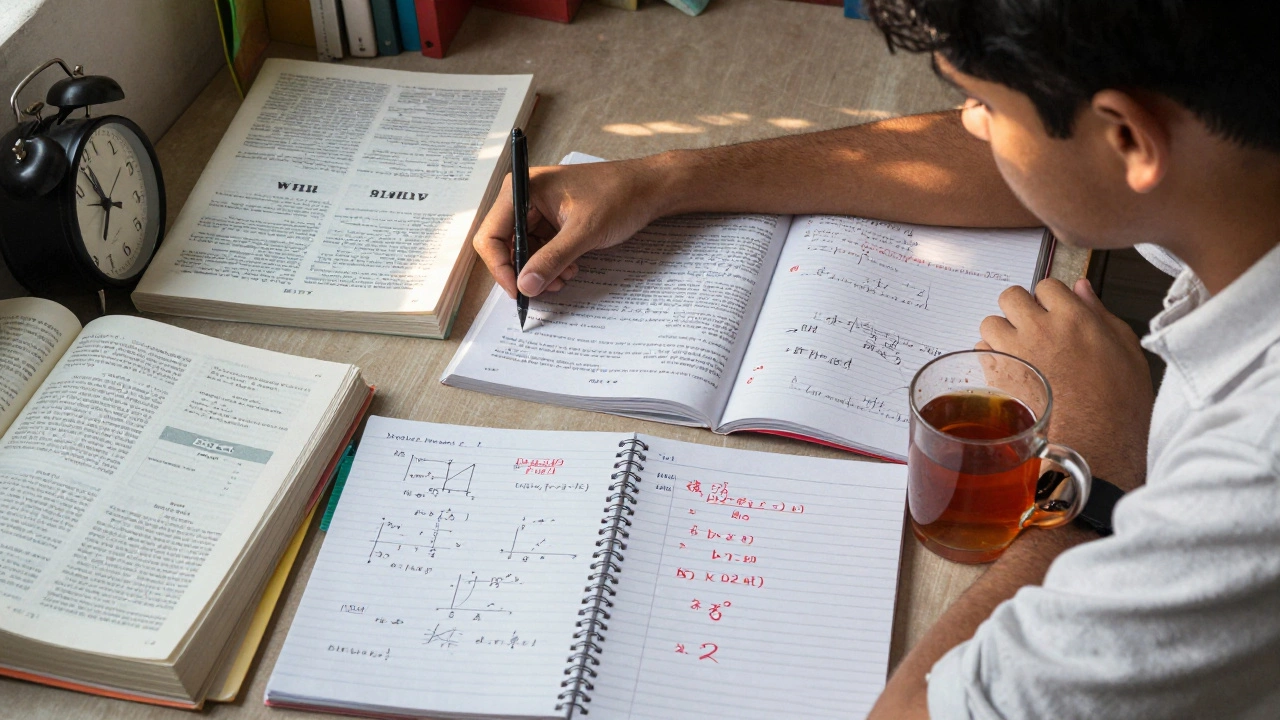
Starting IIT JEE preparation too late is one of the biggest mistakes students make. Many think they can cram in Class 12, but the truth is, the syllabus is too heavy, the competition too fierce, and the mindset too complex to build in just one year. The real window to get ahead opens in Class 11 - and for some, even earlier.
Why Class 11 Is the Real Starting Point
IIT JEE doesn’t test what you memorized last night. It tests how deeply you understand physics, chemistry, and math - concepts that are built over time. Class 11 introduces foundational topics like Newton’s laws, chemical bonding, and quadratic equations - the very building blocks of JEE Advanced. If you don’t get these right in Class 11, Class 12 becomes a scramble.
Take thermodynamics in chemistry. In Class 11, you learn the basics: enthalpy, entropy, laws of thermodynamics. In Class 12, you apply them to electrochemistry and equilibrium problems. Skip the foundation? You’ll be guessing on JEE questions instead of solving them.
Math is even clearer. Trigonometry and coordinate geometry in Class 11 are used everywhere in calculus and vectors in Class 12. If you’re shaky on sin(A+B) formulas or the equation of a tangent to a circle, you’ll lose time - and marks - in JEE. There’s no time to go back.
What About Class 10? Is It Too Early?
Class 10 isn’t the official start, but it’s the perfect time to build habits. Students who begin thinking like JEE aspirants in Class 10 have a massive edge. They start solving problems differently - not just to finish homework, but to understand why a formula works.
For example, instead of memorizing the quadratic formula, they derive it. Instead of learning Ohm’s Law as V=IR, they ask: Why does resistance increase with length? This shift in thinking takes months to develop. Starting in Class 10 gives you that time.
Also, Class 10 math and science are the closest to JEE’s basic level. If you can handle NCERT Class 10 problems with speed and accuracy, you’re already ahead of 70% of Class 11 students who struggle with the same topics.
What Should You Do in Class 11?
Class 11 is where strategy matters more than effort. Here’s what works:
- Stick to NCERT first - Seriously. Most coaching institutes push advanced books too early. But if you can’t solve every NCERT question in physics and chemistry without help, you’re not ready for advanced material. NCERT is the base. JEE questions are built on it.
- Focus on concepts, not shortcuts - Don’t learn tricks like “plug in values” for calculus problems. Learn how limits work. Understand why integration finds area. JEE now tests conceptual clarity, not pattern recognition.
- Start solving previous year questions - Not in Class 12. Start in December of Class 11. Look at JEE Main 2020-2024 papers. See how often they repeat types of questions - like the same kind of pulley system in physics or the same organic reaction mechanism in chemistry.
- Build a mistake journal - Write down every error you make, even small ones. Did you forget the negative sign in a vector? Did you mix up sigma and pi bonds? Review this weekly. Top scorers don’t study more - they make fewer repeat mistakes.
- Don’t skip biology topics in chemistry - Even if you’re aiming for engineering, biochemistry, polymers, and biomolecules appear in JEE. They’re easy marks if you’ve seen them before.

Coaching or Self-Study?
There’s no one-size-fits-all answer. But here’s what actually happens:
- If you’re in a top school with strong teachers and disciplined peers, self-study with good books (like HC Verma, OP Tandon, RD Sharma) works fine. Many IITians came from small towns with no coaching.
- If you’re easily distracted, need structure, or your school doesn’t cover JEE-level depth, coaching helps. But choose wisely. Avoid institutes that push 12-hour days or sell fake “IIT toppers’ notes.” Look for ones that focus on doubt-clearing, not just lectures.
- Hybrid is the new standard: Online lectures for theory (like Unacademy or BYJU’S) + local coaching for problem-solving + self-study for revision.
Remember: Coaching doesn’t make you smart. Your consistency does.
Common Mistakes to Avoid
Here are the mistakes most students make in Class 11 - and how to dodge them:
- Waiting for Class 12 to start serious prep - By then, you’re already behind. The syllabus is 60% Class 11 content.
- Doing too many books at once - One good physics book + one good chemistry book + one math book is enough. Jumping between 5 books just creates confusion.
- Ignoring weak topics - If you hate permutations and combinations, don’t skip them. They’re in JEE every year. Face them early.
- Measuring progress by hours studied - Studying 8 hours with distractions is worse than 3 focused hours. Track concepts mastered, not time logged.
- Comparing yourself to others - One student learns 10 topics fast. Another learns 3 deeply. The second wins in JEE. Depth beats speed.
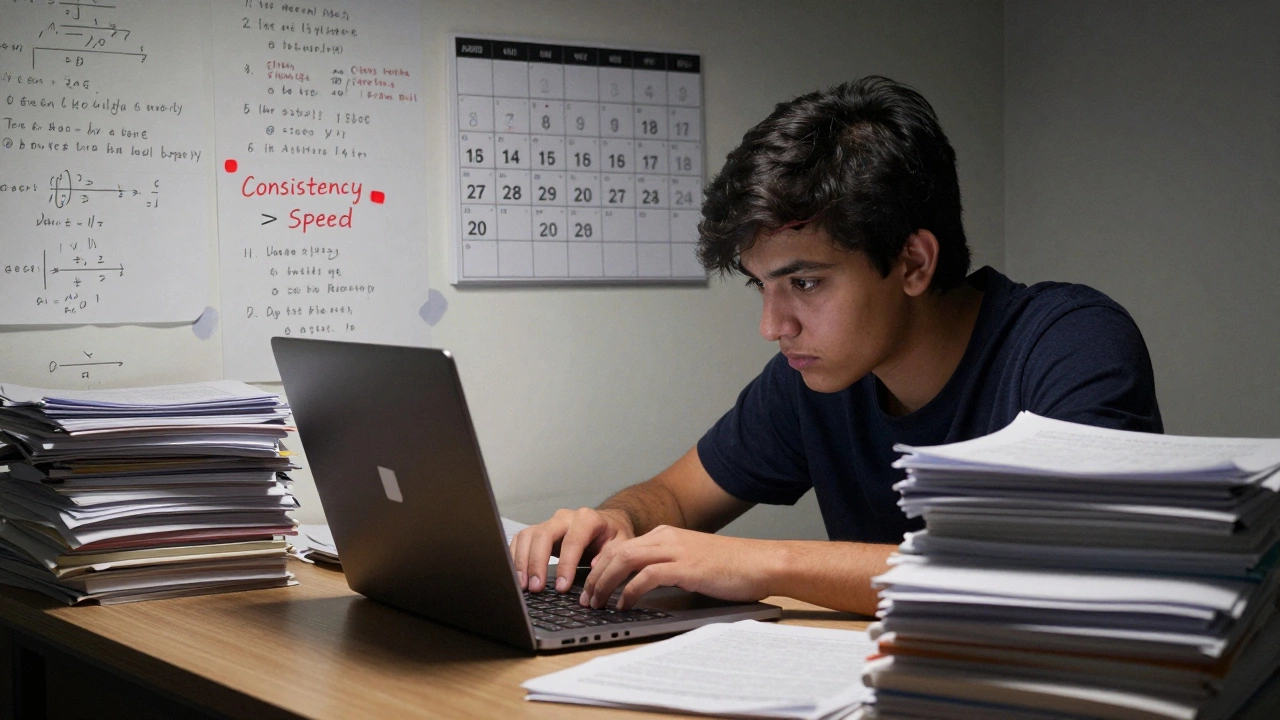
Timeline: What to Do Month by Month in Class 11
Here’s a realistic plan:
- April-June - Complete NCERT Physics, Chemistry, and Math for Class 11. Solve all in-text and back exercises.
- July-August - Start previous year JEE Main questions (2019-2021). Focus on understanding patterns.
- September-October - Take your first mock test. Don’t worry about the score. See where you’re weak.
- November-December - Revise weak topics. Start a mistake journal.
- January-March - Solve JEE Main 2022-2024 papers under timed conditions. Build speed and accuracy.
By the end of Class 11, you should be able to solve 80% of JEE Main questions without help. That’s the goal.
What If You’re Already in Class 12?
It’s harder - but not impossible. You’ll need to do two things at once: finish Class 11 syllabus and learn Class 12. Prioritize:
- First 2 months: Complete all Class 11 NCERTs and basic problems.
- Next 3 months: Focus on high-weightage topics - Mechanics, Electrostatics, Organic Chemistry, Calculus.
- After that: Full mock tests every week. Analyze every mistake.
Many students crack JEE from Class 12. But they didn’t waste time. They cut distractions, dropped social media, and treated every day like a race.
Can I start IIT JEE preparation in Class 10?
Yes, and it’s a smart move. Class 10 is the best time to build strong fundamentals in math and science. Focus on understanding concepts deeply, not just memorizing formulas. Solve NCERT problems until you can do them quickly and accurately. This sets you up for success in Class 11 without starting from zero.
Is coaching necessary for IIT JEE preparation?
No, coaching isn’t necessary - but structure is. Many top rankers studied on their own using NCERT, HC Verma, and previous papers. If you’re self-disciplined and can create a study plan, you can succeed without coaching. If you need accountability, doubt-solving, or test series, then coaching helps. Choose quality over quantity.
Which books should I use for IIT JEE in Class 11?
Start with NCERT for all three subjects. Then, for physics, use HC Verma. For chemistry, use OP Tandon for theory and MS Chouhan for organic problems. For math, RD Sharma is enough for basics; move to Cengage or Arihant once you’re comfortable. Don’t collect books - master them.
How many hours should I study daily in Class 11?
Quality matters more than quantity. Aim for 4-6 focused hours daily. That includes school, self-study, and revision. Two hours of deep problem-solving beats six hours of passive reading. Use the Pomodoro technique - 25 minutes focused, 5 minutes break - to stay sharp.
Can I crack IIT JEE without joining any coaching institute?
Absolutely. Many IITians have cracked JEE without coaching. They used free YouTube lectures, NCERT, previous year papers, and online test series. The key is consistency. If you study daily, review mistakes, and test yourself regularly, coaching adds little value. Your discipline is your biggest advantage.
Final Thought: It’s Not About When You Start - It’s About How You Stick With It
The best class to start IIT JEE prep isn’t a magic number. It’s the class where you decide to stop waiting and start building. Whether you’re in Class 10, 11, or even 12, the only thing that matters is this: Are you solving one problem better today than yesterday? Are you learning from your mistakes? Are you staying consistent?
IIT JEE isn’t won by the smartest. It’s won by the most persistent. Start where you are. Use what you have. Do what you can. And don’t look back.