Recent POST





MBA ROI & Break-Even Calculator (2026)
Your Financial Profile
Analysis Result
Strategic Insight:
Enter your financial details to see if an MBA is a smart investment in 2026.
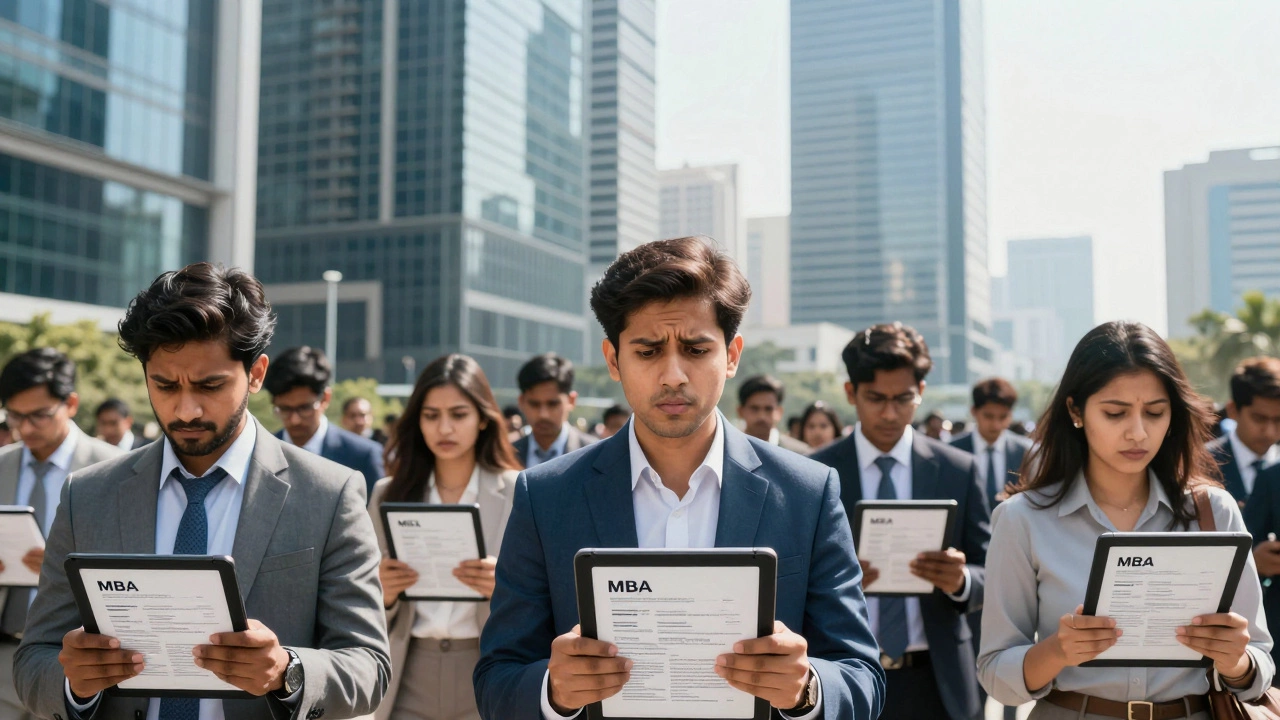
Walk into any major city in 2026, and you will see the same thing: a sea of resumes with MBA degrees from top-tier programs. The narrative is loud. People say the market is flooded. They claim the degree is worthless because everyone has one. If you are sitting on the fence about applying to business school, this noise is probably keeping you up at night. Is the return on investment dead? Or is it just that the old playbook doesn't work anymore?
The short answer is no, the MBA is not oversaturated in terms of value, but it is saturated in terms of mediocrity. The days when a generic master's in business administration guaranteed a corner office and a six-figure salary out of the gate are over. That era ended around 2015. Today, the degree is a tool, not a ticket. Its value depends entirely on how you wield it, where you get it, and what industry you target. Let’s cut through the hype and look at the data driving the current landscape.
The Myth of Saturation vs. The Reality of Supply
When people talk about saturation, they usually mean there are too many graduates chasing too few jobs. But if you look at the numbers, that isn’t quite right. According to recent labor market analysis, demand for mid-to-senior level management roles continues to grow, particularly in sectors like technology, healthcare, and renewable energy. The issue isn’t the number of jobs; it’s the mismatch between what schools teach and what companies need.
In 2026, employers are less interested in your ability to calculate break-even points manually. They want leaders who can navigate digital transformation, manage remote global teams, and understand data analytics. Traditional curricula often lag behind these shifts. If you attend a program that still relies heavily on case studies from the early 2000s without integrating modern AI tools or sustainability frameworks, you are entering a saturated pool of outdated skills. However, if you choose a program that emphasizes agile leadership and tech-fluency, you are entering a niche with high demand and low supply.
Consider the difference between a generalist MBA and a specialized track. A generalist degree might feel crowded because thousands of graduates compete for broad "management trainee" roles. But an MBA with a concentration in Business Analytics or Healthcare Administration faces significantly less competition. The saturation is real only for those who refuse to specialize.
Who Actually Benefits from an MBA in 2026?
Not everyone needs an MBA. In fact, for some profiles, the opportunity cost is simply too high. To determine if the degree makes sense for you, we need to look at three distinct personas who currently derive the most value from business school.
- The Career Switcher: You have five years of experience in engineering or marketing, but you want to move into product management or strategy. An MBA provides the credential and the network to make that jump. Without it, hiring managers often view lateral moves as risky. With it, you signal competence in business fundamentals.
- The Accelerator: You are already in management but hit a ceiling. You have the technical skills, but you lack the strategic vision or the executive presence to reach the C-suite. Here, the MBA acts as a validator. It fills gaps in financial acumen and organizational behavior that self-study rarely covers effectively.
- The Entrepreneur: You plan to start a company. While you don’t need an MBA to launch a startup, the alumni network and access to venture capital contacts can be invaluable. Programs like Stanford GSB or MIT Sloan offer ecosystems that are hard to replicate elsewhere.
If you fall outside these categories-say, you are a fresh graduate with no work experience-the ROI drops sharply. Entry-level roles rarely require an MBA, and the debt burden can delay your financial independence by a decade. For recent grads, gaining two to three years of practical experience is almost always a better investment than tuition fees.

The ROI Calculation: Debt vs. Earnings
Let’s talk money. This is the core of the saturation argument. If the salary bump doesn’t justify the cost, the degree is a bad deal. In 2026, the average starting salary for graduates from top-ranked programs (like Harvard Business School or Wharton) remains strong, often exceeding $170,000 annually including bonuses. However, the median salary for graduates from unranked or regional programs hovers closer to $85,000.
Now, factor in the cost. Tuition at elite schools can range from $160,000 to $200,000 for two years. When you add living expenses, especially in cities like New York or San Francisco, the total cost approaches $250,000. For a graduate from a lower-tier school earning $85,000, paying back $150,000 in student loans takes more than ten years, even before interest accrues.
| Metric | Top-Tier Program | Regional/Average Program |
|---|---|---|
| Average Tuition (2 Years) | $180,000 | $60,000 |
| Median Starting Salary | $175,000 | $85,000 |
| Break-Even Point (Years) | 3-4 Years | 8-10 Years |
| Network Value | High (Global Access) | Medium (Local Focus) |
This table illustrates why the "saturation" fear is misplaced. The market isn’t saturated with valuable MBAs; it’s saturated with expensive, low-return ones. If you attend a prestigious school, the brand name opens doors that remain closed otherwise. Recruiters filter candidates by school reputation. If you attend a lesser-known institution, you must work twice as hard to prove your worth, and the salary premium shrinks dramatically.
Alternatives to the Traditional MBA
Because the traditional two-year residential MBA is so costly and time-intensive, alternatives have exploded in popularity. These options challenge the dominance of the classic degree and offer different paths to similar outcomes.
- Executive MBA (EMBA): Designed for professionals with 10+ years of experience. You keep your job while studying. The tuition is high, but since you aren’t losing income, the net cost is lower. The network is stronger because peers are senior leaders.
- Online MBA: Schools like Indiana University Kelley and University of Illinois Gies have built robust online programs. These are ideal for working professionals who need flexibility. The accreditation is the same, but the networking opportunities are weaker unless you actively participate in virtual events.
- Micro-Credentials and Certificates: Platforms like Coursera and edX offer certificates in specific skills like data science or digital marketing. These are cheap and fast but lack the holistic business perspective of an MBA. They are great for upskilling, not for career pivoting.
In 2026, employers are increasingly accepting these alternatives. A candidate with an EMBA from a reputable school is often viewed more favorably than a fresh MBA grad because they bring proven experience. If your goal is simply to learn finance or marketing, a certificate might suffice. But if you want leadership credibility, the full degree still holds weight.

How to Avoid the "Saturated" Trap
If you decide to pursue an MBA, you must treat it as a strategic investment, not a default step. Here is how to ensure you stand out in a crowded field.
Choose the Right Fit, Not Just the Rank. A top-20 school in Europe might be better for international careers than a top-10 school in the US focused on local banking. Research the employment reports. Where do graduates actually go? If 80% of them end up in consulting, but you want to work in tech, that school is a poor fit regardless of its prestige.
Leverage the Network Early. The biggest mistake students make is waiting until graduation to use their alumni network. Start connecting during orientation. Attend industry clubs. Schedule informational interviews with alumni in your target sector. Your network is the primary asset you buy with tuition. If you don’t activate it, you’ve wasted half the price tag.
Specialize Strategically. General management is a commodity. Specialized knowledge is scarce. Combine your MBA with technical skills. Learn Python for data analysis. Understand blockchain for supply chain efficiency. Get certified in project management (PMP). This hybrid profile makes you resilient against market fluctuations and less susceptible to the "oversaturated" label.
Negotiate Aggressively. Don’t accept the first job offer. Use multiple offers to negotiate salary, signing bonuses, and relocation packages. In 2026, the job market is competitive for talent. Companies know good candidates have options. Exercise that power. A $10,000 difference in starting salary compounds significantly over a career.
Final Thoughts on the MBA Landscape
The MBA is not dead, nor is it universally oversaturated. It is evolving. The degree rewards specificity, effort, and strategic choice. It punishes passivity and generic expectations. If you approach it with a clear goal, select a program that aligns with your industry, and leverage the network aggressively, the ROI remains compelling. If you expect the degree to magically fix a lack of direction or work ethic, you will join the crowd of disappointed graduates complaining about saturation.
Ultimately, the market saturates with people who blend in. It never saturates with people who stand out. Your MBA can be the platform for that distinction, but only if you build something unique on top of it.
Is an MBA worth it in 2026?
An MBA is worth it in 2026 if you attend a reputable program and have a clear career goal, such as switching industries or accelerating into senior leadership. The ROI is highest for those who leverage the network and specialize in high-demand fields like tech or healthcare. For generalists or those attending low-ranked schools, the debt may outweigh the benefits.
Are there too many MBA graduates?
There is a surplus of generic MBA graduates, but a shortage of skilled business leaders with specialized expertise. The market is saturated with candidates who lack practical skills or industry focus. Differentiating yourself through specialization and active networking mitigates this risk.
What is the best alternative to an MBA?
The best alternative depends on your goals. For experienced professionals, an Executive MBA (EMBA) offers similar networking without leaving your job. For skill acquisition, micro-credentials in data analytics or digital marketing are cost-effective. For career switchers, a specialized Master’s in Finance or Data Science may provide a higher immediate ROI.
Does an MBA guarantee a higher salary?
No, an MBA does not guarantee a higher salary. Graduates from top-tier schools typically see significant salary increases, often doubling their pre-MBA income. However, graduates from lower-ranked schools may see modest bumps that take years to offset tuition costs. Individual performance and negotiation skills play a larger role than the degree alone.
Should I get an MBA if I have no work experience?
Generally, no. Most top MBA programs require 2-5 years of work experience. Admissions committees value professional maturity and peer learning. Additionally, entry-level jobs rarely require an MBA, making the debt burden difficult to justify. Gain practical experience first, then pursue the degree to accelerate your career.