Recent POST






IIT Branch Predictor
Predict Your IIT Branch
Enter your JEE Advanced rank and category to see your possible options
How It Works
Our tool uses historical data from 2024 to predict your likely admission options. Remember: Cutoffs vary yearly based on exam difficulty and student performance.
Getting into an IIT isn’t about scoring 90% in your board exams. It’s about beating over a million students for fewer than 20,000 seats across all IITs. The rank you need isn’t fixed-it changes every year based on how hard the exam was and how many students scored close to the top. But here’s what actually matters: if you’re aiming for the top IITs like Bombay, Delhi, or Madras, you need to be in the top 1,000 ranks in JEE Advanced. For newer IITs or less competitive branches, you might make it with a rank under 10,000.
How JEE Rank Works
JEE has two parts: Main and Advanced. You must clear JEE Main to even sit for JEE Advanced. Your JEE Main score doesn’t directly decide your IIT admission-it only qualifies you. The real game is JEE Advanced. That’s where your rank is calculated, and that’s the only rank that matters for IITs.
Your JEE Advanced rank is based on your raw score, normalized across all shifts, and then compared to every other candidate. If 1.2 million students take JEE Main and only 250,000 qualify for Advanced, then your rank among those 250,000 is what counts. In 2024, the top 25,000 ranks in JEE Advanced were eligible for IIT admissions. But not all of them got into the IITs they wanted.
What Rank Do You Need for Top IITs?
Here’s the reality check. If you want Computer Science at IIT Bombay or IIT Delhi, you’re competing with the top 150-300 ranks. In 2024, the closing rank for CSE at IIT Bombay was 142 for the General category. At IIT Delhi, it was 211. For IIT Madras, it was 298.
For Electrical Engineering, the numbers are a little more forgiving. At IIT Bombay, the last admitted student in 2024 had rank 567. At IIT Kanpur, it was 789. If you’re okay with Mechanical Engineering at newer IITs like IIT Jodhpur or IIT Palakkad, you can get in with a rank around 4,000-6,000.
Don’t assume a rank under 10,000 guarantees an IIT. In 2024, over 18,000 students got ranks under 10,000, but only about 16,500 seats were available across all IITs. That means 1,500 students with ranks under 10,000 didn’t get in. Competition isn’t just about your score-it’s about your branch choice.
Branch Matters More Than IIT
Many students think getting into any IIT is the goal. But that’s a mistake. The difference between IIT Delhi CSE and IIT Guwahati Civil Engineering is massive in terms of job offers, placements, and future opportunities. A rank of 8,000 might get you into IIT Roorkee for Civil, but the same rank at IIT Hyderabad could land you in Data Science.
Check the previous year’s closing ranks for your preferred branch. Don’t just look at the IIT name. In 2024, IIT Indore’s Electronics and Communication Engineering closed at rank 2,100. IIT Bhubaneswar’s Mechanical Engineering closed at 5,200. If you’re okay with a newer IIT and a high-demand branch, you can get a better future than someone in a low-demand branch at an older IIT.

Category and Reservation Rules
If you belong to OBC-NCL, SC, ST, or PwD categories, your rank cutoffs are lower. But don’t assume it’s easy. In 2024, the last OBC-NCL student admitted to IIT Bombay CSE had rank 214. For SC, it was 68. For ST, it was 31. These numbers are still extremely competitive.
PwD candidates with 40% or more disability have separate seats. In 2024, the closing rank for PwD in IIT Delhi CSE was 242. That’s still in the top 250. The reservation system helps, but you still need to be among the best in your category.
What If You Don’t Get Into an IIT?
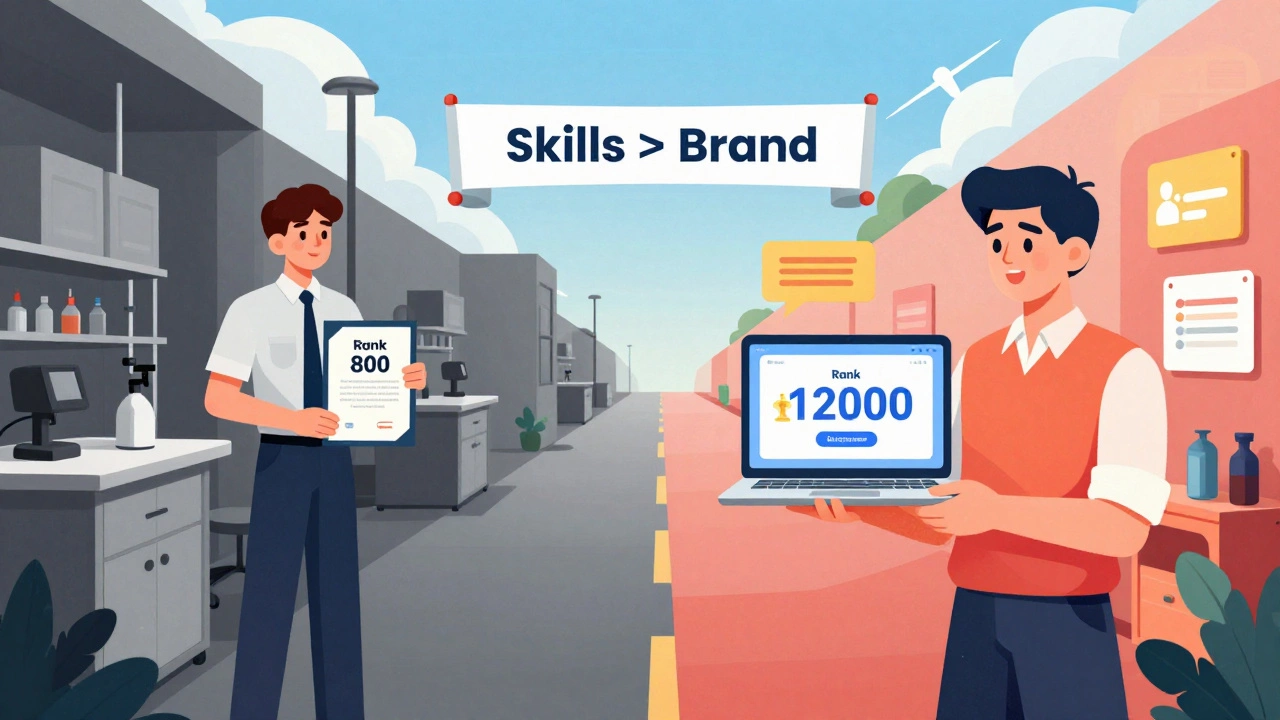
Not getting an IIT doesn’t mean your engineering dream is over. Many top private colleges like BITS Pilani, IIIT Hyderabad, and NITs have better placement records than some newer IITs. In 2024, the average CTC at IIIT Hyderabad for CSE was ₹32 LPA. At IIT Jodhpur, it was ₹21 LPA. The brand name matters, but your skills and internships matter more.
If you scored a rank between 15,000 and 30,000 in JEE Advanced, consider NITs. The top 10 NITs like NIT Trichy, Surathkal, and Warangal often have better faculty, infrastructure, and placements than IITs ranked 15-20. And they’re easier to get into.
How to Improve Your Rank
Rank isn’t just about how much you study-it’s about how smart you study. Most students waste time solving 100 easy problems instead of mastering 10 hard ones. Focus on these three things:
- Master previous years’ papers. 70% of JEE Advanced questions are based on patterns from the last 10 years.
- Don’t skip Physics and Math. Together, they make up 65% of the weightage. Chemistry is easier to score, but it won’t lift you from rank 8,000 to 500.
- Take full mock tests under real exam conditions. Time pressure is the biggest reason students lose marks. Practice solving 18 questions in 2 hours, not 50 in 5 hours.
If you’re scoring below 60% in mocks, you’re not in the top 10,000 range. If you’re consistently scoring above 80%, you’re in the top 2,000. Track your progress every month. Small improvements add up.
What’s Changing in 2026?
Starting 2026, JEE Advanced will be conducted only once a year-no second attempt. That means every student gets one shot. There’s no safety net. This will push more students to prepare harder from day one.
Also, the number of seats is expected to increase by 10-12% across all IITs. That could lower the cutoff ranks slightly, especially for newer branches. But don’t count on it. Demand is rising too. More students are taking JEE every year.
The real trend? Companies are hiring based on coding skills, projects, and internships-not just IIT names. If you’re ranked 12,000 but have built 3 real apps and done a summer internship at a startup, you’ll outperform someone ranked 800 who did nothing outside the syllabus.
Final Advice: Aim for the Right Rank, Not Just an IIT
There’s no magic number. But here’s a simple rule: if you want to be in the top 5% of engineers in India, aim for a JEE Advanced rank under 2,000. If you’re okay with a solid career in engineering, aim for under 8,000. If you’re targeting a top branch at a top IIT, you need to be in the top 1,000.
Don’t chase IITs because they’re famous. Chase the branch that excites you, the college that gives you the best labs, and the professors who’ll push you. The rank is just the ticket. What you do after you walk in is what defines your future.
What is the minimum rank to get into any IIT?
In 2024, the lowest rank admitted to any IIT was around 18,500 for less popular branches at newer IITs like IIT Dharwad or IIT Tirupati. But this varies yearly. Generally, ranks below 20,000 have a chance if you’re flexible with branch and location.
Can I get into IIT with a JEE Main rank?
No. JEE Main rank only qualifies you to sit for JEE Advanced. Only your JEE Advanced rank determines your IIT admission. You must clear the JEE Advanced cutoff to even be considered.
Is a rank under 5,000 good enough for IIT?
Yes. A rank under 5,000 gets you into most IITs for core branches like Mechanical, Civil, or Electrical. You might not get CSE at IIT Bombay, but you’ll get it at IIT Roorkee, IIT Kanpur, or newer IITs. This rank opens many doors.
How many students get into IITs every year?
About 16,000-17,000 students get into IITs each year. Around 250,000 qualify for JEE Advanced, but only the top 18,000-20,000 are eligible for admission due to seat limits and category quotas.
Does JEE Advanced get harder every year?
The difficulty changes yearly, but the competition doesn’t. Even in easier years, top ranks stay the same because more students prepare better. A ‘simple’ paper in 2023 still saw the top 1,000 ranks stay under 1,000. It’s about relative performance, not absolute difficulty.