Recent POST


Parents and students are asking one question again and again: Which board is best for the future? It’s not about which one is harder. It’s not about which one has more marks. It’s about which one prepares you for what’s coming next - college, careers, global opportunities, and real-world problem solving.
In 2025, the answer isn’t simple. But it’s clearer than ever.
CBSE: The National Standard for Future-Ready Learning
CBSE, the Central Board of Secondary Education, isn’t just the most popular board in India - it’s the most aligned with how the world is changing. Over 20 million students are enrolled in CBSE schools across India and abroad. Why? Because CBSE has quietly rebuilt itself around skills, not just scores.
Since 2020, CBSE shifted from rote memorization to competency-based learning. That means instead of asking you to recite the periodic table, they ask you to predict chemical reactions based on real-life scenarios. Instead of memorizing historical dates, you analyze causes and effects of events. This is the same approach used by top universities in the U.S., Canada, and Europe.
CBSE’s curriculum now includes coding from Class 6, financial literacy in Class 8, and environmental science as a core subject. The board also partners with NCERT to update textbooks every two years - faster than any other board in India. That’s why CBSE students consistently score higher in international assessments like PISA and are preferred by foreign universities.
And here’s the practical part: If you’re aiming for JEE, NEET, or any national competitive exam, CBSE is your default path. The syllabus, exam pattern, and question style match almost exactly. No extra coaching needed to bridge the gap.
ICSE: The Deep-Dive Option
ICSE - the Indian Certificate of Secondary Education - is often called the ‘academic’ board. It’s known for detailed textbooks, heavy emphasis on English, and a broader range of subjects. If you love reading, writing essays, and diving into literature or science theory, ICSE might feel more natural.
But here’s the catch: ICSE doesn’t align with India’s top competitive exams. JEE Main questions are designed around CBSE’s NCERT structure. NEET follows CBSE’s biology syllabus word-for-word. ICSE students often need 6-12 months of extra coaching just to catch up.
ICSE also has more internal assessments and project work. That sounds good - until you realize most Indian colleges don’t value those projects. They care about your board exam score. And ICSE exams are harder to score high in. The marking is stricter. The pass rate is lower. That can hurt your chances for scholarships or top colleges.
ICSE is great if you’re planning to study abroad early - especially in the UK or Canada. But if you’re staying in India for undergrad, CBSE gives you a faster, smoother ride.
State Boards: Local Strength, National Weakness
State boards like Maharashtra Board, UP Board, or Tamil Nadu Board are deeply rooted in local culture and language. That’s a strength - if you’re staying in your state for college and career.
But if you’re thinking about engineering, medicine, or even a corporate job in Delhi, Bangalore, or Hyderabad, state boards put you at a disadvantage. Why? Because most national entrance exams - JEE, NEET, CUET, NDA - are designed with CBSE’s syllabus as the baseline. State board students often find themselves learning the same topics again in coaching centers.
Also, state board textbooks are outdated. Many still use 2010-era content. Science concepts aren’t updated with recent discoveries. Math problems don’t reflect modern applications. And there’s no standardized digital learning platform like CBSE’s DIKSHA portal.
There’s one exception: If your state has a strong university system - like Kerala or Karnataka - and you’re planning to study locally, a state board can work. But even then, top colleges in those states prefer CBSE applicants.
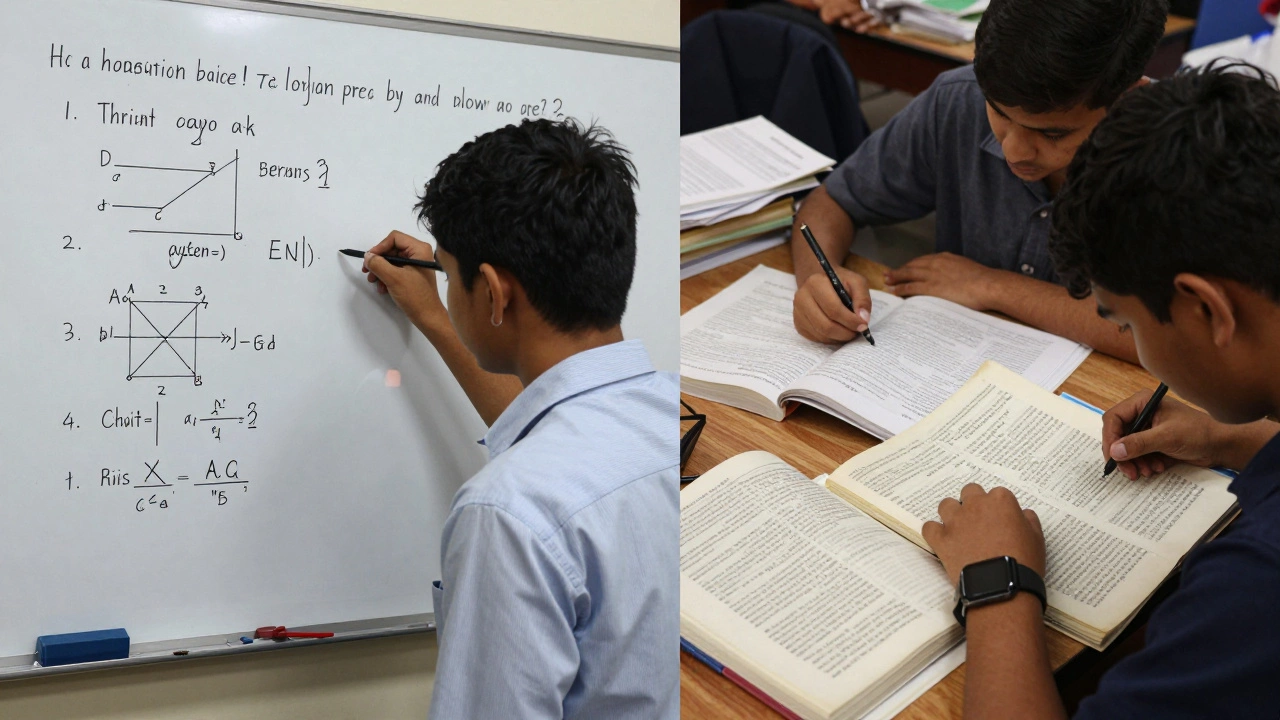
What the Future Demands - And How CBSE Delivers
The future isn’t about knowing facts. It’s about solving problems you’ve never seen before. It’s about adapting to new tools, thinking critically, and working in teams.
CBSE is the only board in India that’s actively building that into its DNA. Here’s how:
- AI and Coding: CBSE introduced AI as a subject in Class 8 in 2023. By 2025, over 15,000 schools offer it. That’s more than any other board.
- Project-Based Learning: Every student must complete at least one interdisciplinary project per year - combining science, math, and social studies. This mirrors how universities teach.
- Flexible Assessment: CBSE now allows internal assessments worth up to 30% of the final grade. That rewards consistent effort, not just one exam day.
- Global Recognition: CBSE certificates are accepted by over 1,200 universities worldwide, including top schools in the U.S., Australia, and Germany.
Compare that to state boards, where projects are optional and rarely graded. Or ICSE, where the focus is still on long-form answers instead of real-world application.
Who Should Choose What? A Simple Decision Guide
Let’s cut through the noise. Here’s who wins with each board in 2025:
| Goal | Best Board | Why |
|---|---|---|
| Clear path to JEE/NEET | CBSE | Syllabus matches exactly. No extra prep needed. |
| Studying abroad after Class 12 | ICSE or CBSE | Both are accepted. CBSE has wider recognition. |
| Want to learn coding/AI early | CBSE | Only board with mandatory AI and coding from Class 6. |
| Planning to stay in your home state for college | State Board | May have local advantages. But still harder to transfer later. |
| Strong in English, literature, arts | ICSE | Better depth in humanities. But limits STEM options. |
| Need scholarship or top college admission | CBSE | Higher average scores, better global recognition. |
The Hidden Risk of Choosing the ‘Easier’ Board
Some parents think: ‘Let’s pick a state board. It’s easier. My child will get 90%.’
That’s a trap.
In 2024, a study by the National Council of Educational Research and Training found that students from state boards who scored 90%+ were 40% less likely to clear JEE Advanced than CBSE students with 85%. Why? Because CBSE students learned how to think - not just how to memorize.
It’s not about the percentage. It’s about the skill behind it.
The future doesn’t care how many marks you got. It cares what you can do with them.
Final Answer: CBSE Is the Best Board for the Future
Is CBSE perfect? No. It’s still too exam-focused. But it’s the only board actively changing to meet the future.
If you want your child to compete globally, study at top Indian institutes, learn AI, or adapt to jobs that don’t even exist yet - CBSE is the only board that gives you a real shot.
State boards? Fine for local careers. ICSE? Good for literature lovers. But if you’re asking, ‘Which board is best for the future?’ - the answer isn’t even close.
CBSE is the only board building the future. The rest are just catching up.
Is CBSE better than ICSE for JEE preparation?
Yes, CBSE is better for JEE. The JEE syllabus is based directly on NCERT textbooks, which are the core of CBSE’s curriculum. ICSE covers similar topics but in more depth and with different emphasis. Most JEE toppers come from CBSE schools because they don’t need to relearn the material - they’re already aligned with the exam’s structure and question style.
Can a CBSE student apply to foreign universities?
Absolutely. CBSE is recognized by universities in the U.S., UK, Canada, Australia, Germany, and more. Many top schools, including MIT, University of Toronto, and University of Melbourne, accept CBSE certificates directly. CBSE students often score higher on standardized tests like SAT and IELTS because their curriculum emphasizes critical thinking and English communication.
Is AI taught in CBSE schools in 2025?
Yes. CBSE introduced AI as a mandatory subject for Class 8 in 2023. By 2025, over 15,000 schools across India offer it as a full-year course. Students learn machine learning basics, data analysis, and ethical AI use. No other Indian board has made AI this central to its curriculum.
Should I switch from a state board to CBSE in Class 9?
If you’re aiming for JEE, NEET, or a career outside your home state, switching to CBSE in Class 9 is one of the best decisions you can make. The transition is manageable - most topics overlap. The real advantage is gaining access to standardized, updated material and national-level exam alignment. Many students who switch see a 20-30% improvement in their conceptual clarity within a year.
Do CBSE students have an advantage in college admissions?
Yes. Top Indian colleges like IITs, NITs, AIIMS, and DU prefer CBSE applicants because they know the syllabus is rigorous and standardized. In CUET, which replaced state-level entrance exams, CBSE students score higher on average. Foreign universities also trust CBSE grades because they’re verified nationally and updated regularly.
Is CBSE too stressful because of exams?
CBSE is exam-focused, but it’s changing. Since 2021, it has reduced the weight of final exams and added internal assessments, projects, and skill-based evaluations. The board now encourages ‘no homework on weekends’ and ‘no marks for attendance’. The stress isn’t from CBSE itself - it’s from how families and coaching centers use it. The board is moving toward holistic evaluation - you just need to choose schools that follow that spirit.
If you're still unsure, ask this: What kind of adult do you want your child to become? One who memorizes facts? Or one who solves problems, adapts quickly, and thinks critically? CBSE is the only board in India actively building the second kind of learner.