Recent POST






JEE Subject Difficulty Simulator
Assess Your Strengths
Rate your proficiency in the core skills required for each subject on a scale of 1 (Weak) to 10 (Strong).
Difficulty Analysis
Higher bar = Higher Difficulty for you.
Personalized Strategy
Adjust the sliders above to generate your personalized study strategy based on the article's insights.
Walk into any coaching center in Kota or Delhi, and you will hear the same question whispered by anxious students: "Which subject is the hardest in JEE?" The answer changes depending on who you ask. For some, it is the abstract laws of Physics, which require visualizing invisible forces. For others, it is the sheer volume of facts in Chemistry, which feels like memorizing an entire dictionary. And for many, it is the relentless logic puzzles of Mathematics, where one wrong step ruins the whole solution.
The truth is, there is no single "hardest" subject for everyone. Difficulty is subjective. It depends on your strengths, your weak points, and how well you understand the core concepts. However, we can break down why each subject feels difficult and what makes them challenging in the context of JEE Main and JEE Advanced.
Why Mathematics Often Tops the "Hardest" List
If you look at rank lists and student feedback, Mathematics is frequently cited as the most stressful subject. Why? Because it offers no room for approximation. In Physics, you might estimate a value. In Chemistry, you might guess based on trends. In Math, if your calculation is off by a decimal point, the answer is wrong. Period.
The challenge in Math comes from two main areas:
- Conceptual Depth: Topics like Calculus (Integration and Differentiation), Coordinate Geometry, and Algebra are not just about formulas. They require a deep understanding of how functions behave. You cannot rote-learn Integration; you have to feel it.
- Time Pressure: Math problems often take longer to solve than Physics or Chemistry questions. In a timed exam like JEE Main, spending 15 minutes on one Math problem can cost you marks in other sections. This creates panic.
Many students struggle because they try to memorize tricks instead of understanding the underlying theory. When the exam throws a twisted variation of a standard problem, those tricks fail. To conquer Math, you need practice-not just solving problems, but analyzing why certain methods work faster than others.
The Hidden Trap of Chemistry
Chemistry is often called the "scoring" subject, but don't let that fool you. It is deceptively difficult. The reason? It is divided into three very different parts: Physical, Organic, and Inorganic.
- Physical Chemistry: This part is basically applied Physics and Math. It involves numerical calculations, thermodynamics, and kinetics. If you are good at Math, this part will feel easy. If you hate numbers, it will be a nightmare.
- Organic Chemistry: This requires logical reasoning. You need to understand reaction mechanisms-how electrons move from one atom to another. It is like learning a language with its own grammar rules. Once you get the logic, it flows. If you try to memorize every reaction without understanding the mechanism, you will forget half of them during the exam.
- Inorganic Chemistry: This is the memory game. Periodic table trends, coordination compounds, and p-block elements require pure recall. There is no derivation here. You either know it, or you don't.
The difficulty in Chemistry lies in its breadth. You cannot ignore any part. A strong student must be a calculator (Physical), a logician (Organic), and a librarian (Inorganic) all at once. Many students neglect Inorganic Chemistry because it seems boring, only to lose easy marks later.
Physics: The Conceptual Wall
Physics is unique because it bridges the gap between real-world observation and mathematical abstraction. The hardest part of Physics is not the math-it is the visualization.
Consider Electrostatics or Magnetism. You cannot see electric fields. You have to imagine them. Students who struggle with Physics often do so because they try to apply formulas blindly. They see a charge and a distance, plug them into Coulomb's Law, and hope for the best. But JEE Advanced loves to test conceptual clarity. A question might involve multiple forces acting simultaneously, requiring you to draw free-body diagrams and resolve vectors correctly.
Key topics like Rotational Motion, Fluid Mechanics, and Modern Physics are notorious for confusing students. Rotational Motion, for example, introduces new concepts like moment of inertia and angular momentum that behave differently from linear motion. If your foundation in Newton's Laws is shaky, these advanced topics will collapse under their own weight.
However, Physics has a silver lining. Once you truly understand a concept, it stays with you. Unlike Chemistry facts that fade, Physics principles are universal. Mastering Physics means mastering the language of the universe, which pays off not just in JEE, but in engineering college.
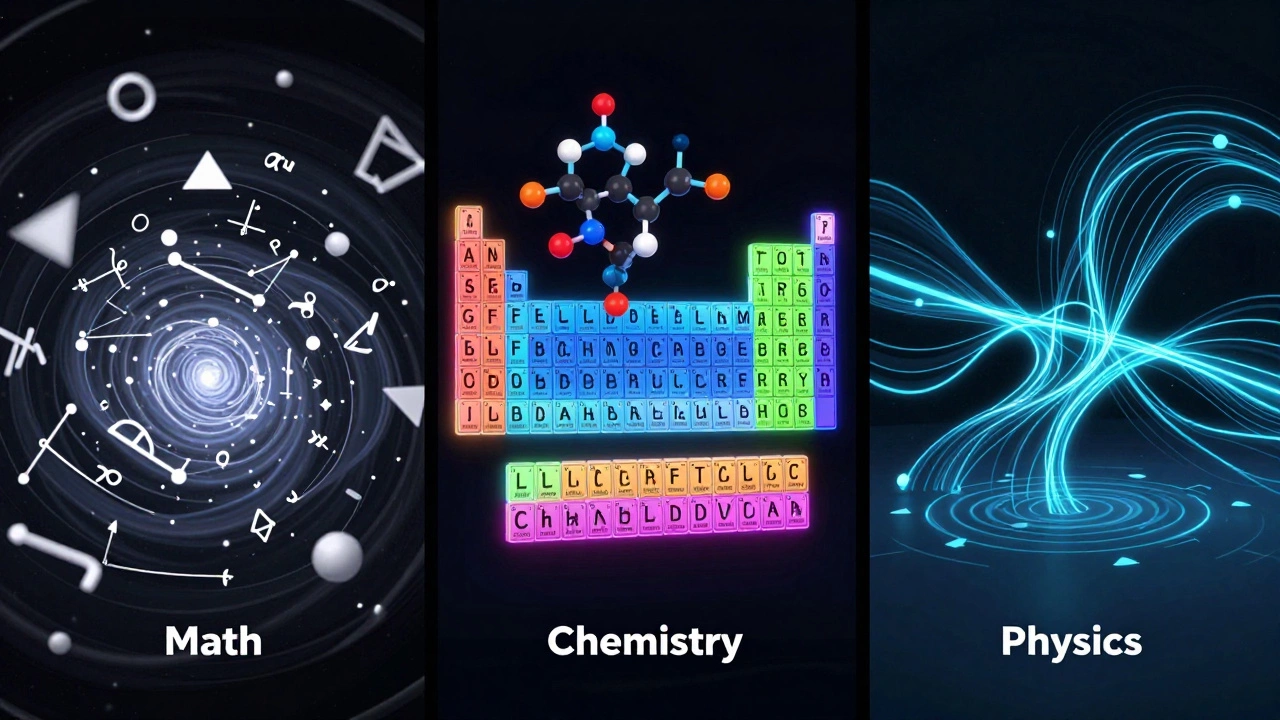
JEE Main vs. JEE Advanced: The Difficulty Shift
It is crucial to distinguish between the two exams. The perception of difficulty changes dramatically between JEE Main and JEE Advanced.
| Subject | JEE Main Focus | JEE Advanced Focus | Primary Challenge |
|---|---|---|---|
| Mathematics | Straightforward application of formulas | Multi-concept problems, complex integrals | Speed and accuracy in calculation |
| Physics | Basic concepts, direct formula usage | Deep conceptual links, experimental errors | Visualization and vector analysis |
| Chemistry | Factual recall, simple numericals | Complex organic mechanisms, theoretical depth | Breadth of syllabus coverage |
In JEE Main, the questions are generally shorter and more direct. Here, Chemistry often becomes the easiest way to secure high marks because the questions are factual. In JEE Advanced, the difficulty spikes. Math becomes extremely time-consuming, Physics demands deeper insight, and Chemistry tests your ability to connect disparate concepts.
How to Identify Your Personal "Hardest" Subject
Instead of worrying about what is hardest for the majority, focus on what is hardest for you. Here is a quick self-assessment:
- If you struggle with visualization: Physics is likely your biggest hurdle. Spend more time drawing diagrams and using simulations to understand forces and fields.
- If you hate memorization: Inorganic Chemistry will drain your energy. Create mnemonics and flashcards to make retention easier.
- If you make careless mistakes: Mathematics is your enemy. Practice speed drills and learn to check your answers quickly.
Your goal should not be to eliminate the hard subject, but to manage it. Allocate more study time to your weakest area, but do not neglect your strengths. A balanced score across all three subjects is better than being a genius in one and failing in the others.

Strategic Tips to Tackle the Tough Subjects
No matter which subject you find hardest, these strategies can help you turn weakness into strength:
- Start with NCERT: For Chemistry and basic Physics/Math concepts, the NCERT textbooks are the bible. Do not skip them. JEE Advanced often picks questions directly from NCERT lines, especially in Inorganic Chemistry.
- Practice Previous Year Questions (PYQs): Nothing prepares you for the actual exam like past papers. Analyze PYQs from the last 10 years. Notice patterns. Which topics repeat? How are they framed?
- Mock Tests are Non-Negotiable: You cannot prepare for JEE without taking full-length mock tests. They build stamina and teach you time management. Review every mistake you make in a mock test. Understand why you got it wrong.
- Focus on High-Weightage Topics: Not all chapters are equal. In Math, Calculus carries significant weight. In Physics, Mechanics and Electrodynamics are heavy hitters. Prioritize these to maximize your score.
- Stay Consistent: Cramming does not work for JEE. Study a little every day. Consistency builds the neural pathways needed for quick recall and problem-solving.
Final Thoughts on JEE Preparation
Asking "which subject is the hardest" is a natural part of the journey, but dwelling on it can be counterproductive. The difficulty is an illusion created by lack of practice. Every topic that seems impossible today can become second nature with consistent effort.
Remember, JEE is not just a test of intelligence; it is a test of resilience. The students who succeed are not necessarily the smartest; they are the ones who refused to give up when the problems got tough. Identify your weak spots, attack them with strategy, and trust the process. The hard subject today will be your scoring subject tomorrow.
Is Physics or Math harder in JEE Advanced?
For most students, Math is perceived as harder due to the time required to solve complex problems. However, Physics is conceptually deeper. If you are slow at calculations, Math will feel harder. If you struggle with abstract concepts, Physics will be more challenging.
Can I ignore Inorganic Chemistry in JEE preparation?
No, you should never ignore Inorganic Chemistry. It consists of direct, factual questions that are relatively easy to score if you have studied the material. Neglecting it means leaving free marks on the table, which can significantly impact your overall rank.
Which chapter is the most difficult in JEE Math?
Calculus, particularly Integration and Differential Equations, is often considered the most difficult and extensive chapter in JEE Math. Coordinate Geometry is also challenging due to the variety of problems and the need for precise visualization.
How many hours should I study for the hardest subject?
There is no fixed number of hours. Quality matters more than quantity. Dedicate at least 2-3 focused hours daily to your weakest subject. Break down complex topics into smaller chunks and practice active recall rather than passive reading.
Does JEE Main have negative marking?
Yes, JEE Main typically has negative marking for incorrect answers in MCQ sections. Usually, 4 marks are awarded for a correct answer and 1 mark is deducted for an incorrect one. This makes accuracy crucial, especially in the subjects you find difficult.