Recent POST


IIT JEE Self-Study Readiness & Cost Calculator
Skip the expensive coaching centers? Calculate how much you could save and check if you have the right profile to succeed through self-study.
Note: Use saved money for high-quality mock tests and doubt-clearing apps.
Check the statements that apply to you. Be honest!
You’ve probably heard the myth: to crack IIT JEE, you need expensive coaching in Kota or Delhi. But is that actually true? Every year, a small but significant group of students clears one of India’s toughest exams without ever stepping into a coaching classroom. They aren’t geniuses born with a cheat code; they are disciplined strategists who mastered self-learning.
If you’re considering this path-or just curious about how it works-you’re asking the right question. This isn’t about luck. It’s about structure, resource management, and mental resilience. Let’s look at who these students are, what they did differently, and how you can replicate their success.
The Profile of the Self-Studied Ranker
Who exactly cracks IIT without coaching? It’s rarely the student who hates studying. Usually, it’s someone who finds traditional coaching inefficient. These students often share specific traits:
- High Autonomy: They prefer setting their own pace rather than following a rigid batch schedule.
- Resourcefulness: They know how to find the best free or low-cost materials online instead of relying on printed modules.
- Consistency Over Intensity: They don’t burn out by studying 14 hours a day for a week. They stick to a sustainable 6-8 hour routine for months.
- Strong Fundamentals: Many come from schools where teachers provided solid conceptual clarity, reducing the need for external remedial teaching.
Take Anand Kumar, for instance (not the Super 30 founder, but a common name among recent rankers). Or consider real-world examples like those shared on forums like Quora or Reddit’s r/JEENEETards. You’ll see stories of students from tier-2 cities who used YouTube lectures and NCERT books to score above 95 percentile. The common thread? They treated preparation as a personal project, not a factory assembly line.
Why Some Students Skip Coaching Entirely
Coaching centers offer structure, but they also impose limitations. For many self-taught aspirants, the decision to skip classes comes down to three practical reasons:
- Pacing Issues: In a batch of 100 students, the teacher moves at an average speed. If you’re fast, you get bored. If you’re slow, you get lost. Self-study lets you rewind, pause, and accelerate based on your understanding.
- Cost Efficiency: Quality coaching can cost ₹1.5-₹2.5 lakhs per year. Self-study might cost under ₹20,000 if you use free resources wisely. That money can go toward test series subscriptions, which are crucial.
- Mental Health: The pressure of peer comparison in classrooms can be toxic. Studying alone removes the distraction of seeing others “ahead” of you, allowing you to focus on your own progress metrics.
However, skipping coaching doesn’t mean skipping guidance. Successful self-studiers replace the teacher with curated content. They become their own curriculum designers.
The Toolkit: What Resources Did They Use?
You might wonder, “If I’m not in class, what am I learning from?” The answer lies in a carefully selected stack of resources. Here’s the typical toolkit used by top self-studied rankers:
| Category | Recommended Resource | Why It Works |
|---|---|---|
| Core Theory | NCERT Textbooks | JEE Main questions are directly lifted from NCERT lines. Mastery here builds the base. |
| Advanced Concepts | HC Verma (Physics), OP Tandon (Chemistry) | These books provide depth beyond school level without being overly complex. |
| Video Lectures | Unacademy, Mohit Tyagi, Physics Wallah | Free, high-quality explanations available on YouTube. No travel time needed. |
| Practice | Previous Year Questions (PYQs) | Solving 10 years of PYQs reveals patterns and difficulty trends better than random mock tests. |
| Assessment | Online Test Series (e.g., Marks App, NTA Abhyas) | Simulates exam conditions. Essential for identifying weak areas without teacher feedback. |
Note that while video lectures are helpful, passive watching is a trap. Top rankers watch a concept, close the video, and solve problems immediately. Active recall beats passive consumption every time.
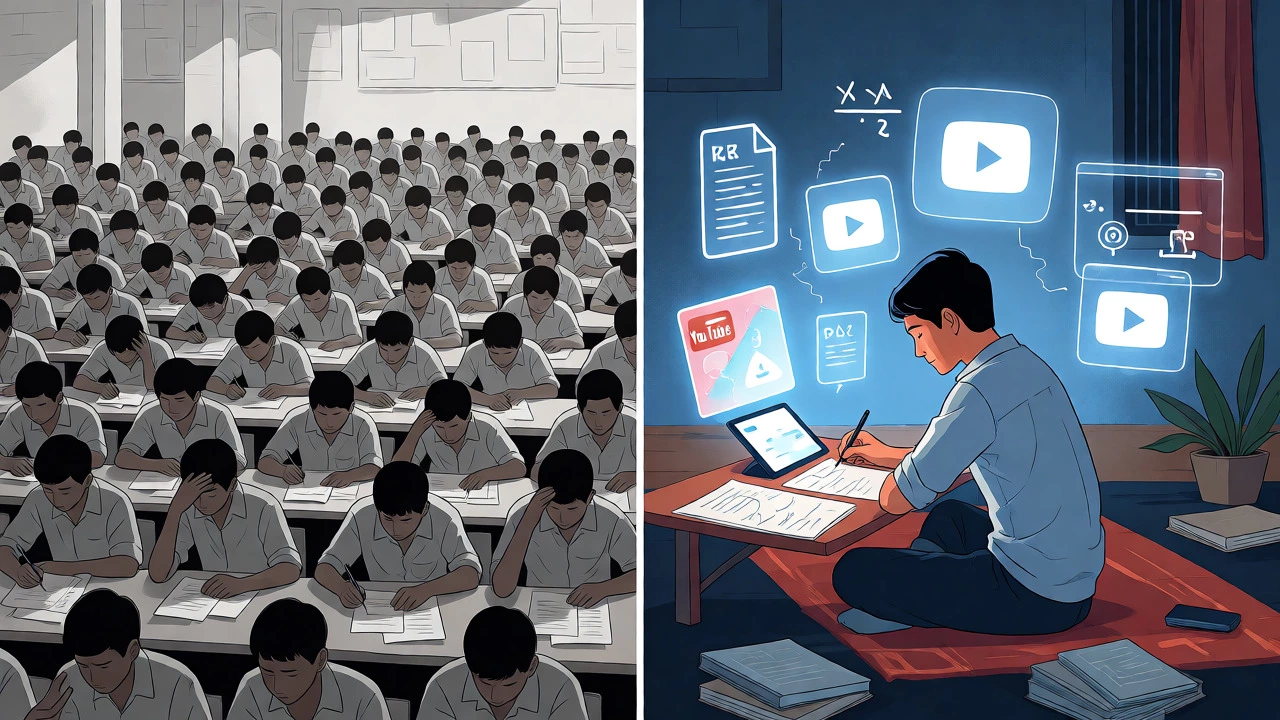
Structuring Your Day Without a Timetable Imposed by Others
Without a coach telling you what to study next, procrastination becomes your biggest enemy. Successful self-studiers create rigid daily structures. Here’s a realistic template that has worked for many:
- 06:00 AM - 08:00 AM: High-focus subject (usually Math or Physics) when the mind is fresh.
- 08:00 AM - 09:00 AM: Breakfast and break. Avoid phone scrolling.
- 09:00 AM - 12:00 PM: School/College hours (if applicable) or deep work block on Chemistry/Theory.
- 02:00 PM - 04:00 PM: Problem-solving session. Apply what you learned in the morning.
- 04:00 PM - 05:00 PM: Physical activity. Exercise boosts cognitive retention.
- 06:00 PM - 08:00 PM: Revision of old topics. Spaced repetition prevents forgetting.
- 08:00 PM - 09:00 PM: Light reading or error log analysis.
The key is consistency. Missing one day is fine. Missing three days breaks the momentum. Self-discipline replaces external accountability.
Common Pitfalls and How to Avoid Them
Not everyone succeeds without coaching. Failure usually stems from specific mistakes. Recognize these red flags early:
- The Illusion of Competence: Watching a video makes you feel like you understand. Solving a problem proves it. Always test yourself immediately after learning.
- Ignoring Weak Areas: Without a teacher pointing out gaps, you might avoid subjects you dislike (often Organic Chemistry or Modern Physics). Force yourself to tackle them first.
- Lack of Mock Tests: Knowledge isn’t enough. You need exam temperament. Take full-length mocks every two weeks starting six months before the exam.
- Overloading Resources: Don’t buy ten books for Physics. Pick one standard book and master it. Depth beats breadth in JEE.
One student shared his story: he failed his first attempt because he only studied theory and never timed himself solving papers. He cracked it the second year by dedicating 40% of his time to timed practice.

Can You Crack JEE Advanced Without Coaching?
JEE Main is manageable with self-study due to its predictable pattern. JEE Advanced is trickier because of its unpredictable nature and multi-concept questions. However, it’s still possible.
Students who crack Advanced without coaching usually have stronger analytical skills. They spend more time on why a solution works, not just how. They engage in community discussions on platforms like Stack Exchange or dedicated Discord servers to clarify doubts. Peer learning replaces teacher mentoring.
If you aim for Advanced, add these steps to your plan:
- Solve at least 15 years of Advanced PYQs.
- Focus on inter-subject connections (e.g., using calculus in Physics).
- Join online doubt-clearing groups to simulate classroom interaction.
Real-Life Examples: Proof It Works
Let’s look at concrete data. While exact numbers vary yearly, approximately 5-10% of top 1,000 rankers claim minimal or no formal coaching. Many cite sources like:
- YouTube Channels: Mohit Tyagi for Math, Alakh Pandey (early videos) for Physics.
- Books: Cengage series for practice, NCERT for Chemistry facts.
- Apps: Unacademy or Vedantu for occasional doubt sessions.
One notable example is a student from rural Bihar who cleared AIR 450 using only library access and internet downloads. His secret? He solved every single NCERT exercise and then moved to advanced problems only after mastering basics. This approach minimized confusion and maximized confidence.
Another case involved a girl from Kerala who balanced school and JEE prep. She used weekends for intensive testing and weekdays for steady syllabus coverage. Her strategy was simple: never leave a topic half-done.
Final Checklist for the Independent Aspirant
Before you commit to this path, ask yourself these questions:
- Do I have a quiet place to study without distractions?
- Can I motivate myself to start studying even when I don’t feel like it?
- Do I have access to reliable online resources and a stable internet connection?
- Am I willing to analyze my mistakes honestly without someone else grading me?
If you answered yes to most of these, you’re ready. Coaching is a tool, not a requirement. The best tool is the one you’ll actually use consistently.
Is it harder to crack IIT without coaching?
It depends on your discipline. For highly self-motivated students, it can be easier because there’s no commute or rigid schedule. For those who need external pressure, it’s much harder. Success requires strong time-management skills.
Which books are essential for self-study?
Start with NCERT for all three subjects. Then move to HC Verma for Physics concepts, OP Tandon for Chemistry theory, and Arihant or Cengage for Mathematics practice. Previous Year Questions (PYQs) are non-negotiable.
How do I clear doubts without a teacher?
Use online platforms like Doubtnut, Chegg, or dedicated Facebook/Telegram groups. You can also post questions on Physics Stack Exchange or Quora. Often, explaining your doubt helps you solve it yourself.
Do I need to join a test series?
Yes. Even if you don’t attend classes, take an online test series. It provides competition benchmarks, identifies weak areas, and simulates exam pressure. Options include Marks App, NTA Abhyas, or Allen’s online series.
Can I balance school and JEE prep without coaching?
Absolutely. In fact, many self-studiers do better in school exams because JEE prep covers the same syllabus deeply. Just ensure you allocate specific hours for school assignments so they don’t pile up.