Recent POST






IIT Bombay Admission Feasibility Checker
Enter your details below to see which IIT Bombay branches are realistically within reach for your rank.
| Branch | Typical Closing Range (Gen) | Feasibility Score |
|---|
Strategic Advice
So, you’ve cracked JEE Advanced and landed in the 5000 range. It’s a solid score-definitely not something to scoff at. But now comes the hard part: staring at the JoSAA seat matrix and wondering if those dreams of studying at IIT Bombay are realistic or just wishful thinking.
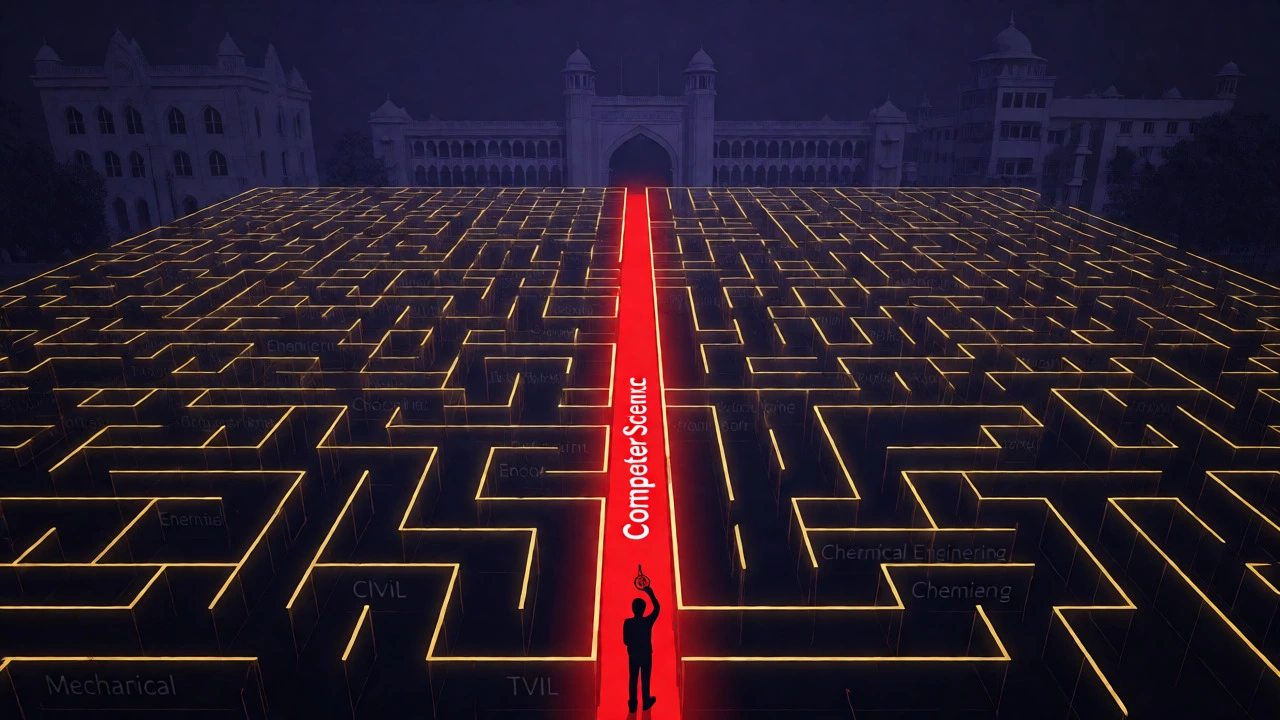
The short answer? Yes, you can get into IIT Bombay with a 5000 rank, but it depends heavily on which branch you’re targeting and your category. If you’re aiming for Computer Science (CSE), you might be out of luck unless you have a strong reservation benefit. But if you’re open to core engineering disciplines like Mechanical, Civil, or Chemical Engineering, you have a very real shot.
Understanding the Rank vs. Branch Trade-Off
Most students fixate on the institute name first, then the branch. At IIT Bombay, this hierarchy flips when you look at admission data. The competition for Computer Science and Engineering (CSE) is brutal. In recent years, the closing rank for CSE under the General category has often hovered around 100-300. That means a rank of 5000 is significantly outside the typical cutoff for that specific program.
However, IIT Bombay offers over 20 undergraduate programs. While CSE and Electrical Engineering (EE) draw the highest ranks, other departments have more accessible cutoffs. For instance, Chemical Engineering, Metallurgical Engineering, and Civil Engineering often close within the 2000-4000 range for General category candidates. This puts a 5000 rank right on the borderline, sometimes inside, sometimes slightly outside depending on the year’s difficulty level and seat availability.
| Branch | Typical Closing Rank Range | Feasibility with Rank 5000 |
|---|---|---|
| Computer Science & Engineering | 1 - 300 | Low |
| Electrical Engineering | 300 - 800 | Low |
| Mechanical Engineering | 1500 - 2500 | Moderate |
| Civil Engineering | 2500 - 4000 | High |
| Chemical Engineering | 3000 - 4500 | Very High |
| Metallurgical Engineering | 4000 - 6000 | Very High |
How Category Impacts Your Chances
If you fall under OBC-NCL, EWS, SC, or ST categories, your perspective changes entirely. The reservation system in Indian Institutes of Technology adjusts the effective cutoff ranks significantly. For an OBC-NCL candidate, a rank of 5000 could potentially secure a seat in Electrical Engineering or even Mechanical Engineering, which are highly respected programs. For SC/ST candidates, a rank of 5000 is often sufficient for almost any branch, including CSE, though this varies by year.
It’s crucial to check the last three years’ closing ranks specifically for your category. Don’t rely on general “topper” anecdotes. Look at the official JoSAA data archives. You’ll notice patterns. Some years, due to paper difficulty, ranks inflate, making 5000 seem worse than it is. Other years, easier papers compress the ranks, making 5000 more competitive. Always adjust your expectations based on the current year’s normalization factor.
Beyond the Branch: The Value of the Tag
Let’s address the elephant in the room: Is it worth going to IIT Bombay for a non-CS branch versus a better branch at another top IIT? This is a classic dilemma. IIT Bombay holds a unique position in India’s academic landscape. Its location in Mumbai, its industry connections, and its alumni network offer distinct advantages that pure branch rankings don’t capture.
Consider the ecosystem. IIT Bombay has a vibrant startup culture. Students from all branches participate in tech fests, coding clubs, and entrepreneurship cells. A Mechanical Engineer from IIT Bombay who learns coding on the side often lands jobs comparable to CSE grads from mid-tier institutes. The brand value opens doors during campus placements. Recruiters visit IIT Bombay for all branches because they trust the rigor of the selection process, regardless of whether you studied thermodynamics or algorithms.
On the flip side, if your heart is set on software development or data science, starting in a non-CS branch requires extra effort. You’ll need to self-study computer science fundamentals, build projects, and perhaps pursue minors or electives in CS. It’s doable-many successful tech founders came from non-CS backgrounds-but it demands discipline.
Alternative Options: Should You Consider Other IITs?
If getting into IIT Bombay feels too risky for your preferred branch, consider the broader IIT network. With a rank of 5000, you have strong options at:
- IIT Delhi: Similar prestige to Bombay. Core branches here also have similar cutoffs. If you prefer Delhi’s location or specific research labs, this is a viable swap.
- IIT Madras: Often has slightly lower cutoffs for some branches compared to Bombay/Delhi, especially in newer interdisciplinary programs.
- IIT Kanpur: Historically strong in Physics and Math. If you lean towards theoretical sciences or specialized engineering, Kanpur offers excellent depth.
- IIT Kharagpur: Has the largest number of seats among older IITs. This volume advantage often means better chances for niche branches like Mining or Agricultural Engineering at higher ranks.
Don’t overlook new IITs either, but weigh them carefully. An old IIT tag generally carries more weight in corporate hiring and higher education admissions abroad than a new IIT, even if the new IIT offers you CSE. The network effect is real and long-lasting.

Strategic Choices in JoSAA Counseling
Your choice list in JoSAA counseling will determine your fate. Here’s how to structure it if you’re determined to try for IIT Bombay:
- Prioritize Branch Over Institute Only If Necessary: If you absolutely cannot study anything but CS, put IIT Delhi/Bombay CSE at the top, knowing the risk. Then list IITs where CSE is likely (e.g., IIT BHU, IIT Indore).
- Prioritize Institute Over Branch: If you want the IIT Bombay tag, list all available branches at IIT Bombay first, ordered by your interest. Then move to IIT Delhi, IIT Madras, etc., for their top branches.
- Include Double Degree Programs: IIT Bombay offers dual degree programs (B.Tech + M.Tech) in some fields. These often have slightly different cutoffs and can be a backdoor entry into the institute.
- Keep Backup Options: Ensure your list includes safe bets like NIT Trichy or NIT Surathkal for CSE/ECE. Leaving no backup option can lead to a bad outcome if you slip through the cracks.
Real Talk: What Happens After Admission?
Getting in is half the battle. Surviving and thriving is the other half. IIT Bombay’s curriculum is demanding. If you enter through a lower-ranked branch, you’ll face peers who scored much higher. This can impact confidence initially. However, grades matter less than skills in the long run.
Focus on building a portfolio. Participate in student chapters (ACM, IEEE). Do internships. Many companies hire based on intern performance, not just CGPA. A student from Chemical Engineering at IIT Bombay with two strong internships in fintech will often outperform a CSE grad with average grades and no experience.
Also, consider the flexibility. Most IITs allow branch changes after the first year based on CPI (Cumulative Performance Index). If you start in Civil Engineering and crush your first-year exams, you might switch to CSE or EE. It’s competitive, but possible. Use this as a strategic lever: join IIT Bombay in a safer branch, aim for a high CPI, and switch later if you still crave CS.
Is 5000 rank good enough for IIT Bombay CSE?
Generally, no. For General category candidates, the closing rank for Computer Science at IIT Bombay is usually well below 500, often under 100. A rank of 5000 is typically insufficient for CSE unless you belong to a reserved category (SC/ST/OBC-EWS) where cutoffs are adjusted downward.
Which IIT Bombay branches are reachable with rank 5000?
For General category students, branches like Civil Engineering, Chemical Engineering, Metallurgical Engineering, and Materials Science often have closing ranks near or above 5000. These are reputable programs with strong placement records, though not as hyped as CSE.
Should I take IIT Bombay for a low branch or IIT Delhi for a better branch?
This depends on your career goals. Both institutes have equal prestige. If you plan to work in core sectors (manufacturing, energy, infrastructure), the branch matters more. If you aim for finance, consulting, or tech startups, the institute brand and location (Mumbai vs. Delhi) might offer better networking opportunities, making the "lower" branch acceptable.
Can I change my branch after joining IIT Bombay?
Yes, IIT Bombay allows branch changes after the first year based on CPI. However, it is highly competitive. To move into popular branches like CSE or EE, you typically need to be in the top 1-5% of your batch. Starting in a less competitive branch gives you a chance to rebuild your GPA and compete for a switch.
What are the job prospects for non-CS branches at IIT Bombay?
Placement rates for all branches at IIT Bombay remain very high, often exceeding 90%. Non-CS students get hired by core companies (L&T, Reliance, Tata Steel) and increasingly by IT firms and consultancies that value problem-solving skills over specific degrees. Self-learning coding and internships significantly boost employability in tech roles.