Recent POST






NEET Memory Strategy Quiz
Loading question...
Ready to Test Your Strategy?
This quiz covers the core memory hacks mentioned in the article: Active Recall, Spaced Repetition, Interleaving, and Subject-Specific Tactics.
Quiz Complete!
0/5
Keep practicing!
You have 180 questions. You have 3 hours and 20 minutes. That’s roughly 67 seconds per question. In NEET, speed isn’t just about writing fast; it’s about recognizing the answer before you finish reading the options. Most students fail not because they don’t know the material, but because their retrieval is too slow. They are searching through a dusty mental library instead of grabbing a book from the shelf.
If you are looking for the fastest way to memorize the vast syllabus of the National Eligibility cum Entrance Test, stop highlighting textbooks. Highlighting is passive. It feels productive, but your brain checks out after ten minutes. The real secret lies in active engagement with the data. We need to hack how your brain stores and retrieves information. This guide breaks down the specific cognitive techniques that top rankers use to compress months of study into efficient, retainable chunks.
The Core Engine: Active Recall and Spaced Repetition
Before you touch a single formula sheet, you need to understand the mechanism of memory. Rote learning-repeating something until it sticks-is the enemy of efficiency. It works for phone numbers, but it fails for complex biological pathways or chemical mechanisms. Instead, you must leverage two scientifically proven methods: Active Recall and Spaced Repetition. These aren't just buzzwords; they are the backbone of medical education worldwide.
Active Recall is the practice of stimulating your memory during the learning process. Instead of re-reading a chapter on Genetics, you close the book and ask yourself, "What are the exceptions to Mendel's laws?" If you can't answer, you haven't learned it yet. The struggle to retrieve the answer strengthens the neural pathway. It feels harder than reading, which is exactly why it works. Your brain marks difficult retrievals as important.
Combine this with Spaced Repetition. Your brain forgets things on a predictable curve, known as the Forgetting Curve. If you learn a concept today, you will likely forget 50% of it by tomorrow unless you review it. By reviewing at increasing intervals (1 day, 3 days, 1 week, 1 month), you reset the forgetting curve each time. Tools like Anki are great for this, but for NEET, physical flashcards often work better because the act of writing reinforces motor memory.
- Immediate Review: Review notes within 24 hours of learning them.
- Short-Term Review: Review again after 3 days.
- Long-Term Retention: Review after 1 week, then monthly.
Subject-Specific Memorization Tactics
NEET isn’t a monolith. Biology, Chemistry, and Physics require different memory architectures. Treating them all the same is a recipe for burnout. Let’s break down how to tackle each pillar specifically.
Biology: The NCERT Bible
In Biology, 90% of questions come directly from the NCERT textbooks. But knowing NCERT doesn’t mean just reading it. You need to visualize it. Human memory is visual-spatial. When you read about the structure of a nephron, don’t just read the text. Close your eyes and build the image in your mind. Draw it. Label it from memory. Then compare it to the book.
For taxonomy and examples, use mnemonics. There are hundreds of standard mnemonics for Kingdom Plantae and Animalia. Don’t reinvent the wheel. Use established ones like "MAMMALIA" for mammalian characteristics or create your own absurd stories. The weirder the story, the stickier the memory. For example, to remember the order of taxonomic hierarchy (Kingdom, Phylum, Class, Order, Family, Genus, Species), use "Keep Pot Clean Or Family Gets Sick." It sounds silly, but silly sticks.
Chemistry: Divide and Conquer
Chemistry is split into three distinct parts, and each needs a different approach.
| Section | Primary Challenge | Best Memorization Technique |
|---|---|---|
| Inorganic Chemistry | Pure fact retention (colors, trends, reactions) | Mnemonics and Group Trends Charts |
| Organic Chemistry | Reaction mechanisms and named reactions | Flowcharts and Mechanism Mapping |
| Physical Chemistry | Formula application and numerical problems | Derivation Understanding and Formula Sheets |
For Organic Chemistry, do not memorize reactions in isolation. Memorize the mechanism. If you understand why an electron moves from A to B, you can predict the product even if you’ve never seen that specific reaction before. Create flowcharts connecting functional groups. Start with Alkanes, move to Alkenes, then Alcohols. See how one transforms into another. This creates a web of knowledge rather than a list of isolated facts.
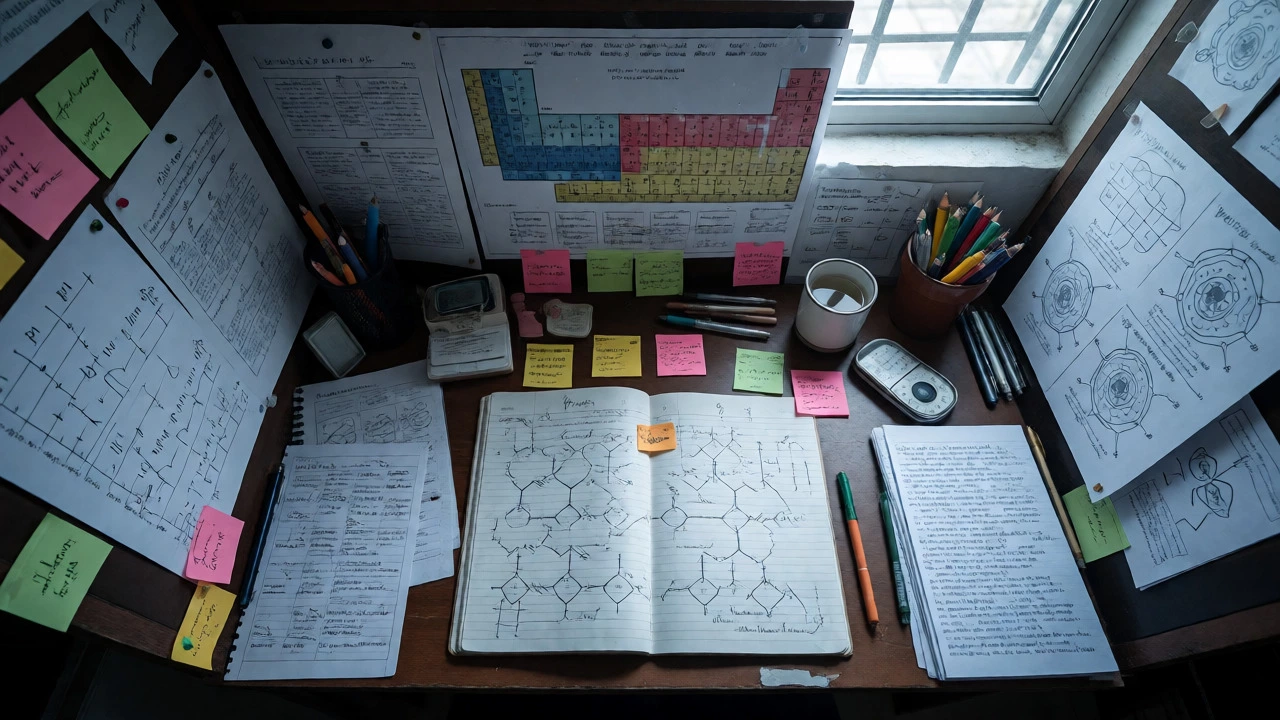
Inorganic Chemistry is pure rote memory, but organized. Focus heavily on the periodic table trends. Atomic radius, ionization energy, electronegativity-know these cold. Use charts that show the trend arrows (up/down/left/right). Stick these charts on your wall. You’ll absorb them passively while walking past them daily.
Physics: Conceptual Clarity Over Cramming
Many students try to memorize Physics formulas. This is dangerous. Physics is logical. If you forget the formula for projectile motion, you can derive it from kinematics equations if you understand the components of velocity. However, there are constants and specific results you must memorize, such as the moment of inertia for standard shapes or the values of gravitational constant G.
Create a "Formula Sheet" for every chapter. Write only the final derived formulas and key constants. Review this sheet every morning. But more importantly, solve problems. Solving a problem forces you to retrieve the correct formula from memory under pressure. This is the ultimate test of whether you actually "know" the physics or just recognize it when you see it.

The Power of Interleaving
Most students study in blocks: three hours of Biology, then three hours of Chemistry. This is called blocked practice. It feels smooth, but it leads to poor long-term retention. Switch to interleaving. Mix subjects within a single study session. Study 45 minutes of Genetics, then switch to 45 minutes of Thermodynamics, then back to Organic Chemistry.
Why does this work? Because it forces your brain to constantly reload context. When you switch from Biology to Physics, your brain has to discard the biological framework and load the mathematical framework. This "reload" cost is where the learning happens. It mimics the actual exam environment, where you jump from a biology question to a physics calculation without warning.
Mock Tests: The Ultimate Memory Tool
You cannot memorize what you haven’t tested. Taking full-length mock tests is not just for assessing your score; it is a powerful memorization tool. Every mistake you make in a mock test is a memory anchor. When you get a question wrong, don’t just look at the solution. Analyze why you got it wrong. Did you misread the question? Did you forget a specific exception?
Keep an "Error Notebook." Write down every question you got wrong or guessed on. Review this notebook weekly. These are your personal weak spots. General advice says "study everything," but your Error Notebook tells you exactly what you need to memorize. It cuts out the noise. If you keep getting questions wrong on "Hybridization," stop studying the entire chapter of Chemical Bonding. Drill hybridization until it’s automatic.
Lifestyle Factors That Boost Memory
You can have the best strategies in the world, but if your hardware is broken, the software won’t run. Memory consolidation happens during sleep. If you cut sleep to five hours to study more, you are actively deleting what you learned that day. Aim for 7-8 hours of quality sleep. Non-negotiable.
Exercise also plays a huge role. Aerobic exercise increases blood flow to the hippocampus, the part of the brain responsible for memory formation. Even a 20-minute brisk walk after a study session can help solidify new information. And hydration-your brain is mostly water. Dehydration shrinks brain tissue and impairs focus. Keep a bottle on your desk.
Common Pitfalls to Avoid
First, avoid the "Illusion of Competence." This happens when you read a solution and think, "Ah, I knew that." You didn’t know it; you recognized it. Recognition is easy; recall is hard. Always cover the answer and try to reproduce it from scratch.
Second, don’t ignore the negative marking trap. In NEET, guessing can hurt you. If you are unsure between two options, trust your first instinct if you have studied well. Hesitation usually indicates lack of clarity. Go back and clarify that concept immediately.
Third, stop multitasking. Your brain cannot deeply encode information while checking Instagram notifications. One task at a time. Deep work sessions of 60-90 minutes with zero distractions beat four hours of distracted studying.
Is NCERT enough for Biology memorization?
Yes, for the majority of Biology questions, NCERT is sufficient. However, you must memorize every line, including diagrams, tables, and summary points. Many students skip the 'Summary' section at the end of chapters, but these often contain high-yield facts asked in exams.
How many hours should I dedicate to revision?
Revision should take up 30-40% of your total study time in the last three months. Before that, aim for 20%. Consistent small revisions are better than one massive cramming session before the exam.
Do mnemonics really work for NEET?
Absolutely. Mnemonics reduce cognitive load by chunking complex information into simple cues. They are particularly effective for Biology taxonomy, Chemistry periodic trends, and Physics constants. Just ensure you understand the underlying concept so you don't misuse the mnemonic in tricky questions.
Should I join coaching classes for better memorization?
Coaching provides structure and curated materials, which can save time. However, memorization is a personal cognitive skill. Coaching can provide the content, but you must implement active recall and spaced repetition yourself. Self-study with disciplined revision often beats passive attendance in large classrooms.
How do I handle anxiety during the exam?
Anxiety blocks memory retrieval. Practice deep breathing exercises during mock tests. Simulate exam conditions strictly at home. Familiarity reduces fear. If you panic, skip the question, mark it for review, and move on. Often, the answer pops up later when your stress levels drop.