Recent POST




Learning Path Finder: Online vs. E-Learning
Not sure which format suits your needs? Answer 3 quick questions about your goals and schedule to find out if you need the structure of E-Learning or the interaction of Online Learning.
Deep Mastery & Degrees
I want a degree, complex skill (like public speaking), or deep theoretical knowledge.
Quick Upskilling & Facts
I need specific technical skills (Python, Excel) or compliance certification quickly.
Your Recommended Path
Why this fits you:
Key Features You'll Get
Ideal Use Case
Have you ever scrolled through a job board or an educational catalog and felt confused by the terminology? One listing promises "online training," while another advertises "e-learning modules." They sound identical, right? You click around, expecting different content, only to find that they often look exactly the same. This confusion is common because the terms are used interchangeably in marketing. However, if you are trying to choose the right path for your career or education, understanding the nuance between these two concepts can save you time and money.
The short answer is no, they are not exactly the same thing, although they overlap significantly. Think of it like this: online learning is the broad umbrella term for any education delivered via the internet. E-learning is a specific subset of online learning that focuses on structured, digital courseware and software-based delivery. One is about the connection; the other is about the content format. Let’s break down why this distinction matters for students, professionals, and educators in 2026.
The Broad Umbrella: Understanding Online Learning
When we talk about online learning is an educational method where instruction and interaction occur over the internet. It is defined by the medium of delivery rather than the specific tools used. If you are connecting to a teacher, peers, or resources through a web browser or an app, you are engaging in online learning. This category is massive. It includes live video lectures, asynchronous discussion forums, virtual reality simulations, and even simple email exchanges with a tutor.
The key characteristic of online learning is connectivity. It removes geographical barriers. A student in Wellington, New Zealand, can attend a live lecture hosted by a professor in London. The focus here is on the human element and the real-time or near-real-time interaction. Many online programs mimic traditional classroom dynamics but move them into a digital space. You might have scheduled Zoom calls, group projects managed via Slack, and exams taken on secure proctoring platforms. The technology serves as a bridge, but the pedagogy often remains rooted in traditional teaching methods.
Consider a university degree program offered entirely remotely. You log in every Tuesday at 10 AM for a live seminar. You submit essays via a portal. You chat with classmates in a Discord server. This is pure online learning. The structure mirrors a physical campus experience, just digitized. The value proposition is flexibility and access, not necessarily the innovation of the learning material itself.
The Structured Core: Defining E-Learning
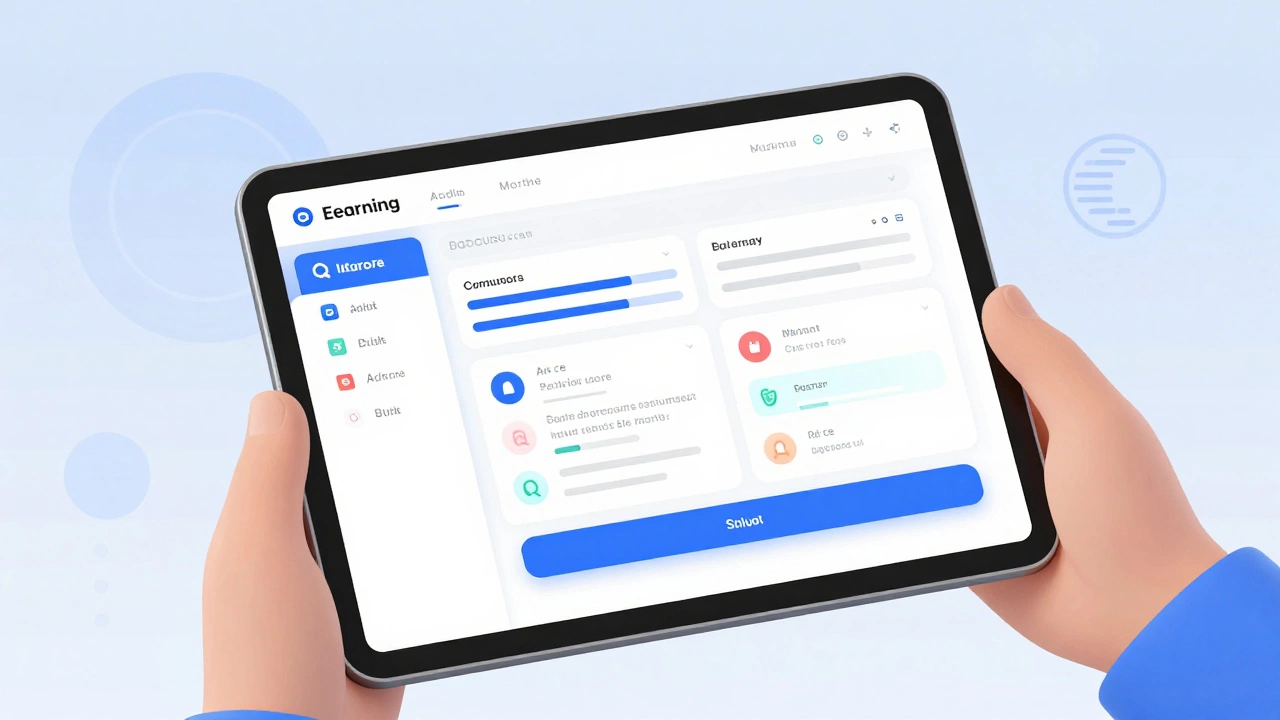
E-learning, short for electronic learning, refers specifically to the use of digital technologies to deliver educational content. While online learning is about the "where" and "how" of connection, e-learning is about the "what" of the material. E-learning implies a structured, self-paced, or semi-structured curriculum delivered through software. This often involves Learning Management Systems (LMS), interactive modules, quizzes, and multimedia assets designed to be consumed independently.
In an e-learning context, the instructor might not be present at all. Instead, you interact with the content. Think of a compliance training module at work. You click through slides, watch embedded videos, take a multiple-choice quiz, and get a certificate upon completion. There is no live teacher, no peer discussion, and no real-time feedback loop. This is classic e-learning. It is scalable, standardized, and efficient. Companies love it because they can roll out the exact same training to 10,000 employees simultaneously without hiring thousands of trainers.
E-learning also encompasses more sophisticated formats like adaptive learning platforms. These systems use algorithms to adjust the difficulty of questions based on your performance. If you ace a math problem, the next one gets harder. If you struggle, the system offers hints or revisits foundational concepts. This personalization is a hallmark of advanced e-learning, distinguishing it from the static nature of many general online courses.
| Feature | Online Learning | E-Learning |
|---|---|---|
| Primary Focus | Connectivity and Interaction | Content Delivery and Structure |
| Instructor Role | Active facilitator (often live) | Designer/Curator (often absent) |
| Pacing | Synchronous (scheduled) or mixed | Asynchronous (self-paced) |
| Technology Used | Video conferencing, LMS, social tools | SCORM packages, interactive modules, apps |
| Best For | Degrees, complex skills, community building | Compliance, certification, quick upskilling |
Why the Confusion Persists
If the definitions are distinct, why do people mix them up? The primary reason is convergence. In 2026, most modern educational programs are hybrids. A typical professional certification course might start with a live webinar (online learning) and then require you to complete several interactive modules (e-learning). Because both elements are accessed via the internet, users lump them together under "online study." Furthermore, the industry marketing has blurred the lines. Platforms like Coursera or Udemy offer both live cohort-based courses and pre-recorded video series. To the casual user, the interface looks similar. You log in, you watch, you learn. The underlying mechanics differ, but the user experience feels uniform. This lack of transparency in labeling contributes to the semantic fog.
Another factor is the evolution of technology. Ten years ago, e-learning meant clicking through PowerPoint slides converted into HTML. Today, e-learning includes immersive VR experiences and AI-driven tutoring bots. As e-learning becomes more interactive and social, it starts to resemble online learning. Conversely, as online learning incorporates more automated grading and digital resources, it adopts e-learning traits. The boundary is porous, but the core intent remains different: one seeks connection, the other seeks efficiency.

Choosing the Right Path for Your Goals
Understanding the difference helps you make better decisions. If you are looking for a deep, transformative educational experience, such as a master’s degree or a complex skill like public speaking, you likely need online learning. You benefit from the accountability of a schedule, the motivation of peer interaction, and the guidance of a live instructor. The human element is crucial for mastering nuanced subjects where feedback loops matter.
On the other hand, if you need to acquire specific, factual knowledge quickly, e-learning is superior. Need to learn Python basics? A well-structured e-learning platform with coding exercises and instant feedback will teach you faster than a weekly lecture. You control the pace. You can pause, rewind, and repeat. There is no pressure to keep up with a class average. This autonomy is ideal for busy professionals who need to upskill without disrupting their workflow.
For organizations, the choice dictates budget and strategy. Online learning requires significant investment in faculty, scheduling, and support staff. E-learning has high upfront development costs but near-zero marginal cost per additional learner. If a company needs to train new hires on safety protocols, e-learning is the logical choice. If they need to develop leadership skills in managers, online learning with coaching components is more effective.
The Future of Digital Education
As we move further into the decade, the distinction may become less relevant to the end-user but more critical to designers. Artificial intelligence is creating personalized learning paths that blend the best of both worlds. Imagine a system that assigns you e-learning modules based on your weak spots identified during live online sessions. Or an online class where an AI tutor provides immediate e-learning-style feedback during a discussion.
This hybrid model, often called "blended learning" or "hy-flex" education, represents the future. It leverages the scalability of e-learning and the engagement of online learning. Students won't ask whether something is online or e-learning; they will expect a seamless integration of both. The goal is no longer just delivering information but ensuring comprehension and retention through optimized digital experiences.
For now, however, keeping the terms straight empowers you. When evaluating a course, ask yourself: Do I need a teacher or a textbook? Do I want a community or a certificate? Your answers will guide you toward the right type of digital education, regardless of what the marketing brochure calls it.
Is e-learning always online?
Not necessarily. Historically, e-learning could be delivered via CD-ROMs or internal networks without internet access. However, in 2026, the vast majority of e-learning is delivered online due to the convenience of cloud-based Learning Management Systems (LMS). So, while technically possible offline, practically, e-learning is almost synonymous with internet-delivered digital content today.
Which is better: online learning or e-learning?
Neither is inherently better; it depends on your learning style and goals. Online learning is better for complex subjects requiring mentorship, debate, and real-time feedback. E-learning is better for standardized information, compliance training, and self-paced skill acquisition. Most successful learners use a combination of both.
Can I get a degree through e-learning?
Yes, but it is usually part of a broader online learning program. Pure e-learning degrees are rare because higher education requires assessment, discussion, and academic integrity checks that go beyond simple module completion. Most online degrees use e-learning materials for lectures but rely on online learning structures for seminars, exams, and thesis supervision.
What is the difference between synchronous and asynchronous learning?
Synchronous learning happens in real-time, like a live Zoom class. This is common in online learning. Asynchronous learning allows you to engage with content at your own pace, like watching a recorded video or completing a quiz. This is the hallmark of e-learning. Many programs blend both to offer flexibility and structure.
Do employers value e-learning certificates?
It depends on the field. In tech and IT, practical e-learning certifications (like AWS or Google Cloud) are highly valued because they prove specific technical competence. In fields requiring soft skills or deep theoretical knowledge, employers may prefer degrees from accredited online programs that demonstrate sustained effort and peer interaction.