Recent POST





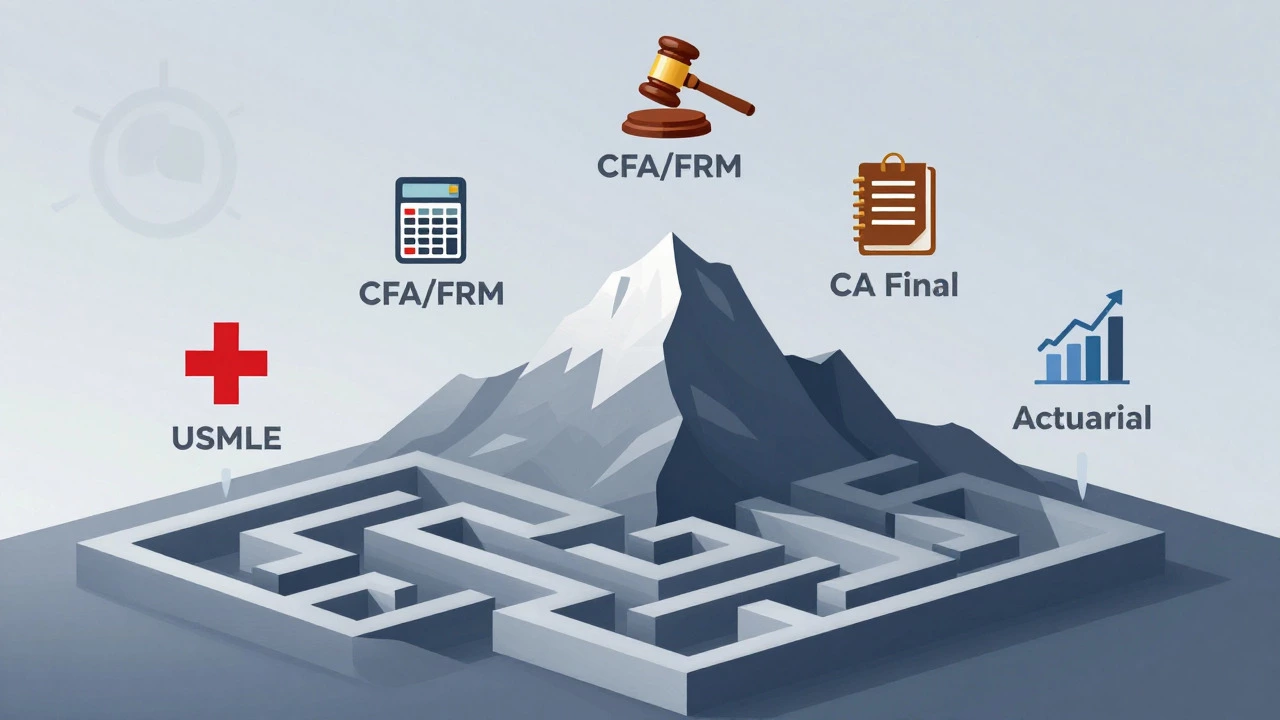
Imagine sitting for a test where only 40% of candidates pass. Now imagine doing that three times in a row before you can even call yourself qualified. That is the reality for many professionals chasing elite credentials. But which one actually holds the title of the hardest professional exam? The answer isn't just about how difficult the questions are; it’s about the combination of volume, complexity, and the psychological toll on the candidate.
We often hear people brag about passing their bar exam or clearing medical boards. While impressive, these tests usually have pass rates hovering around 75-80%. If you want to talk about true difficulty, we need to look at exams with single-digit pass rates, massive syllabi, and high stakes that determine your entire career trajectory. In this article, we will break down the top contenders for the title of the world's hardest professional exam, looking at data from 2025 and early 2026 to see who really suffers the most.
The Financial Sector Titans: CFA vs. FRM
When discussing financial qualifications, two names dominate the conversation: the Certified Financial Analyst (CFA) and the Financial Risk Manager (FRM). Both are globally recognized, but they differ significantly in scope and pain level.
The CFA program is widely considered the gold standard in investment management. It consists of three levels, each requiring roughly 300 hours of study. The catch? You cannot take Level 2 until you pass Level 1, and so on. This creates a bottleneck effect. According to recent data from the CFA Institute, the global pass rate for CFA Level 3 hovers around 45-50%. However, when you look at first-time takers, the numbers drop drastically. Many candidates spend years stuck on Level 2 because the ethical standards and portfolio management concepts require deep, intuitive understanding rather than rote memorization.
In contrast, the FRM exam focuses specifically on risk management. It has only two parts, making it shorter in duration. Yet, its reputation for difficulty stems from its mathematical intensity. Part I covers foundations of risk management, quantitative analysis, and valuation. The pass rates for FRM have historically been lower than CFA Levels 1 and 2, often dipping below 40% for first-time candidates. Why? Because the questions are scenario-based and require quick, accurate calculations under pressure. There is no room for guesswork here.
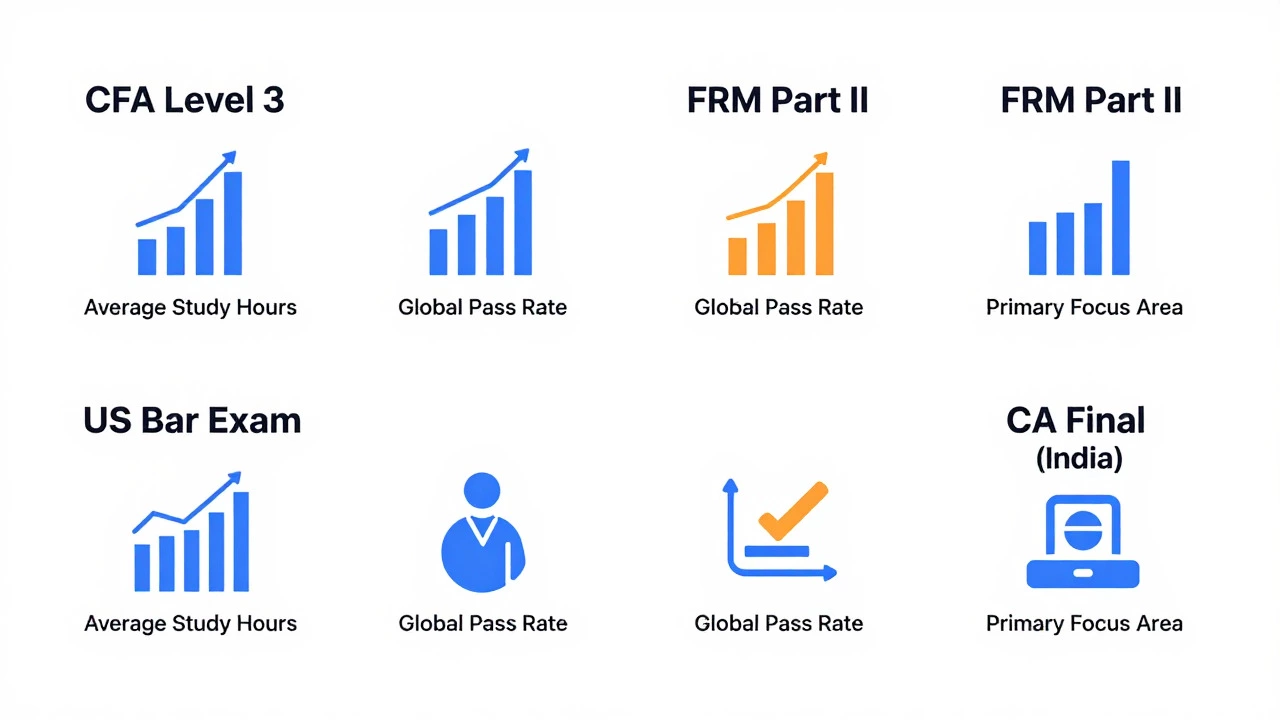
| Exam | Levels/Parts | Avg. Study Hours | Global Pass Rate | Primary Focus |
|---|---|---|---|---|
| CFA Level 3 | 3 | 900+ total | ~45% | Portfolio Management |
| FRM Part II | 2 | 600+ total | ~35-40% | Risk Modeling |
| CA Final (India) | Multiple stages | 1000+ | <10% | Accounting & Taxation |
The Legal Gauntlet: The US Bar Exam
If finance is about math and logic, law is about endurance and memory. The United States Bar Exam is infamous for its length and stress. Most states use the Uniform Bar Examination (UBE), which lasts two days. Day one covers multiple-choice questions on legal principles, while Day two involves essays and performance tests where you must draft legal documents from scratch.
Why is it so hard? First, the sheer volume of material. Candidates study for six months or more, covering contracts, torts, criminal law, evidence, and constitutional law. Second, the grading is subjective. Unlike the CFA, where answers are right or wrong, bar exam essays depend on how well you argue your point. A single missed nuance in a hypothetical case can cost you hundreds of points.
Pass rates vary wildly by state. In New York and California, first-time pass rates often sit between 50% and 60%. For repeat takers, the number drops to around 30%. The mental toll is immense. Many candidates report burnout, anxiety, and sleep deprivation during the final weeks of preparation. It is not just a test of knowledge; it is a test of resilience.

The Accounting Nightmare: CA Final in India
While Western exams get plenty of attention, the Chartered Accountant (CA) Final exam in India is arguably the toughest accounting qualification in the world. Administered by the Institute of Chartered Accountants of India (ICAI), this exam has a legendary reputation for low pass rates. In recent attempts, the overall pass rate has frequently fallen below 10%, sometimes even dipping into single digits.
What makes it so brutal? The syllabus is enormous. Candidates must master advanced auditing, strategic financial management, direct and indirect taxation, and corporate laws. The exams are conducted twice a year, and you must clear all papers in one attempt to be eligible for articleship completion. The pressure is compounded by the fact that millions of students compete for a limited number of top-tier jobs. Failing means waiting six months to try again, losing momentum and confidence.
Unlike the CFA, which allows modular progression, the CA Final demands holistic mastery. You cannot skip weak areas. Every subject carries equal weight, meaning a failure in any single paper results in failing the entire exam. This "all-or-nothing" structure creates intense psychological stress, making it a true test of mental fortitude.
Medical Boards: USMLE Step 3
Doctors endure years of rigorous training, culminating in the United States Medical Licensing Examination (USMLE). While Step 1 and Step 2 CK (Clinical Knowledge) are notoriously difficult, Step 3 is the final hurdle. It is taken after completing the first year of residency, meaning candidates are already working full-time clinical shifts while studying.
Step 3 is unique because it simulates real-world patient care. Candidates manage virtual patients over two days, making decisions about diagnosis, treatment, and follow-up. The difficulty lies in the integration of knowledge. You are not just recalling facts; you are applying them in complex, evolving scenarios. Fatigue plays a huge role here. Residency hours are long, and studying for Step 3 often happens in stolen moments between surgeries and rounds.
Pass rates for USMLE Step 3 are generally higher, around 90-95%, but this masks the underlying difficulty. Those who fail often do so due to exhaustion rather than lack of knowledge. The exam tests your ability to perform under extreme physical and mental strain, mirroring the demands of actual medical practice.

Actuarial Exams: The Long Game
Actuaries deal with risk and uncertainty using mathematics and statistics. Their certification path, governed by societies like the Society of Actuaries (SOA) or Casualty Actuarial Society (CAS), is a marathon, not a sprint. Candidates must pass a series of preliminary and fellowship exams, which can take five to ten years to complete.
The initial exams, such as P (Probability) and FM (Financial Mathematics), have pass rates around 50-60%. However, as you progress to advanced topics like actuarial modeling and enterprise risk management, the pass rates drop significantly. Some fellowship-level exams have pass rates below 30%. The challenge is not just the content; it is the time commitment. Most candidates work full-time while studying, balancing family life and career advancement. The attrition rate is high, with many quitting midway due to the relentless pace.
How to Prepare for the Impossible
Whether you are tackling the CFA, the Bar, or the CA Final, success requires more than just intelligence. Here are practical strategies used by top performers:
- Active Recall Over Passive Reading: Don’t just read textbooks. Test yourself constantly. Use flashcards, practice questions, and mock exams to force your brain to retrieve information.
- Spaced Repetition: Review material at increasing intervals. This technique leverages the forgetting curve to ensure long-term retention.
- Simulate Exam Conditions: Practice under timed conditions. If the exam is four hours long, do four-hour practice sessions. Build stamina alongside knowledge.
- Mental Health Maintenance: Sleep, exercise, and social support are non-negotiable. Burnout is the biggest enemy of exam success. Schedule breaks and stick to them.
- Join Study Groups: Learning from peers provides different perspectives and keeps you accountable. Discussing tough concepts aloud helps solidify understanding.
Final Thoughts on Exam Difficulty
So, what is the hardest professional exam? There is no single answer. The CFA Level 3 tests depth of financial expertise. The US Bar Exam tests legal reasoning and endurance. The CA Final in India tests comprehensive accounting knowledge under extreme pressure. Each exam has its own unique challenges, shaped by its industry context and cultural expectations.
Ultimately, the "hardest" exam is the one that aligns with your career goals and personal strengths. Choosing the right path matters more than conquering the toughest one. Focus on building a sustainable study routine, seeking mentorship, and maintaining perspective. These exams are milestones, not destinations. They open doors, but they don’t define your worth.
Which exam has the lowest pass rate globally?
The Chartered Accountant (CA) Final exam in India consistently reports the lowest pass rates, often falling below 10% per attempt. This is due to the vast syllabus, strict grading, and high competition among millions of candidates.
Is the CFA harder than the FRM?
It depends on your background. The CFA covers a broader range of topics including ethics and portfolio management, requiring more total study hours. The FRM is more specialized in risk modeling and mathematics, with potentially lower pass rates for specific parts. Both are extremely challenging, but the CFA is longer and more comprehensive.
How long does it take to prepare for the US Bar Exam?
Most candidates dedicate 6 to 9 months of full-time study to the US Bar Exam. This includes attending a bar review course, memorizing black-letter law, and practicing essay writing extensively. Part-time students may take up to a year.
Can you work while studying for the CA Final?
Yes, most CA Final candidates work as articled assistants during their training period. However, the workload is intense, requiring careful time management. Many candidates reduce their working hours or take leave close to the exam dates to focus solely on preparation.
What is the best strategy for passing actuarial exams?
Success in actuarial exams relies on consistent, long-term study habits. Use official study manuals, solve past exam problems repeatedly, and join online forums for peer support. Since exams are offered only twice a year, missing a window means waiting six months, so thorough preparation is essential.