Recent POST






NEET Physics Strategy Scorecard
Select the resources you currently use for Physics preparation and indicate your daily time split.
Resources Used
Daily Time Allocation (% of Total Study Time)
Strategy Efficiency
Click "Analyze" to see your score and personalized recommendations based on expert guidelines.
Every year, thousands of students staring at a pile of books ask the same question: "Is DC Pandey enough for NEET (National Eligibility cum Entrance Test) preparation?" The short answer is no. The long answer involves understanding exactly what DC Pandey offers, where it falls short, and how to combine it with other resources to secure a top rank.
If you are relying solely on DC Pandey for your physics preparation, you are missing a critical piece of the puzzle. While it is an excellent book for building conceptual depth and solving complex numerical problems, it is not designed as a standalone guide for the specific pattern and syllabus of the NEET exam. To crack NEET in 2026, you need a strategy that balances speed, accuracy, and syllabus coverage-areas where DC Pandey alone cannot carry you across the finish line.
Understanding the Nature of DC Pandey
To judge if a resource is "enough," you first need to know what it actually is. DC Pandey is a series of physics textbooks authored by D.C. Pandey, widely used by engineering aspirants for JEE Main and JEE Advanced preparation. The books are known for their rigorous approach, detailed theory, and challenging problem sets.
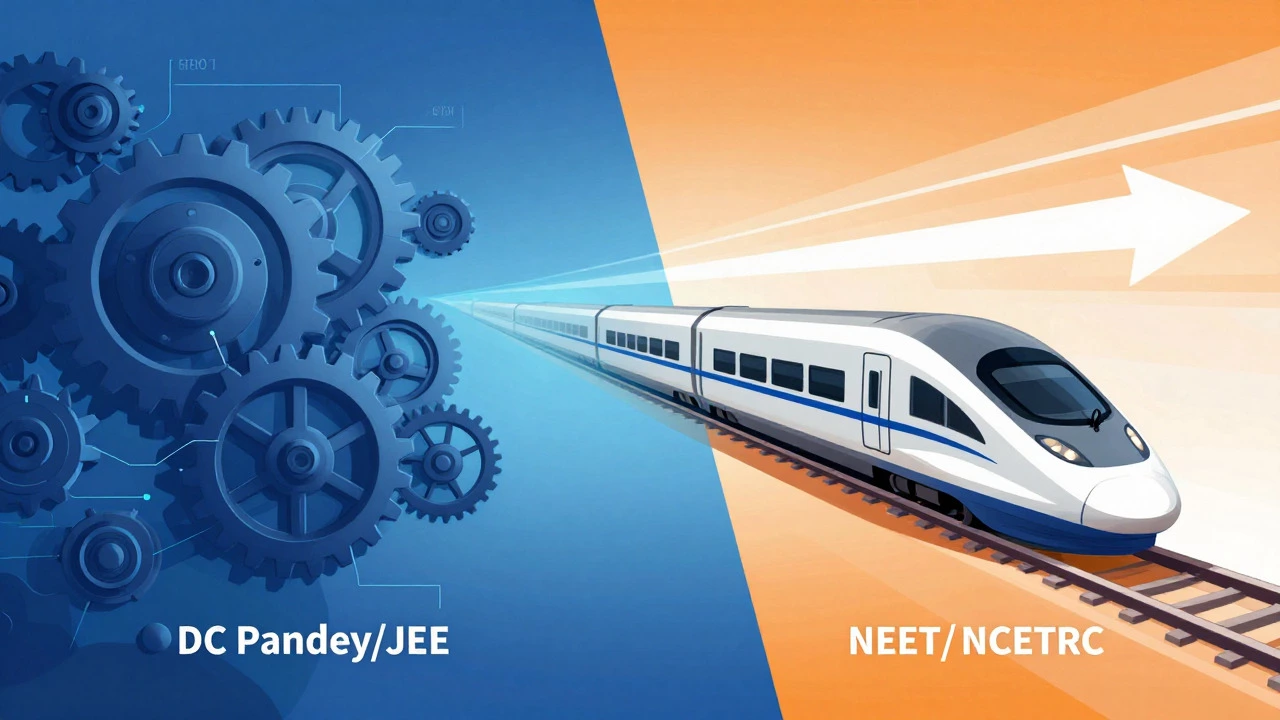
The primary audience for these books is students aiming for IITs through the Joint Entrance Examination (JEE). This distinction matters because JEE and NEET have different demands. JEE tests deep analytical skills and multi-concept application, often requiring longer calculations. NEET, on the other hand, tests breadth of knowledge, quick recall, and direct application of concepts within a tight time limit. Using a tool built for one purpose to achieve another requires significant adaptation.
When you open a DC Pandey volume, you will find chapters divided into sections like "Concepts of Physics," "Solved Examples," and "Exercises." The exercises are further categorized into levels, often including single-correct, multiple-correct, and comprehension-based questions. For a NEET student, this structure can be both a blessing and a curse. It builds strong fundamentals but can lead to over-preparation on topics that rarely appear in the medical entrance exam.
The Gap Between DC Pandey and NEET Requirements
The core issue isn't that DC Pandey is bad; it's that it doesn't align perfectly with the NCERT is the National Council of Educational Research and Training curriculum, which serves as the primary source for NEET biology, chemistry, and physics content. NEET is heavily dependent on NCERT. In Biology, nearly every question comes directly from the lines of the NCERT textbook. In Chemistry, especially Organic and Inorganic, NCERT is the bible. Even in Physics, while numerical ability is key, the concepts tested are usually standard and directly derived from Class 11 and 12 NCERT texts.
DC Pandey goes beyond NCERT. It introduces advanced derivations, higher-order thinking problems, and approximations that are useful for JEE but irrelevant for NEET. If you spend weeks mastering rotational motion complexities found in DC Pandey, you might neglect memorizing the biological cycles or chemical reactions that constitute 80% of the NEET paper. This imbalance is the biggest risk of using DC Pandey as your sole resource.
| Feature | DC Pandey | NCERT Textbooks | NEET-Specific Guides (e.g., MTG) |
|---|---|---|---|
| Primary Focus | JEE Main & Advanced | School Curriculum / Base for NEET | NEET Exam Pattern |
| Difficulty Level | High (Analytical) | Moderate (Conceptual) | Moderate to High (Exam-Oriented) |
| Question Style | Multi-step, Complex Numericals | Direct, Theory-Based | Speed-Focused, Direct Application |
| Syllabus Coverage | Beyond NCERT | Exact Match | Aligned with NEET Syllabus |
| Time Efficiency | Low (Time-Consuming) | High (Quick Revision) | High (Targeted Practice) |
Why You Need More Than Just One Book
Imagine trying to run a marathon while carrying a backpack full of bricks. The bricks make you stronger, but they slow you down. DC Pandey is those bricks. It makes your physics foundation incredibly strong, but if you carry nothing else, you won't finish the race on time. NEET is a speed test. You have 200 minutes to answer 200 questions. That gives you just one minute per question. Many questions in Biology and Chemistry require less than 30 seconds. Physics questions might take two minutes, but only if you recognize the concept instantly.
Relying only on DC Pandey means you might solve a physics problem correctly but spend five minutes doing so. In the exam, that five-minute loss could mean missing three easy Biology questions. Therefore, your strategy must include resources that train you for speed and precision, not just depth.
You also need practice with previous years' questions (PYQs). NEET has a distinct pattern of repetition. Certain concepts, like Newton's Laws, Electrostatics, or Human Physiology, appear almost every year in similar formats. DC Pandey does not organize its content around past NEET trends. You need a separate bank of PYQs to understand what the National Testing Agency (NTA) actually asks.
The Ideal Resource Combination for NEET 2026
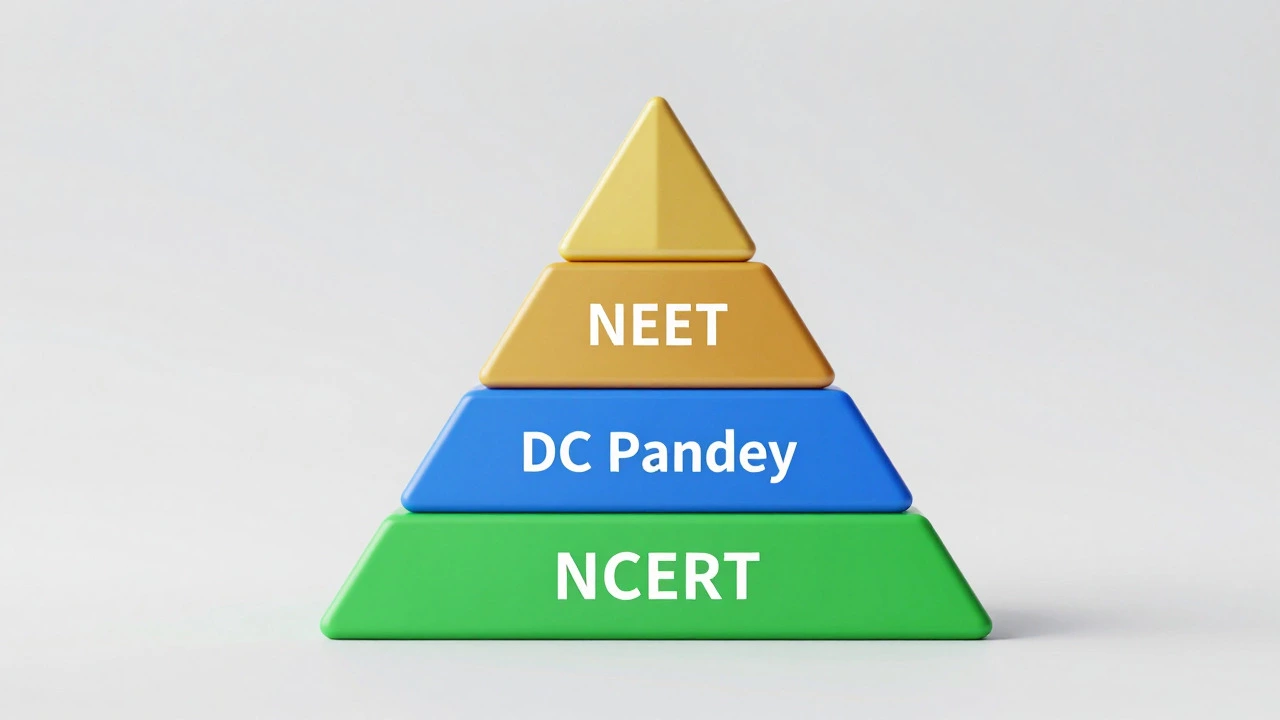
So, if DC Pandey isn't enough, what is? The most successful candidates use a layered approach. Here is a practical framework:
- Foundation Layer: NCERT Physics. Read every line, every example, and every exercise in the NCERT Class 11 and 12 Physics books. Understand the derivations. This is non-negotiable. If you can solve all NCERT examples without looking at the solution, you have cleared the baseline.
- Practice Layer: DC Pandey (Selective Use). Use DC Pandey specifically for topics you find difficult. For instance, if you struggle with Mechanics or Electrodynamics, pick up the relevant DC Pandey volume. Solve the "Objective-I" section (single correct options) and skip the highly complex multi-correct or assertion-reason questions unless you are aiming for an AIR under 100. Do not try to complete the entire book cover-to-cover.
- Speed Layer: NEET-Specific Question Banks. Books like MTG NCERT at Your Fingertips is a popular reference book for NEET aspirants that compiles chapter-wise questions based strictly on NCERT content. or similar guides are essential. These books provide hundreds of MCQs that mimic the exact style and difficulty of the NEET exam. They help you transition from "understanding" to "answering quickly."
- Revision Layer: Previous Year Questions (PYQs). Dedicate the last three months of your preparation to solving PYQs from the last 10-15 years. Analyze mistakes. Identify patterns. This step bridges the gap between knowing physics and passing the exam.
Common Pitfalls to Avoid
Many students fall into the trap of "book hoarding." They buy DC Pandey, HC Verma, and five other guides, then feel guilty for not finishing them all. Remember, quality of practice beats quantity of books. If you master one good resource, you will outperform someone who skimmed ten.
Another pitfall is ignoring Biology and Chemistry. Since Physics is often the differentiator for top ranks, students tend to over-invest time here. However, NEET is a cumulative score. Dropping marks in Biology due to lack of revision is a fatal error. Ensure your study schedule allocates roughly 40% time to Biology, 30% to Chemistry, and 30% to Physics, adjusting based on your personal strengths.
Also, avoid getting stuck on "impossible" questions. In DC Pandey, some problems are designed to test limits, not typical exam scenarios. If you spend more than 10 minutes on a single problem without progress, check the solution, understand the method, and move on. Don't let one problem derail your day.
How to Integrate Coaching Material
If you are enrolled in a coaching institute like Allen, Aakash, or Resonance, their module sheets are often sufficient for basic practice. These modules are tailored to the NEET syllabus. In this case, DC Pandey should serve as a supplementary challenge, not a primary text. Use it when you finish your coaching assignments early and want extra exposure to tricky numericals.
For self-study students, DC Pandey can replace coaching modules for Physics, provided you pair it with a strict NCERT-first routine. Without a teacher to guide you, there is a risk of misinterpreting solutions or skipping important basics. In such cases, online video lectures accompanying the book can be helpful, but ensure they focus on NEET-relevant methods.
Final Verdict: Is It Enough?
No, DC Pandey is not enough for NEET on its own. It is a powerful tool, but it is a hammer, not a Swiss Army knife. You need NCERT for the foundation, a NEET-specific question bank for speed, and PYQs for pattern recognition. DC Pandey fits into this ecosystem as a strengthener for your Physics scores. Use it wisely, selectively, and always in conjunction with other resources. Your goal is not to become a theoretical physicist; it is to become a high-scoring NEET candidate. Keep that end goal in sight, and let your resources serve that purpose.
Should I read DC Pandey before or after NCERT?
Always read NCERT first. NCERT provides the foundational concepts and definitions that NEET tests directly. Once you are comfortable with the NCERT theory and examples, use DC Pandey to practice harder numerical problems and deepen your understanding of complex topics.
Which parts of DC Pandey are most useful for NEET?
Focus on the "Objective-I" sections (single correct options) and the solved examples. These closely mirror the NEET format. Avoid spending too much time on "Objective-II" (multiple correct) or highly advanced assertion-reason questions unless you are targeting a very high rank.
Can I skip DC Pandey if I am weak in Physics?
If you are struggling with basics, DC Pandey might be too difficult and discouraging. Start with simpler resources like HC Verma (Vol 1 & 2) or coaching modules. Build your confidence with NCERT-level problems first. Introduce DC Pandey only when you can comfortably solve standard numericals.
Is DC Pandey better than HC Verma for NEET?
HC Verma is generally considered more aligned with NEET than DC Pandey because it focuses more on conceptual clarity and less on extreme complexity. However, both are superior to NCERT in terms of problem variety. Most top rankers prefer HC Verma for NEET, using DC Pandey only for specific tough chapters.
How much time should I spend on DC Pandey daily?
Limit your DC Pandey practice to 1-2 hours daily. Spend the rest of your Physics time on NCERT revision and solving NEET-specific MCQs. Consistency is key; solving 10-15 quality problems daily is better than cramming 100 problems once a week.